“WHAT ARE YOU DOING HERE?! THIS CAN’T BE REAL!”
The words tore out of my throat before I could stop them, echoing harshly against the beige walls of the principal’s office. My knees buckled, and I had to grab the edge of the desk to keep from collapsing entirely. The fluorescent lights above flickered faintly, buzzing like they always did, but now the sound drilled into my skull as if reality itself had cracked open.
Because standing across the room—thin, worn, but unmistakably real—was my husband.
Michael.
The man I had buried five years ago.
The man whose funeral I had planned with trembling hands and hollow eyes after the police told me he died in a car crash on a rain-slick highway.
The man my daughter had cried herself to sleep for, night after night.
Alive.
The principal, Mr. Hargrove, hovered awkwardly beside me, his face drained of color. He kept adjusting his tie like it might somehow restore order to a situation that clearly had none.
“I—I think you should sit down,” he stammered.
But I couldn’t sit. I couldn’t breathe.
Michael stepped forward slowly, his hands raised like he was approaching a frightened animal.
“I know how this looks,” he said, his voice hoarse but achingly familiar. “But please… just let me explain.”
Explain?
Explain how a dead man was standing in front of me?
Explain how five years of grief had been built on a lie?
My chest tightened, anger and disbelief twisting together into something sharp and unbearable.
Before I could respond, Mr. Hargrove cleared his throat.
“Should I… bring Emma in?” he asked carefully.
At the sound of her name, everything shifted.
Emma.
Our daughter.
Sixteen years old now.
The reason any of this was happening at all.
I swallowed hard and nodded.
Minutes later, the door opened again.
Emma stepped inside, her backpack slung over one shoulder, her hair tied back in that messy ponytail she always wore to school. She looked mildly annoyed at first—probably pulled from class unexpectedly—but then her eyes landed on him.
And the world stopped.
Her face drained of color.
Her lips parted slightly.
For a second, she didn’t move at all.
Then, in the smallest, most fragile voice I had ever heard, she whispered:
“Dad?”
Michael dropped to his knees.
Emma didn’t hesitate.
She ran to him.
The force of her hug nearly knocked him backward, and the sound that came out of her—half sob, half laugh—broke something open inside me that I didn’t even know was still intact.
“I thought you were dead,” she cried. “I thought—you left—you—”
“I know,” he said, wrapping his arms around her like he was afraid she might disappear. “I know, sweetheart. I’m so sorry.”
I sank into a chair, my legs finally giving out.
Because this wasn’t just grief anymore.
This was something else.
Something bigger.
Something far more complicated.
The story came out in pieces.
Slowly.
Painfully.
Michael explained that he hadn’t died in the crash. It had been staged. He had uncovered something dangerous in his work as an investigative journalist—something involving powerful people who didn’t want the truth exposed.
Threats had followed.
Strangers watching the house.
Phone calls that ended in silence.
And then one day, he made a choice.
A terrible, irreversible choice.
He disappeared.
He let us believe he was dead so that whoever was after him would stop looking at us.
For five years, he lived off the grid. No contact. No trace.
Just watching from a distance.
Waiting for it to be safe.
I should have felt relief.
But all I felt at first was rage.
“You let us mourn you,” I said, my voice shaking. “You let your daughter grow up thinking her father was gone.”
His eyes filled with tears.
“I thought it was the only way to protect you.”
Emma, still clinging to him, looked up.
“Then why come back now?”
That was when everything circled back to the beginning.
To the reason we were all in that office.
To the act of kindness that had changed everything.
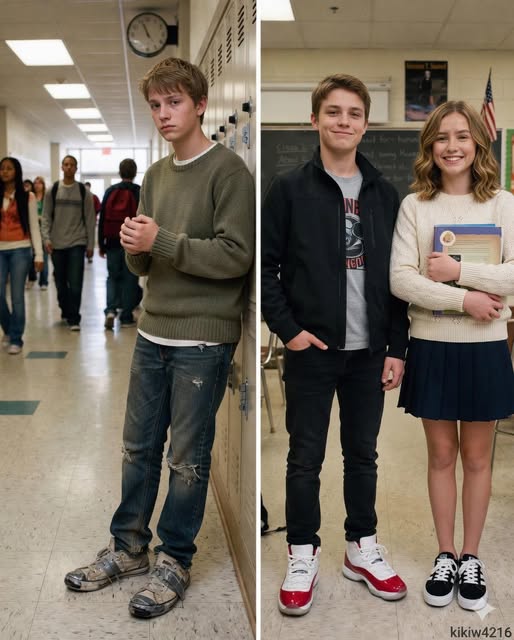
It started with a pair of shoes.
Caleb was new at school.
Quiet. Withdrawn. The kind of kid who tried not to be noticed.
But Emma noticed.
She noticed the way his sneakers were falling apart, the soles patched with duct tape.
She noticed the way he avoided gym class.
The way he walked carefully, like he was trying not to draw attention.
She didn’t say anything at first.
That was just who she was—observant, thoughtful, quietly kind.
But she couldn’t ignore it.
So she started saving.
Birthday money.
Allowance.
Every dollar she could manage.
She skipped lunches. Turned down outings with friends. Took small jobs walking dogs and babysitting.
For months.
Until she had enough.
Then she bought him a brand-new pair of sneakers.
Good ones.
Durable.
Something he could be proud of.
She gave them to him in a simple box with a note that read:
“Everyone deserves to walk tall.”
Someone took a picture.
It ended up online.
A small local story at first.
Then it spread.
And somewhere, miles away, hidden from the world—
Michael saw it.
“I saw her smile,” he said, his voice breaking. “And I realized… she didn’t lose her kindness. Not after everything.”
He looked at Emma.
“You became everything I hoped you would be.”
Emma wiped her eyes.
“I just didn’t want him to feel small,” she said softly.
That was the moment everything shifted.
Not just for Michael.
For all of us.
The days that followed were messy.
Emotional.
Complicated in ways none of us were prepared for.
There were questions without easy answers.
Anger that didn’t disappear overnight.
Trust that had to be rebuilt from nothing.
But there was also something else.
Something stronger.
A thread of connection that had never really broken—just stretched thin over time.
Michael moved back in gradually.
Emma refused to leave his side at first.
She showed him everything.
Her room.
Her school projects.
Her sketchbooks filled with drawings he had never seen.
She talked endlessly, trying to make up for five years of silence.
And he listened.
Really listened.
Like he was trying to memorize every second.
Caleb became part of our lives too.
At first, he was hesitant.
Embarrassed, even.
But Emma made it easy.
She never treated him like a charity case.
Just a friend.
Eventually, he started coming over.
Staying for dinner.
Laughing.
Opening up.
Michael helped his family quietly—finding work connections, offering support without making it obvious.
And slowly, things changed for them too.
One evening, months later, we all sat together on the porch.
The air was warm.
The sun was setting.
Emma leaned back in her chair, watching the sky.
“You know,” she said, “I didn’t think buying those shoes would do anything big.”
Michael smiled.
“It did more than you know.”
She tilted her head.
“How?”
I reached over and squeezed her hand.
“It brought your father home.”
She thought about that for a moment.
Then she smiled.
Not proudly.
Not like she had done something extraordinary.
Just… quietly.
Like it made sense.
A year later, the story had become something we told differently.
Not as tragedy.
Not as loss.
But as something deeper.
A reminder.
That kindness doesn’t disappear, even in grief.
That love can survive distance, time—even lies.
And that sometimes, the smallest act—
A simple pair of sneakers.
A quiet gesture.
A moment of empathy—
Can ripple outward in ways you never expect.
Changing lives.
Healing wounds.
Bringing people back from the impossible.
Because in the end, it wasn’t the disappearance that defined us.
Or even the return.
It was Emma.
Her heart.
Her belief that people matter.
That no one should be left behind.
And that goodness—
Real goodness—
Is worth holding onto.
No matter what.
Even after loss.
Even after everything.
And maybe that’s the real miracle.
Not that Michael came back.
But that Emma never stopped believing he could.