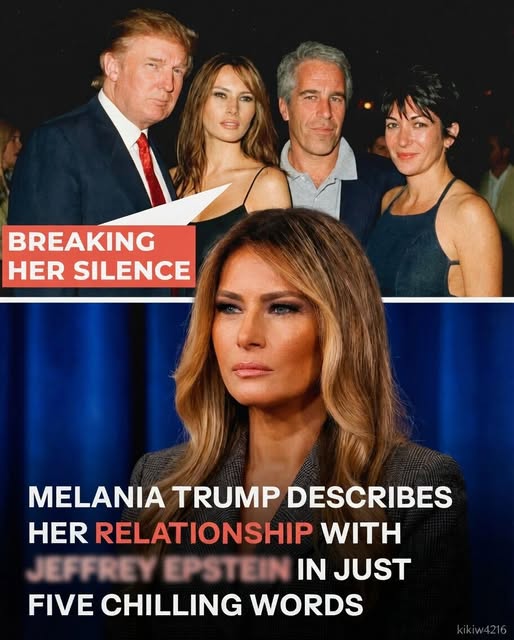
Melania Trump has issued one of her most direct and unambiguous public statements in recent years, firmly rejecting any meaningful connection to Jeffrey Epstein or his longtime associate Ghislaine Maxwell. The statement comes in response to renewed scrutiny triggered by the resurfacing of early-2000s social records and a 2002 email that has circulated widely across media platforms and online discussions. At a time when public figures continue to face intense reexamination of past associations, her response signals a deliberate attempt to draw clear boundaries between casual social contact and any implication of deeper involvement.
The renewed attention highlights how the Epstein case continues to cast a long shadow over individuals who once moved within similar social circles, even when no evidence of wrongdoing has been presented against them. For Melania Trump, whose public persona has often been defined by restraint and distance from controversy, the decision to respond so forcefully marks a notable shift in tone. Rather than allowing speculation to unfold unchecked, she has chosen to address the issue head-on, emphasizing both factual clarity and her broader stance on accountability.
At the center of the current discussion is a brief email exchange dating back to 2002. In it, Melania reportedly complimented Maxwell on a magazine feature and suggested reconnecting upon returning to New York. Critics have pointed to the message as evidence of familiarity, while her statement frames it as a routine and inconsequential social interaction typical of the time. According to her account, such exchanges were common within the overlapping networks of fashion, business, and social elites in New York and Palm Beach, where introductions and polite correspondence did not necessarily indicate meaningful relationships.
Her denial goes further, explicitly stating that she was never friends with Epstein, never associated with him beyond incidental encounters, and had no awareness of his criminal behavior. She also underscored that she has never been identified in any legal proceedings, victim testimonies, or investigative records connected to his crimes. This distinction is central to her defense, as it separates documented evidence from assumptions built on proximity or shared social environments.
The context in which these claims have resurfaced is important. The Epstein scandal, despite years having passed since his death, continues to evolve as new documents emerge, legal battles unfold, and public interest remains high. Each new release of information tends to reignite scrutiny not only of those directly implicated but also of anyone who appeared, however briefly, within Epstein’s orbit. This phenomenon reflects a broader societal effort to understand the extent of his network, but it also raises questions about fairness when applied to individuals without substantiated involvement.
Melania Trump’s statement attempts to navigate this tension carefully. While firmly rejecting allegations, she also shifts part of the focus toward the victims, calling for congressional hearings that would allow survivors to testify publicly under oath. This proposal introduces a different dimension to the conversation, positioning her not only as someone defending her own reputation but also as an advocate for greater transparency and accountability in addressing the broader scandal.
The call for hearings is particularly notable given the highly charged political environment in which it was made. Discussions surrounding Epstein have often intersected with debates about power, privilege, and the failure of institutions to protect vulnerable individuals. By urging formal proceedings, Melania aligns herself with the idea that unresolved questions should be addressed through official channels rather than speculation or media-driven narratives. Whether this suggestion gains traction remains uncertain, but it adds a proactive element to her response.
Public reaction to her statement has been divided. Supporters argue that her clear and detailed denial, combined with the absence of evidence linking her to wrongdoing, should put the matter to rest. They view the renewed scrutiny as an example of how individuals can become entangled in controversy simply due to past proximity to powerful social networks. From this perspective, her willingness to speak out is seen as both necessary and justified.
Critics, however, maintain that any connection—no matter how limited—deserves examination, particularly in cases involving individuals as widely connected as Epstein. They argue that transparency requires asking difficult questions, even when the answers ultimately confirm innocence. For them, the issue is less about assigning guilt and more about understanding the full scope of relationships within influential circles.
This divergence in interpretation reflects a broader challenge in modern public discourse. In an era where information is rapidly disseminated and often amplified without context, the line between inquiry and implication can become blurred. Social media, in particular, plays a significant role in shaping narratives, sometimes elevating partial information into widespread belief before it can be fully verified or contextualized.
Melania Trump’s situation illustrates how quickly such dynamics can unfold. A single email, viewed in isolation, can take on disproportionate significance when presented without the surrounding context of time, place, and social norms. Her response seeks to restore that context, framing the interaction as a routine exchange rather than evidence of a deeper relationship.
Beyond the immediate controversy, the episode also ties into ongoing discussions about her public image. Throughout her time in the spotlight, Melania has been the subject of intense scrutiny not only for her associations but also for her style choices, public appearances, and perceived messaging. Moments such as the widely debated jacket she wore during a 2018 trip have contributed to a narrative in which her actions are frequently analyzed for symbolic meaning.
This tendency to interpret personal expression as political signaling adds another layer to the current situation. The renewed focus on her past interactions is not occurring in isolation but as part of a larger pattern in which every aspect of her public and private life is subject to examination. In this context, her statement can be seen as an effort to assert control over her narrative and establish clear boundaries regarding what is and is not relevant.
The geographic and social settings referenced in the discussion—New York and Palm Beach in the early 2000s—are also significant. These environments were characterized by dense networks of overlapping connections among individuals in business, fashion, entertainment, and politics. In such settings, brief encounters and casual correspondence were commonplace, often involving people who may not have known each other beyond surface-level interactions.
Understanding this context is crucial when evaluating claims based on limited evidence. While proximity can sometimes indicate association, it does not automatically imply knowledge or involvement in private activities. This distinction is at the heart of Melania Trump’s argument, as she seeks to differentiate between being present in similar spaces and being connected in a meaningful way.
Legal experts have noted that, in the absence of documented involvement, the threshold for drawing conclusions should remain high. They emphasize that public discourse should be grounded in verifiable facts rather than inference, particularly in cases involving serious allegations. From this standpoint, her denial aligns with the principle that individuals should not be judged based on association alone.
At the same time, the persistence of the Epstein story demonstrates how deeply it has resonated within public consciousness. The scale and severity of his crimes, combined with the number of influential figures who crossed paths with him, have created an ongoing demand for answers. This demand often extends beyond those directly implicated, encompassing anyone whose name appears in related records.
For Melania Trump, the challenge lies in addressing this scrutiny without amplifying it further. By issuing a comprehensive statement that covers both the specific claims and the broader context, she appears to be aiming for resolution rather than prolonged engagement. Whether this approach succeeds will depend largely on how the conversation evolves in the coming weeks and months.
Her emphasis on factual clarity, combined with the call for institutional action, suggests a strategy focused on redirecting attention toward verifiable processes rather than speculative narratives. This approach may resonate with those who prioritize evidence-based discussion, while others may continue to view the situation through a more skeptical lens.
Ultimately, the episode underscores the complexities of navigating public life in an era of constant visibility and retrospective scrutiny. For individuals in high-profile positions, past interactions—no matter how minor—can resurface and take on new significance when viewed through the lens of later events. The challenge is not only to respond effectively but also to do so in a way that maintains credibility and coherence.
Melania Trump’s statement represents an attempt to meet that challenge directly. By clearly outlining her position, rejecting unfounded claims, and advocating for broader accountability measures, she has sought to address both the immediate controversy and the larger issues it reflects. Whether this effort will bring closure or simply become another chapter in an ongoing narrative remains to be seen.
What is certain, however, is that the intersection of personal history, public perception, and unresolved questions surrounding Epstein’s network will continue to generate debate. In that context, her response serves as a reminder of the importance of distinguishing between evidence and assumption, as well as the need for careful, informed analysis in discussions of significant public interest.