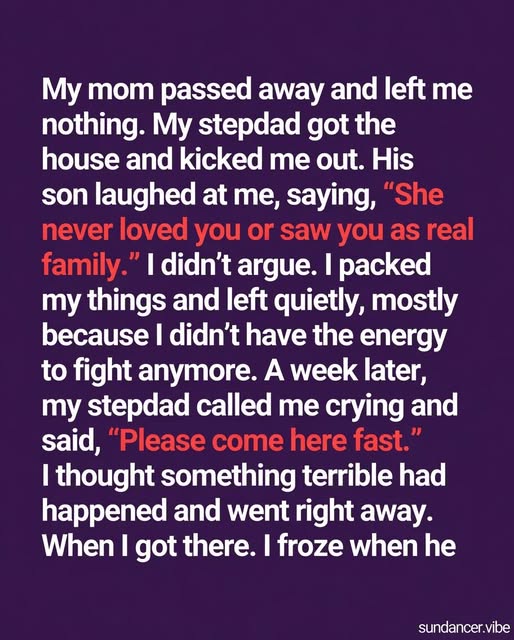
When my mother died, the silence she left behind wasn’t peaceful—it was unsettling. It filled every room in a way that made the house feel unfamiliar, as though something essential had been removed and nothing could replace it. Grief didn’t come all at once. It seeped in slowly, through ordinary moments—the hum of appliances, the echo of footsteps, the absence of her voice where it used to live so naturally.
I told myself I was prepared for the reading of the will. I went in with no expectations, repeating to myself that I wasn’t there for money or possessions. I just wanted reassurance—something small, something symbolic—that I still belonged. But when the lawyer finished speaking, the reality landed harder than I could have imagined. Everything had been left to my stepfather.
Every account. Every asset. The house. The life she had built.
There was no mention of me.
I didn’t react immediately. I couldn’t. It felt like the room had tilted, like I had somehow stepped into the wrong version of my own life. Before I could even form a question, my stepfather stood and told me I had a week to leave. His son didn’t even try to soften it. He leaned back with a kind of quiet satisfaction and said what they had both clearly believed for a long time—that I had never really been family.
I didn’t argue. I didn’t defend myself. I didn’t cry, at least not there.
I just nodded.
Packing my things felt less like moving and more like disappearing. Every item I placed into a box felt like proof that my presence in that house could be reduced to something temporary, something removable. Clothes. Books. A few photographs I wasn’t even sure I had the right to take. No one offered to help. No one asked how I was doing. The absence of my mother had already created a void, but now it felt like everything connected to her—including me—was being erased.
When I left, I didn’t look back.
I stayed with a friend for a while, sleeping on a couch that never quite felt like mine. Nights were the hardest. That’s when the questions came. Not about the house or the money—but about her. About us.
Had I misunderstood everything?
Had I imagined the bond we shared?
I replayed memories over and over again, searching for certainty. Small moments—conversations in the kitchen, the way she looked at me when she thought I wasn’t paying attention, the quiet reassurance in her presence. I needed something solid, something that told me those things had been real.
But doubt has a way of rewriting even the clearest memories.
A week later, my phone rang.
It was my stepfather.
His voice was different. The sharpness was gone. So was the confidence. He sounded unsettled—almost afraid. He didn’t explain much. Just told me I needed to come back to the house. Immediately.
I almost didn’t go.
But something in his tone made it impossible to ignore.
When I arrived, the house felt different again. Not empty this time—but heavy, like it was holding something it hadn’t revealed yet. He was sitting on the edge of my mother’s bed, shoulders slumped, his expression unreadable.
Without saying much, he handed me a small metal box.
It looked old—scratched, worn, locked. He said he had found it hidden behind the dresser while going through her things again. There was something in the way he said it that made me realize this wasn’t just another forgotten object.
My hands shook as I opened it.
Inside were letters.
Dozens of them.
All addressed to me.
For a moment, I couldn’t move. I just stared, trying to process what I was seeing. Beneath the letters were small personal items—things she had clearly chosen carefully—and an envelope I barely registered at first.
I picked up the top letter and opened it.
And everything changed.
Her handwriting was steady, familiar, unmistakably hers. The words weren’t dramatic or rushed. They were calm. Certain. Intentional.
She wrote about me.
Not in broad, general ways—but in specific moments. Things I hadn’t realized she noticed. Times I stayed patient when it would have been easier to walk away. Times I chose kindness quietly, without expecting anything in return. She had seen all of it.
She had remembered all of it.
As I read through the letters, one after another, it felt like she was speaking directly to me. Like she had anticipated this exact moment—this confusion, this doubt, this feeling of being pushed out—and had prepared something to counter it.
She wrote that she knew things might change after she was gone.
That grief doesn’t always bring people together. Sometimes it exposes fractures that were already there. Sometimes it creates new ones.
And she had been afraid I might be left behind.
So she made sure I wouldn’t be.
In one letter, she wrote something that stopped me completely. I had to read it more than once, just to let it settle:
“You are my child. Nothing can change that. Not time. Not death. Not them.”
It was simple. Direct. Absolute.
And it answered every question I had been asking myself.
By the time I reached the last letter, I wasn’t the same person who had opened that box. The grief was still there—but it had changed. It wasn’t hollow anymore. It wasn’t filled with doubt.
It was grounded in something real.
Recognition.
I hadn’t imagined her love.
I hadn’t misunderstood our connection.
I had just been looking for proof in the wrong place.
The will hadn’t told my story.
The letters did.
My stepfather spoke after I finished reading. Quietly. Carefully. He admitted he hadn’t expected to find something like that. That he had acted quickly—out of anger, confusion, maybe even fear—and hadn’t taken the time to understand everything she had left behind.
He apologized.
Not in a way that erased what had happened. Not in a way that fixed it.
But in a way that acknowledged it.
I didn’t know what to say. And for the first time, I realized I didn’t need to.
Because the most important thing—the thing I thought I had lost—had never been taken from me in the first place.
When I left the house again, it felt different.
Not because anything had changed physically.
But because I had.
I wasn’t leaving as someone who had been excluded.
I was leaving as someone who had been chosen—deliberately, thoughtfully, permanently.
The letters stayed with me. Not just as words on paper, but as something I could return to whenever doubt tried to creep back in. They became a reminder that love doesn’t always show up in obvious ways. Sometimes it’s hidden. Protected. Preserved for the moment you need it most.
What my mother left behind wasn’t something that could be listed in a will.
It wasn’t something that could be taken, divided, or signed over.
It was something far more enduring.
Proof.
Proof that I had always belonged.
Proof that I had always been seen.
And proof that even after she was gone, she had found a way to make sure I would never feel forgotten again.