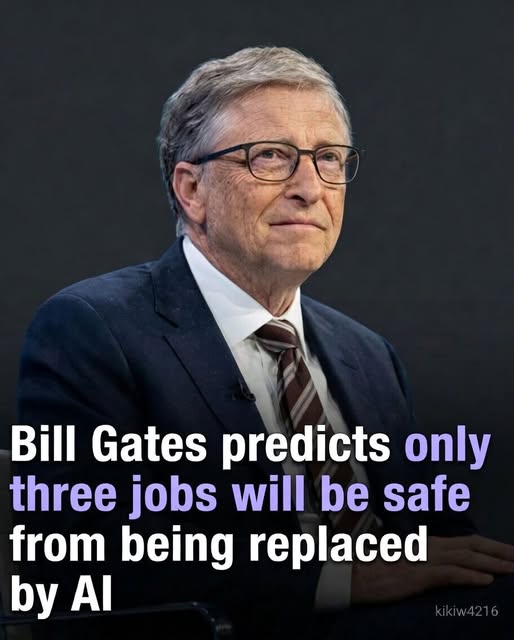
Bill Gates on the Future of Work: Why Human Skills Matter More Than Ever
As artificial intelligence continues to evolve at a rapid pace, questions about the future of work are no longer theoretical—they are immediate and deeply personal. Few voices carry as much weight in this conversation as Bill Gates, who has spent years analyzing how technology reshapes economies, industries, and everyday life.
In his recent reflections, Gates paints a picture that is both disruptive and hopeful. While AI will undoubtedly automate many tasks that humans perform today, it will not eliminate the need for people. Instead, it will redefine what it means to be valuable in the workforce.
The Rise of “Free Intelligence”
One of Gates’ most striking ideas is what he calls the emergence of “free intelligence.” In simple terms, AI has the potential to make expert-level knowledge widely accessible.
Fields like medicine and education, once limited by years of training and scarce expertise, are beginning to shift. AI tools can now analyze medical scans, assist with diagnoses, and generate personalized learning plans. This doesn’t mean doctors or teachers will disappear—but it does mean their roles will evolve.
Knowledge itself is no longer the bottleneck.
What matters now is how that knowledge is used.
Healthcare: Technology Meets Humanity
Healthcare is one of the clearest examples of this transformation.
AI systems can process vast amounts of data, identify patterns, and even suggest treatments. But according to Gates, the professionals who will thrive are those who bring something machines cannot: human understanding.
A doctor may rely on AI to analyze test results, but patients still need reassurance, explanation, and trust. The ability to communicate complex decisions, show empathy, and consider emotional and social factors will remain essential.
In other words, AI may enhance diagnosis—but healing remains human.
Beyond physicians, roles in caregiving, mental health support, and rehabilitation are expected to grow. These professions rely heavily on presence, compassion, and interpersonal connection—qualities that are difficult to automate.
Education: From Information to Inspiration
Education is undergoing an equally profound shift.
AI-powered tutors can already adapt lessons to individual learning styles, helping students progress at their own pace. This could dramatically reduce educational inequality and improve outcomes worldwide.
But Gates emphasizes that great teachers are not defined by how much information they deliver.
They are defined by how they inspire.
In the classroom of the future, teachers will act more like mentors and facilitators—guiding discussions, encouraging curiosity, and helping students develop critical thinking and emotional intelligence.
AI can teach facts.
Humans teach meaning.
The Changing Nature of Work
Across industries, automation is already reshaping job roles.
Routine tasks—data entry, basic analysis, repetitive coding, and administrative work—are increasingly handled by AI systems. This shift may reduce demand for certain roles, but it also creates new opportunities.
Gates highlights the growing importance of professionals who can:
- Work alongside AI systems
- Interpret and apply AI-generated insights
- Solve complex, real-world problems creatively
New career paths are emerging in areas like AI ethics, system design, and human-AI interaction. These roles require both technical knowledge and a deep understanding of human needs.
The key skill? Adaptability.
Creativity in the Age of Machines
Creative industries offer another compelling example of how AI is changing work.
Tools can now generate text, images, music, and designs in seconds. But rather than replacing human creators, these tools are becoming collaborators.
Writers, designers, and artists who learn to use AI effectively can expand their capabilities—producing more work, experimenting with new ideas, and pushing creative boundaries.
What remains uniquely human is originality, emotional depth, and cultural context.
AI can assist.
But it cannot truly create meaning on its own.
The Skills That Will Define the Future
According to Gates, the workers who succeed in the age of AI will focus on skills that machines struggle to replicate:
- Empathy – understanding and connecting with others
- Creativity – generating new ideas and perspectives
- Critical thinking – evaluating information and making decisions
- Communication – explaining complex concepts clearly
- Adaptability – learning and evolving continuously
These are not new skills—but they are becoming more valuable than ever.
Lifelong Learning Becomes Essential
One of the biggest shifts in the modern workforce is the need for continuous learning.
In the past, education often ended in early adulthood. Today, that model is outdated.
As AI tools evolve, workers must update their skills regularly. This doesn’t necessarily mean formal degrees—it could involve online courses, self-study, or hands-on experience.
The idea is simple: staying relevant requires staying curious.
Those who embrace learning will find new opportunities.
Those who resist change may struggle to keep up.
Opportunities in Emerging Fields
Gates also points to several sectors likely to see strong growth:
- Healthcare and elder care
- Mental health and wellness
- Renewable energy and climate solutions
- Advanced manufacturing and system oversight
- AI development and ethics
These fields combine technical expertise with human judgment, making them more resilient to automation.
They also address some of the world’s most pressing challenges, creating meaningful and impactful career paths.
A Balanced Perspective on the Future
Despite the rapid pace of change, Gates remains cautiously optimistic.
He acknowledges that AI will disrupt jobs and create uncertainty. But he also believes it has the potential to improve productivity, expand access to knowledge, and enhance quality of life.
The challenge lies in how society responds.
Governments, businesses, and educational institutions must invest in training, support systems, and equitable access to technology. Without these efforts, the benefits of AI may not be shared evenly.
The Bottom Line
The age of AI is not about humans versus machines.
It’s about humans working with machines.
As Bill Gates suggests, the future belongs to those who embrace this partnership—leveraging technology while strengthening the qualities that make us human.
Because in a world where intelligence becomes more accessible, the real advantage isn’t just what you know.
It’s how you think, how you connect, and how you create.
And those are things no machine can fully replace.