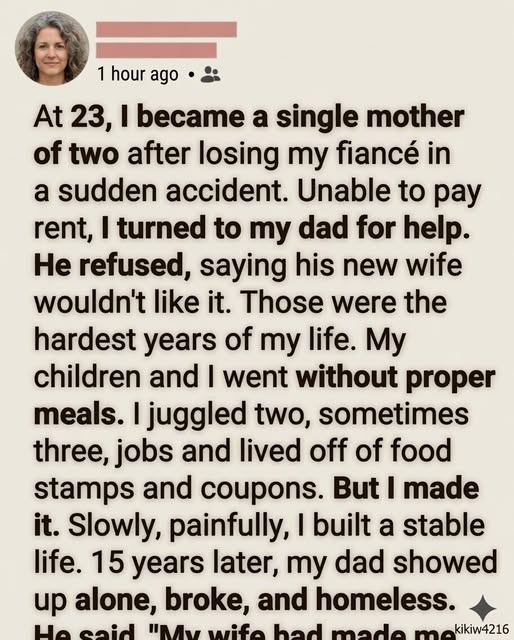
The day everything changed began like any other morning, but I would later realize that life rarely announces its turning points with warning. It simply shifts beneath your feet while you are still pretending everything is stable. I was twenty-three, holding two toddlers on my hips, trying to convince myself that exhaustion was temporary and grief was something I could schedule around nap times. My fiancé had died suddenly in a car accident just months earlier, and the world I thought I understood had fractured into something unrecognizable.
One moment I was planning a future built on shared dreams, and the next I was calculating whether I could afford milk, diapers, and rent in the same week. The financial collapse came fast. Medical bills from emergency care piled up. Rent notices turned from reminders into threats. My bank account became a countdown clock to eviction.
And in the middle of that chaos, I did what any desperate daughter would do. I called my father.
I remember standing outside in the cold, my children wrapped in blankets in the backseat of an old borrowed car, my hands shaking as I dialed his number. He answered after a few rings, his voice calm, distant, already detached from whatever storm I was about to bring into his life.
“Dad, I need help,” I said, trying to keep my voice steady. “Just temporary. I can’t make rent. I don’t have enough for food this week.”
There was a pause. Not confusion. Not concern. Calculation.
Then came the sentence that would live inside me for years.
“I can’t help you,” he said. “My wife wouldn’t be comfortable with that.”
I remember blinking, as if the words needed time to make sense. “It’s your grandchildren,” I said quietly.
“I’m sorry,” he replied, already pulling away emotionally. “But I have to think about my household.”
And just like that, the line went dead—not just the phone call, but something deeper. Something irreversible.
That night, I sat on the floor of my nearly empty apartment while my children slept on a mattress pushed against the wall. I didn’t cry immediately. I just stared at the ceiling, trying to understand how someone could choose comfort over blood, convenience over compassion.
But grief doesn’t pause for philosophy. Survival doesn’t wait for understanding.
The next morning, I got up and went to work.
Then I got another job.
Then another.
My life became a rotation of exhaustion: cashier shifts in the morning, cleaning offices at night, waiting tables on weekends. I learned to survive on broken sleep and leftover food. I learned which bills could be ignored and which ones could destroy me. I learned how to smile when I was falling apart.
There were nights I came home so tired I could barely stand, my children already asleep, their tiny faces peaceful in a world that had already been too harsh for them.
Every time I wanted to quit, I looked at them.
And I kept going.
Years passed like that—slow, heavy, relentless.
Somehow, I survived.
Then I did more than survive.
I rebuilt.
I got a better job. Then a stable one. Then a career. I learned skills I never thought I’d need—budgeting, negotiation, emotional compartmentalization. I stopped waiting for rescue and started becoming my own safety net.
My children grew alongside me, shaped by struggle but not broken by it. They learned resilience the same way I did—not through lectures, but through lived experience.
And slowly, painfully, our life stabilized.
We weren’t rich. We weren’t carefree.
But we were safe.
Fifteen years passed.
I stopped expecting anything from my father a long time ago. Not love. Not apology. Not even acknowledgment. I had buried that part of my story under survival.
Then one evening, everything came full circle.
It was raining when I heard the knock.
At first, I ignored it. Life had taught me caution. But the knocking continued, slower now, more hesitant, like whoever was outside was reconsidering their own existence.
When I opened the door, I didn’t recognize him immediately.
He was smaller than I remembered. Thinner. Broken in a way that had nothing to do with age and everything to do with collapse. His clothes hung loosely on him. His eyes looked like they had forgotten what stability felt like.
“Dad?” I said, unsure.
He nodded once, like the word itself hurt.
“I have nowhere else to go,” he said.
There was no pride in his voice. No manipulation. Just emptiness.
I should have felt satisfaction. For years, I had imagined this moment in darker forms—him asking for help while I refused, him understanding what it felt like to be abandoned.
But reality is never as clean as revenge fantasies.
Because standing there wasn’t just the man who had failed me.
It was a man who had lost everything.
I let him in.
My children saw him first. My son froze. My daughter narrowed her eyes, studying him like a stranger they were trying to remember from stories.
They knew who he was.
They also knew what he had done.
The first few days were unbearable in silence. He sat at my kitchen table like he was afraid to take up space. He ate slowly, carefully, as if food might disappear. He avoided eye contact most of the time.
And I avoided asking questions.
Because I didn’t know what version of me would answer.
Eventually, the truth came out anyway.
My father’s second marriage had not ended in dignity or mutual separation. It had ended in control, manipulation, and financial destruction. The woman he had chosen over us had slowly isolated him, taken control of assets, and ultimately discarded him when he was no longer useful.
Everything he had built with her had been legally and emotionally stripped away.
He had trusted the wrong person.
And now he had nothing.
Listening to him didn’t heal me. It complicated me.
Because part of me wanted him to suffer.
But another part of me—the part I had built through years of survival—recognized something familiar.
Loss has no hierarchy. It simply consumes.
My children watched him cautiously at first. My daughter asked me quietly one night, “Why is he here if he didn’t help us?”
I didn’t have a perfect answer.
So I gave her the only honest one.
“Because I don’t want us to become people who shut the door on someone who is completely alone,” I said.
She didn’t like that answer.
Neither did I.
But life rarely offers clean morality.
Weeks turned into months.
Slowly, something changed.
My father started helping around the house. Small things at first—fixing a leaking faucet, sweeping the porch, cooking simple meals. He didn’t ask for forgiveness. He didn’t demand attention.
He just… stayed.
And tried.
My children remained distant, but curiosity replaced anger over time. My son began asking him about tools and repairs. My daughter asked about history, about his life before everything fell apart.
I watched them cautiously rebuild a relationship I thought was permanently destroyed.
But forgiveness is not a straight line.
There were nights I couldn’t look at him.
Nights where I remembered standing outside my old apartment begging for help that never came.
And I would retreat emotionally, even if I stayed physically present.
One night, after a long silence between us, I finally said it.
“You left me when I needed you most.”
He didn’t defend himself.
“I know,” he said.
And then, quieter: “I will never stop regretting that.”
Something in me shifted—not forgiveness, not yet—but recognition. Accountability, spoken without excuse, changes the shape of pain.
Healing didn’t arrive dramatically.
It arrived slowly, in ordinary moments.
A shared meal.
A repaired broken chair.
A conversation that didn’t end in tension.
Years of bitterness didn’t disappear, but they stopped controlling every interaction.
My father eventually found part-time work. I helped him navigate paperwork, housing assistance, and medical support. He became quieter, more reflective, less certain of himself in the way he once had been.
My children began to see him not just as the man who failed us, but as a flawed human being trying to exist after collapse.
And I began to understand something harder.
Forgiveness is not about erasing the past.
It is about refusing to let it continue destroying the present.
There were still scars. There always would be.
But there was also something new forming—something fragile but real.
Respect earned too late, but not entirely meaningless.
One evening, my daughter asked me, “Do you think you’ll ever forgive him completely?”
I thought about it for a long time.
“I don’t know if forgiveness is a destination,” I said. “Maybe it’s just something you keep choosing, over and over, when you’re strong enough.”
She nodded, not fully understanding, but accepting it anyway.
Looking back now, I see the full circle clearly.
A daughter abandoned in her darkest hour.
A father who returned at his own lowest point.
And a home rebuilt not through perfection, but through endurance.
What I learned is simple, but not easy:
People can fail you.
And still be human.
And sometimes, healing doesn’t come from justice or repayment.
It comes from deciding that your future deserves more space than your past pain.
I did not forgive my father all at once.
I forgave him in pieces.
And in those pieces, I found something I didn’t expect.
Not closure.
But peace.