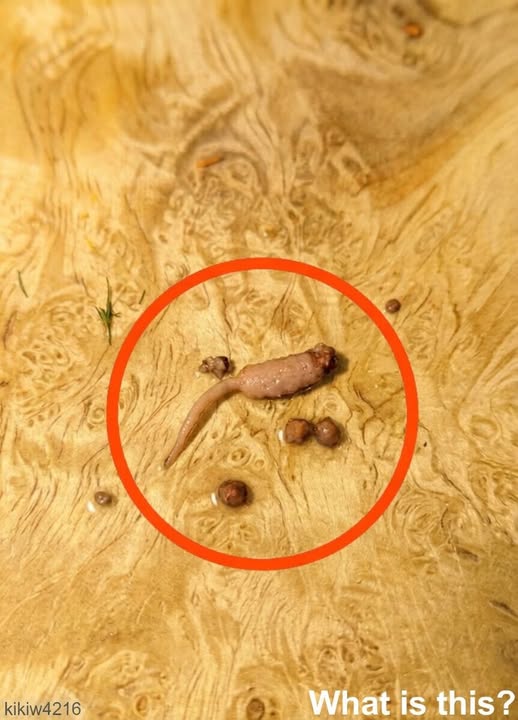
When a mysterious, elongated pink creature with a thin, tail-like extension appears on a household surface, it’s easy to understand why it might trigger confusion—or even alarm. Its unusual shape, slightly translucent body, and unfamiliar features can make it seem like something far more concerning than it actually is. Yet in many such cases, the explanation is far less alarming and far more fascinating.
The organism often identified in these situations is a rat-tailed maggot, the larval stage of a hoverfly, most commonly the species Eristalis tenax. Despite its unsettling nickname and appearance, this creature is completely harmless and plays an important ecological role that often goes unnoticed.
What makes it look so unusual?
At first glance, the rat-tailed maggot doesn’t resemble what most people think of as a typical insect larva. Its body is plump and cylindrical, often pale pink or slightly translucent, giving it a soft, almost gelatinous appearance. But what truly sets it apart is the long, thin appendage extending from one end—commonly mistaken for a tail.
In reality, this structure is not a tail at all, but a respiratory siphon. It functions like a snorkel, allowing the larva to breathe air while submerged in water. This adaptation is essential because rat-tailed maggots thrive in environments where oxygen levels are very low—places like stagnant water, decaying organic material, or sludge-rich habitats.
The darker end of the body contains the head and feeding structures, which the larva uses to filter microorganisms and organic matter from its surroundings. The small brown pellets often found nearby are typically waste (frass) or debris from its feeding environment—not eggs or parasites, as is sometimes assumed.
Where do they come from?
Rat-tailed maggots are aquatic or semi-aquatic organisms. They develop in environments rich in organic material, such as:
- Clogged drains
- Compost piles
- Standing water in containers or gutters
- Ponds or manure-rich areas
Their presence indoors is usually accidental. They may be washed in through plumbing, carried in on objects, or crawl out of their moist habitat when they are ready to transition to the next stage of their life cycle.
Because they cannot survive long in dry conditions, finding one on a wooden surface or floor typically means it has already left its natural environment and is unlikely to remain alive for long.
A fascinating life cycle
Like many flies, rat-tailed maggots undergo complete metamorphosis. Their life cycle includes four stages:
- Egg
- Larva (rat-tailed maggot)
- Pupa
- Adult fly
After feeding and growing in water, the larva eventually leaves its aquatic environment and searches for a dry place to pupate. Inside a hardened casing, it transforms into an adult hoverfly.
The adult form looks nothing like the larva. In fact, hoverflies—members of the family Syrphidae—are often mistaken for bees or wasps due to their striped appearance. However, they are harmless flies and are actually beneficial pollinators.
Why they matter in nature
While their larval stage may seem unappealing, rat-tailed maggots play an important role in ecosystems. They act as decomposers, breaking down organic waste and helping recycle nutrients back into the environment.
In some settings, such as wastewater systems, their presence can even indicate certain environmental conditions. Their ability to survive in low-oxygen environments makes them uniquely adapted to habitats where many other organisms cannot thrive.
As adults, hoverflies contribute to pollination by visiting flowers and transferring pollen between plants. This makes them valuable not only in natural ecosystems but also in agriculture.
Are they dangerous?
Despite their appearance, rat-tailed maggots are not dangerous. They do not:
- Bite or sting
- Carry diseases
- Infest human or animal tissue
- Damage property
Their presence is more of an environmental signal than a health concern. It suggests that somewhere nearby, there may be standing water or decaying organic material that supports their development.
Misidentifications are common. Some people mistake them for parasitic worms, caterpillars, or even small snakes. However, the distinctive breathing tube is a clear identifying feature that sets them apart from other organisms.
Why people react strongly
Part of the strong reaction to these larvae comes from their unfamiliarity. Humans tend to be wary of organisms that don’t fit recognizable patterns, especially when they appear indoors.
Social media can amplify this effect, as images of unusual creatures often spread quickly, sometimes accompanied by incorrect or exaggerated claims. Without proper context, it’s easy for harmless organisms to be perceived as threats.
In reality, encounters with rat-tailed maggots are relatively common, especially in environments where water and organic material are present.
What to do if you find one
If you encounter a rat-tailed maggot in your home, the response can be simple and calm:
- Remove it using a tissue or dispose of it safely
- Clean the area with water or a mild cleaner
- Check for nearby sources of standing water or buildup
Preventative steps may include:
- Cleaning drains regularly
- Emptying water containers
- Maintaining gutters and outdoor drainage
- Avoiding accumulation of organic waste
There is no need for pesticides or aggressive treatment, as these larvae do not establish infestations in dry indoor environments.
A reminder of hidden biodiversity
Encounters like this highlight something easy to overlook: even in everyday environments, there is a vast and complex world of small organisms carrying out essential ecological functions.
What might initially seem alarming can, with a bit of understanding, become an example of nature’s adaptability and resilience. The rat-tailed maggot is a perfect illustration of how evolution has shaped organisms to survive in highly specific conditions—and how those adaptations can occasionally bring them into contact with human spaces.
Final perspective
The mysterious pink creature with a long “tail” is not a threat, but a rat-tailed maggot, a harmless and ecologically valuable stage in the life of a hoverfly. Its unusual appearance reflects a highly specialized adaptation rather than anything dangerous.
Rather than a cause for concern, its presence offers a small window into the hidden processes of decomposition, transformation, and ecological balance happening all around us.
Understanding what it is—and what it isn’t—can replace uncertainty with curiosity, turning an unsettling discovery into an opportunity to appreciate the complexity of life in even the most ordinary places.