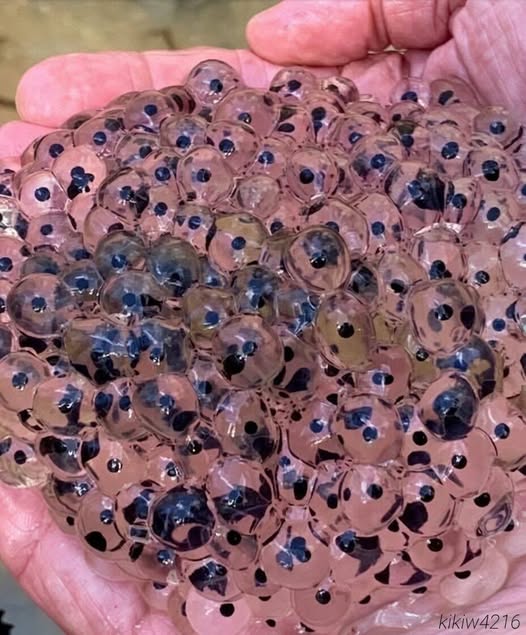
In a moment that feels almost lifted from a science fiction film or a surreal digital artwork, clusters of translucent, jelly-like spheres appear cradled in a human palm, each orb seemingly alive with a dark, central “pupil” that appears to stare back at the viewer. At first glance, the scene is unsettling—almost alien. The glossy, gelatinous mass glistens under soft light, its surface reflecting faint highlights while dozens of perfectly rounded spheres sit tightly packed together, suspended in a viscous matrix that resembles both candy and glass beads.
Yet despite their uncanny appearance, these mesmerizing structures are entirely natural. They are amphibian egg masses—one of the most visually striking early life stages in the animal kingdom. Often referred to online as “eyeball eggs,” these clusters are most commonly associated with frog species such as the Southern leopard frog and related North American amphibians. What looks like a collection of staring eyes is in fact a carefully evolved reproductive strategy that has existed for millions of years, quietly unfolding in ponds, marshes, and seasonal wetlands across the world.
The illusion of eyes in jelly
The illusion that makes these egg masses so captivating comes from the internal structure of each individual egg. Within every transparent sphere lies a developing embryo. The dark central spot that resembles a pupil is actually the pigmented upper surface of the embryo, where early eye structures and neural tissues begin to form.
Because the eggs are suspended in a clear gelatinous medium, light passes through them in a way that enhances contrast. The result is a visual effect that makes each embryo appear to stare outward. This phenomenon, combined with the uniform clustering of dozens or even hundreds of eggs, creates the eerie impression of a living, collective gaze emerging from the palm of a hand or the surface of a pond.
The human brain, wired to recognize faces and eyes even in abstract patterns, amplifies this illusion. This psychological tendency—known as pareidolia—explains why people so often interpret natural structures as familiar forms. In this case, evolution and perception collide to produce one of nature’s most unintentionally artistic displays.
A biological masterpiece hidden in plain sight
Amphibian egg masses are not random aggregations. They are highly structured biological systems designed for survival in unpredictable environments. Each egg is encased in multiple layers of jelly, which serve several essential functions at once.
The outer gelatinous coating acts as a protective barrier, shielding the developing embryos from physical damage, harmful microbes, and ultraviolet radiation. It also helps regulate water exchange, preventing the eggs from drying out in shallow or temporary pools. In addition, the slippery texture discourages many predators from feeding on them, as the clusters are difficult to grasp or consume.
This jelly matrix expands when exposed to water, swelling into a soft, buoyant mass that can float freely or anchor itself to submerged vegetation. The result is a living, breathing nursery suspended in water—an environment carefully engineered by evolution to maximize the survival of future frogs.
Inside the “eyeballs”: the hidden embryo
Each seemingly simple sphere contains a highly dynamic and rapidly developing organism. After fertilization, amphibian embryos begin dividing almost immediately. Within hours, the basic body plan starts forming: head, tail, and neural structures begin to take shape in a process driven by tightly regulated genetic instructions.
The dark pigmentation seen in the “eye-like” region is not yet a functional eye, but rather early tissue that will later differentiate into complex visual organs. Surrounding structures gradually form the spinal cord, brain, and eventually the full anatomy of a tadpole.
Oxygen diffuses directly through the jelly coating, while waste products exit in the opposite direction. This passive exchange system allows the embryos to develop without parental feeding or intervention. Everything required for early survival is contained within the egg itself.
As development progresses, the embryos elongate, forming tails and rudimentary gill structures. Within days to weeks—depending on temperature and species—the eggs hatch into free-swimming tadpoles, beginning an entirely different stage of life.
Where these egg masses are found
These amphibian egg clusters are typically found in freshwater environments such as ponds, wetlands, drainage ditches, floodplains, and seasonal vernal pools. These habitats are especially important because they often lack fish predators that would otherwise consume the eggs.
Southern leopard frogs and similar species prefer shallow, still water warmed by sunlight. During breeding season, males call loudly at night, producing distinctive croaks to attract females. Once mating occurs, females deposit thousands of eggs in a single gelatinous mass, often attaching them to submerged plants or allowing them to float freely.
The timing of reproduction is critical. Many amphibians rely on temporary pools that form after seasonal rains. These environments provide a brief but safe window for development before drying out or becoming inhabited by predators.
Why they sometimes appear in unusual places
Occasionally, people discover these egg masses in unexpected locations—garden ponds, roadside puddles, or even inadvertently carried into human environments. This typically occurs when rising water levels, flooding, or vegetation movement dislodges them from their original breeding site.
Once removed from water, the jelly quickly begins to lose structure, collapsing into a sticky, semi-transparent residue. Without aquatic conditions, the embryos cannot survive long, which is why these egg masses are almost always tied to nearby wetland ecosystems.
Their presence in a given area can actually reveal important ecological information. Healthy amphibian reproduction often indicates relatively clean water and balanced ecosystems, making these egg clusters subtle environmental indicators.
The evolutionary brilliance behind the design
From an evolutionary perspective, amphibian egg masses represent a delicate balance between vulnerability and protection. Unlike birds or mammals, amphibians do not provide ongoing parental care after egg deposition. Instead, survival depends entirely on the physical and chemical properties of the egg mass itself.
The jelly coating is not just passive protection—it is biologically active. It can deter pathogens, regulate hydration, and even influence oxygen availability. Some species produce egg masses with varying thickness depending on environmental conditions, suggesting a level of adaptive flexibility.
The clustering strategy also increases survival odds. While predators may consume some eggs, the sheer number ensures that at least a portion will survive to hatching. This “quantity over protection” strategy has proven effective for millions of years.
From egg to frog: the transformation journey
Once hatched, the embryos emerge as tadpoles—fully aquatic larvae with tails, gills, and simple feeding structures. At this stage, they feed primarily on algae, microorganisms, and organic debris, playing an important role in aquatic food webs.
Over time, metamorphosis begins. Hind legs develop first, followed by front limbs. The tail gradually shortens as it is absorbed into the body. Gills are replaced by lungs, allowing the young frog to transition from water to land.
This transformation is one of the most dramatic in the animal kingdom, turning a soft, fish-like swimmer into a jumping terrestrial amphibian capable of living in both aquatic and land environments.
Ecological importance of amphibian egg masses
Beyond their visual intrigue, amphibian egg masses play a critical role in ecosystem health. Frogs and their larvae help control insect populations, serving as natural pest regulators. They also act as both predator and prey within aquatic food webs, linking multiple trophic levels.
Because amphibians have permeable skin and sensitive reproductive cycles, they are highly vulnerable to environmental changes. Pollution, habitat destruction, climate shifts, and disease outbreaks have led to global declines in amphibian populations.
As a result, the presence of healthy egg masses is often seen as a positive sign of environmental stability. Conservationists monitor breeding sites to track population trends and assess ecosystem health.
Why people find them unsettling—and fascinating
The “eyeball” appearance of these egg clusters triggers a strong emotional response. Humans are biologically wired to react to eye-like patterns, especially when they appear in unexpected contexts. This instinct likely evolved as a survival mechanism for detecting predators.
When combined with their gelatinous texture and submerged origin, the result is an object that feels both beautiful and slightly alien. This duality explains why images of amphibian eggs frequently go viral online, sparking both admiration and discomfort.
They sit at the intersection of science and surrealism—familiar yet strange, natural yet almost artificial in appearance.
A reminder of hidden life all around us
Perhaps the most striking lesson from these “eyeball eggs” is how much life exists unnoticed in everyday environments. Beneath the surface of a quiet pond or hidden among aquatic plants, entire generations of animals are developing in silence.
What appears as a simple jelly mass is actually a complex, dynamic system supporting future life and sustaining ecosystems far beyond what the eye can immediately perceive.
These egg clusters remind us that nature is constantly in motion, even in places we assume are still or empty.
Conclusion: beauty in the microscopic and the strange
Amphibian egg masses—those surreal, shimmering clusters of translucent spheres—represent one of nature’s most elegant paradoxes. They are at once fragile and resilient, simple in appearance yet profoundly complex in function.
Their eerie resemblance to staring eyes is not a trick of imagination but a result of evolutionary design combined with human perception. What initially appears strange or otherworldly is, in reality, a perfectly ordinary stage in the life of a frog.
And perhaps that is what makes them so captivating: they challenge our expectations of what life should look like, revealing instead a hidden world where even the smallest beginnings carry a sense of wonder, intelligence, and quiet beauty.