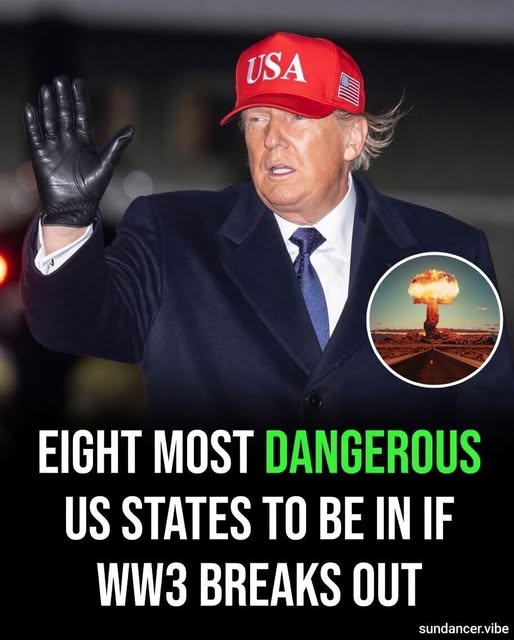
In recent years, as global tensions fluctuate and headlines occasionally reference military buildups, alliances, and strategic deterrence, many people have found themselves asking questions that once felt distant or abstract. Among them is a particularly persistent one: if a large-scale global conflict were ever to occur, which parts of the United States might be most affected?
It’s a serious question—but one that requires careful framing. Security analysts, military historians, and policy experts consistently stress that modern conflict is far more complex than traditional ideas of battle lines and frontlines. Today’s warfare involves not only physical targets, but also cyber systems, economic networks, satellites, and infrastructure that span entire nations.
Still, when analysts explore hypothetical scenarios—often for planning, deterrence, or academic purposes—they sometimes look at where key military and strategic assets are located. These are not predictions of future events, but rather reflections of how national defense is structured.
In that context, certain U.S. states are frequently mentioned because they host important components of military operations, command systems, or defense-related industries. Among the most commonly discussed are North Dakota, Montana, Wyoming, California, Virginia, Washington, Colorado, and Texas.
Each of these states plays a different role in the broader national security framework, and understanding those roles helps explain why they appear in strategic discussions.
North Dakota is often highlighted because of its connection to the United States’ nuclear deterrent. The state is home to Minot Air Force Base, which supports both long-range bombers and intercontinental ballistic missiles (ICBMs). These systems are part of what is known as the nuclear triad—a three-part structure consisting of land-based missiles, submarine-launched missiles, and strategic bombers.
The purpose of this system is not to fight wars, but to prevent them. By maintaining a credible and survivable deterrent, the United States aims to discourage any adversary from considering a large-scale attack. Because of that role, locations associated with these systems often appear in theoretical discussions about strategic importance.
Montana and Wyoming are frequently grouped with North Dakota as part of what analysts sometimes call the “ICBM belt.” These states contain networks of underground missile silos spread across large, sparsely populated areas. The design is intentional: dispersing these systems makes them difficult to eliminate in a single strike, reinforcing their deterrent value.
Wyoming, in particular, is home to F.E. Warren Air Force Base, which oversees a vast number of missile sites extending into neighboring states. Together, these regions represent a significant portion of the land-based nuclear deterrent.
Moving west, California stands out for a different set of reasons. It is not only the most populous state in the country, but also a major hub for military, technological, and economic activity. Naval Base San Diego serves as a central location for operations in the Pacific, supporting a large number of ships and personnel.
Beyond its military installations, California is also home to a powerful technology sector. Companies involved in aerospace, cybersecurity, artificial intelligence, and communications systems contribute to modern defense capabilities in ways that go far beyond traditional weapons.
This blending of military and technological importance makes California a key part of broader strategic considerations.
On the East Coast, Virginia plays a similarly significant role. Naval Station Norfolk, located in Virginia, is the largest naval base in the world and serves as a major center for Atlantic operations. The region also includes shipyards, air stations, and logistical hubs that support naval activity across multiple theaters.
Just outside Washington, D.C., the Pentagon serves as the headquarters of the Department of Defense. While it is an administrative and command center rather than a combat installation, its symbolic and operational importance is substantial.
Because of this concentration of leadership and infrastructure, Virginia is often included in discussions about strategic locations.
Washington state, meanwhile, is closely associated with the sea-based portion of the nuclear deterrent. Naval Base Kitsap supports a fleet of ballistic missile submarines, which are considered one of the most survivable elements of the nuclear triad.
These submarines operate beneath the ocean’s surface, often undetected, providing what is known as a second-strike capability. This means that even if other systems were compromised, the ability to respond would remain intact—an essential component of deterrence.
Washington also has a strong aerospace and manufacturing presence, further contributing to its strategic relevance.
Colorado represents another dimension of modern defense: space and surveillance. The state hosts installations such as Peterson Space Force Base and Schriever Space Force Base, which are involved in satellite operations, missile warning systems, and global communications networks.
Colorado is also home to NORAD, the North American Aerospace Defense Command, which monitors airspace and tracks potential threats. In an era where satellites play a critical role in navigation, communication, and intelligence, these capabilities are increasingly important.
Texas rounds out the list with its combination of military, industrial, and energy assets. The state hosts numerous bases and training centers, along with a large network of defense contractors. It also plays a major role in energy production, which is a crucial factor in both economic stability and national security.
While these eight states are often mentioned in strategic discussions, it is essential to understand that modern conflict would not be limited to specific locations.
Unlike earlier eras, where battles were fought in defined regions, today’s conflicts are likely to involve multiple domains simultaneously. Cyberattacks, for example, could target financial systems, power grids, or communication networks across the entire country.
Such disruptions would not be confined to states with military bases. They could affect daily life in communities far removed from any physical installation.
Economic impacts would also be widespread. Supply chains that deliver food, medicine, and consumer goods are interconnected across states and borders. A disruption in one part of the system can quickly ripple outward, affecting availability and prices nationwide.
Similarly, infrastructure such as transportation networks, energy systems, and telecommunications are deeply integrated. Interruptions in one region can have cascading effects in others.
Another important consideration is population movement. In the event of a major crisis, people may relocate in search of safety or stability, placing additional pressure on housing, services, and resources in other areas.
Emergency planners take these possibilities into account when developing response strategies, but the scale and complexity of such scenarios make them difficult to fully predict.
It’s also worth noting that discussions about “most affected states” can sometimes oversimplify the reality of modern security. While certain locations have clear strategic importance, the interconnected nature of today’s world means that no region is truly isolated from the consequences of conflict.
For this reason, many experts emphasize that the most important aspect of national security is not identifying potential targets, but preventing conflict altogether.
Diplomacy, international cooperation, and arms control agreements have historically played a key role in reducing the risk of large-scale war. Even during periods of tension, communication channels between nations help manage misunderstandings and prevent escalation.
Public awareness also matters. In an age of rapid information sharing, speculation can spread quickly, sometimes without context or accuracy. Understanding the difference between theoretical analysis and real-world prediction is crucial for interpreting these discussions responsibly.
Ultimately, the question of which states might be most impacted reveals a broader truth: in a world defined by technology and interconnection, the effects of conflict would extend far beyond any single location.
The idea of isolated impact is largely outdated. Instead, the consequences would be national—and likely global—in scope.
This reality underscores the importance of maintaining systems that promote stability, cooperation, and resilience. While it is natural to be curious about how such scenarios might unfold, it is equally important to recognize that they remain hypothetical.
The structures and strategies that analysts study are designed not to enable conflict, but to prevent it. And in that sense, their greatest success is measured not by what happens—but by what never does.