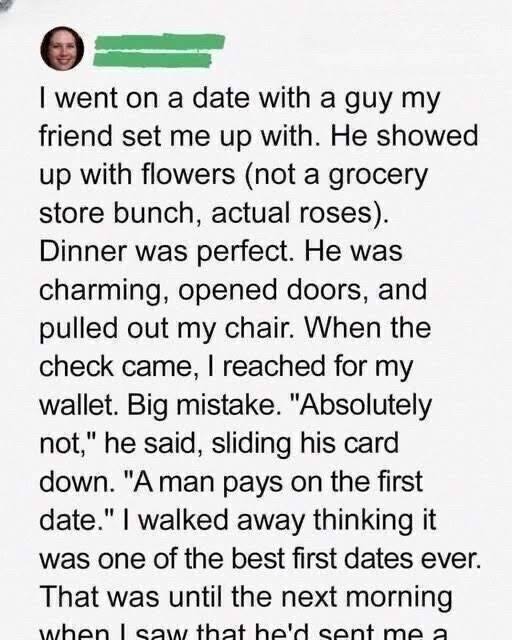
When Mia first mentioned setting me up on a blind date, I treated it like background noise in an otherwise predictable life. She had a way of talking about people she liked for me—turning ordinary introductions into carefully packaged narratives, as if she were trying to convince me to audition for a role I hadn’t applied for. At first, I dismissed it. I wasn’t against dating, but I was deeply suspicious of anything that arrived pre-labeled as “perfect.”
Still, Mia persisted. She didn’t push in a loud or aggressive way; instead, she built her case slowly, over weeks of conversations that felt casual on the surface but carried an undercurrent of persuasion. She described him as emotionally aware, thoughtful, grounded, and different from the usual dating disappointments people joked about. Eventually, what broke me down wasn’t curiosity—it was exhaustion. I agreed just to end the conversation, telling myself I would survive one dinner, one evening, one polite exit.
I had no idea that this decision would unravel into one of the most unsettling emotional experiences I had ever encountered—not because of dramatic conflict in the moment, but because of how smoothly everything appeared at first.
The illusion of perfect introduction
The restaurant Mia chose was the kind of place that immediately sets expectations. Low lighting softened every edge of the room. Candles flickered gently on each table, casting warm reflections across polished glassware. The background music was subtle enough to feel intentional, as if someone had designed it to guide emotional tone. Everything about it suggested intimacy, comfort, and quiet romance.
I arrived early, which gave me time to observe the space and second-guess my decision approximately twelve times. Every passing minute before he arrived made me more aware of my own skepticism. Blind dates always carried that strange tension between hope and caution—the possibility that something meaningful could emerge, and the equally strong possibility that I had agreed to an elaborate social experiment.
When Eric walked in, my first impression disrupted my expectations immediately.
He wasn’t flashy. He wasn’t trying too hard. He simply looked composed, as if he belonged in that space without effort. He carried a small bouquet of flowers—not oversized, not performative, just carefully chosen. His presence felt deliberate but not overwhelming, confident but not aggressive.
He greeted me warmly, and within minutes, I found myself disarmed in ways I hadn’t anticipated. He pulled out my chair without hesitation. He made eye contact when speaking, listened without interrupting, and responded in a way that suggested genuine attention rather than rehearsed politeness.
There was something almost refreshing about how present he seemed.
Then came the small details that shifted the tone further.
A thoughtful compliment delivered without exaggeration. A memory he claimed Mia had shared with him about me, which he referenced naturally in conversation. A small engraved keychain he placed on the table, my initials etched into it in clean, simple lettering.
It didn’t feel excessive. It felt… attentive.
Dinner flowed easily. Conversation moved between work, travel, interests, and random stories that made us both laugh more than expected. There was no awkwardness, no forced pauses, no visible mismatch in rhythm. For the first time in a long time, I wasn’t mentally planning an exit strategy mid-date.
I left that night with something I hadn’t expected: uncertainty about my own judgment. Not alarm, not suspicion—just a quiet sense that maybe, just maybe, I had misjudged blind dates entirely.
The morning that changed everything
The illusion collapsed the next morning with a single notification.
It wasn’t a text. It wasn’t a follow-up message about dinner.
It was an email.
The subject line read: “Invoice from Eric.”
At first, I assumed it was spam or a joke. Something misdirected. Something absurd enough that it couldn’t possibly relate to the previous night. But curiosity won out, and I opened it.
What I saw didn’t immediately register as real.
The email was formatted like a professional bill. Clean lines. Organized sections. Itemized charges.
Dinner experience: listed.
Flowers provided: listed.
Conversation engagement: listed.
Emotional presence: listed.
Active listening: listed.
Each item had a corresponding dollar amount.
At first, I thought I was misunderstanding it. I reread it slowly, convinced there had to be some hidden meaning or joke that I wasn’t catching. But the structure remained consistent. The tone was disturbingly formal, as if emotional interaction had been converted into billable labor.
Then I reached the line that made my stomach drop.
“Hug delivered: $—”
And beneath it:
“Emotional engagement (high value interaction): $—”
At the bottom of the email sat a deadline: forty-eight hours to remit payment.
No explanation. No context. No indication that this was anything other than serious.
My hands went cold.
Confusion turning into recognition
My first reaction wasn’t anger. It was confusion layered with disbelief so thick it felt unreal. I kept asking myself the same questions over and over:
Was this a joke I wasn’t understanding?
Was this some bizarre personality test?
Was there some cultural or experimental context I was missing?
But beneath those questions, something more instinctive was rising—unease.
Because even if it was a joke, it wasn’t a harmless one. It carried an undertone that made my skin tighten: the idea that human interaction could be calculated, priced, and demanded back like a financial transaction.
I called Mia immediately.
I read parts of the email out loud, my voice unsteady. There was a pause on her end that lasted too long. Then she asked me to send it.
Within minutes, she called back, her tone sharper now.
“Block him,” she said immediately. “Don’t respond. Don’t engage. Don’t explain anything.”
Her boyfriend joined the call halfway through, and his reaction shifted the emotional weight of the situation even further. He laughed—not because it was funny, but because disbelief was the only way to process it.
Then he said something that reframed everything:
“He invoiced you for being a human being.”
The moment clarity replaced confusion
That sentence stuck.
Because it stripped away the confusion I had been holding onto. It wasn’t a misunderstanding. It wasn’t an awkward joke that went too far. It was a belief system.
Somewhere in Eric’s thinking, emotional presence wasn’t mutual—it was transactional. Attention wasn’t shared—it was owed. Interaction wasn’t connection—it was service delivery.
And that realization shifted everything.
I blocked him.
Not after debating. Not after drafting a response. Not after trying to understand.
Just blocked.
The aftermath: laughter, reflection, and discomfort
In the days that followed, I expected relief to feel immediate. Instead, it arrived in waves.
At first came humor. The absurdity of the situation made it easy to laugh when retold in pieces. Friends reacted with disbelief, then outrage, then jokes about sending invoices for emotional damage or charging people for “listening energy.”
But underneath the humor was something more serious beginning to surface.
I started thinking about how easily I had been disarmed at the beginning of the date. How quickly effort had translated into trust. How easily charm had overridden caution.
None of his early behavior had been inherently alarming on its own. Flowers. Attentiveness. Thoughtful gestures. None of it screamed danger.
But together, they formed something more complex: intensity without balance.
And that imbalance mattered.
The deeper lesson about manipulation
What unsettled me most wasn’t the invoice itself—it was the logic behind it.
Because manipulation doesn’t always appear as hostility. Sometimes it appears as overinvestment. Excessive attention. Rapid intimacy. Carefully curated impressions of perfection.
At the time, I had interpreted those gestures as interest. In hindsight, they also functioned as setup—emotional investment that created implied obligation.
The invoice simply made that expectation explicit.
It revealed a mindset where affection wasn’t freely given but strategically deployed, and later reclaimed through pressure.
That realization was uncomfortable, but clarifying.
Boundaries as early detection systems
The experience forced me to rethink what I had previously dismissed as “small things.”
Unease during conversation. Overly fast emotional escalation. Grand gestures early in acquaintance. These were not just personality quirks—they were data points.
Boundaries, I realized, are not reactive tools used after harm occurs. They are preventative systems designed to detect imbalance before it becomes entanglement.
And I had nearly ignored mine because everything looked “nice enough.”
Reclaiming perspective
Over time, the emotional sting faded, replaced by something more stable: perspective.
I didn’t feel foolish anymore. I felt informed.
The experience didn’t make me distrustful of kindness. It made me more attentive to context. Kindness without expectation is grounding. Kindness with hidden conditions is pressure disguised as warmth.
The difference matters.
Conclusion: what the invoice really revealed
In the end, the invoice was not about money.
It was about belief.
A belief that emotional presence can be quantified. That attention can be billed. That human interaction can be converted into debt.
But human connection doesn’t work that way. Not sustainably. Not healthily. Not safely.
What I walked away with wasn’t just a story about a bad date. It was a sharper understanding of how manipulation can wear the costume of effort, and how important it is to trust discomfort even when everything on the surface looks perfect.
Because sometimes the most dangerous situations don’t announce themselves loudly.
Sometimes they arrive with flowers.