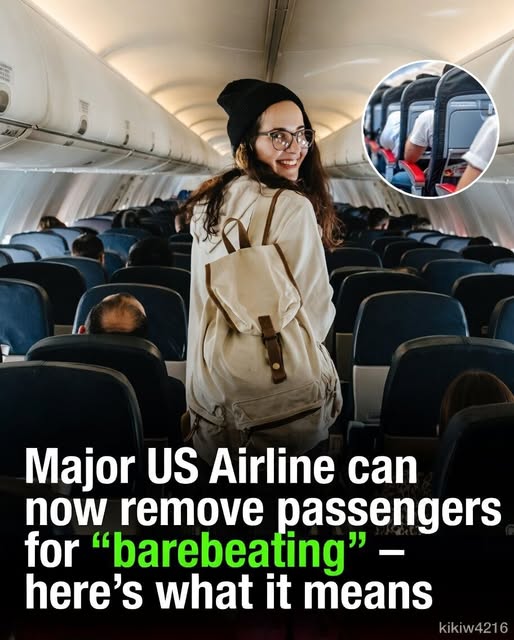
Air travel has never been completely peaceful, but one modern habit has increasingly pushed passengers to their limits: playing audio out loud in a confined cabin. Now, United Airlines is taking a firmer stance, formally addressing what internet culture has dubbed “barebeating”—the act of playing music, videos, or other media without headphones in shared public spaces.
Under an updated version of its Contract of Carriage—specifically Rule 21—the airline has clarified that passengers who refuse to use headphones while playing audio can face consequences that go beyond a simple warning. Flight crews are now explicitly empowered to intervene, request compliance, and, if necessary, remove non-cooperative passengers from the aircraft.
At first glance, the rule may seem like common sense. But its formalization marks a significant shift in how airlines handle in-flight behavior—turning what was once considered a minor etiquette issue into an enforceable policy.
What “barebeating” actually means
The term itself may sound informal, even humorous, but the behavior it describes is widely recognized. “Barebeating” refers to playing audio—whether it’s a TikTok clip, a Netflix show, a YouTube video, or even a loudspeaker phone call—without headphones, forcing nearby passengers to listen.
With the rise of smartphones, stronger built-in speakers, and fast in-flight Wi-Fi, this behavior has become more common. Passengers are no longer limited to silent reading or pre-downloaded content; they can stream endlessly. And when even one person chooses not to use headphones, the impact can ripple across multiple rows.
In an environment where passengers cannot simply leave or change seats easily, even low-volume noise can become a persistent source of irritation.
Why the policy is gaining attention now
The timing of this policy update is not random. Airlines have been receiving increasing complaints about noise disturbances, especially as cabins become more connected and digitally active. On many aircraft, streaming is now encouraged through onboard Wi-Fi systems, sometimes powered by satellite technologies like Starlink, which enable smoother video playback.
That convenience, however, comes with trade-offs.
Psychologists often point out that unwanted noise in confined spaces can trigger stress responses. It interrupts sleep, concentration, and relaxation—three things passengers value most during flights. In a setting already associated with delays, security lines, and limited personal space, added noise can amplify frustration quickly.
By explicitly addressing the issue, United is signaling that passenger comfort—especially collective comfort—is becoming a higher operational priority.
Enforcement: what can actually happen
The key change isn’t the expectation itself—it’s the enforcement mechanism.
Flight attendants can now:
- Ask a passenger to stop playing audio or use headphones
- Issue repeated warnings if necessary
- Escalate the situation if the passenger refuses to comply
In more serious cases, this could lead to removal from the flight before departure or intervention upon landing. While such outcomes are expected to be rare, the fact that they are now clearly allowed gives crew members stronger authority to act without ambiguity.
Importantly, the rule does not target all noise. Conversations between passengers, crying infants, or unavoidable sounds remain part of normal travel. The focus is specifically on controllable electronic audio.
A divided public reaction
As with many rule changes that touch on personal behavior, reactions have been mixed.
Supporters argue that the policy is long overdue. For frequent flyers, stories of enduring hours of unwanted noise—from cartoons to music to loud video calls—are common. Many see the rule as a simple reinforcement of basic courtesy.
Critics, however, raise concerns about how the rule might be applied. Some worry about inconsistent enforcement or situations where passengers are penalized unfairly. Others frame it as part of a broader trend toward increased regulation of personal behavior in already restrictive environments.
At its core, the debate reflects a familiar tension: individual freedom versus shared responsibility.
The bigger cultural shift
What makes this situation particularly interesting is how it reflects broader societal changes. The normalization of consuming media out loud in public spaces didn’t start on airplanes—it evolved with smartphones and social media platforms designed for constant engagement.
In many environments, people can move away from noise. On a plane, they cannot.
That limitation turns what might be a minor annoyance elsewhere into a significant issue in the air. It also forces a clearer definition of acceptable behavior in shared spaces.
Airplanes, in this sense, act as micro-societies—temporary communities where cooperation is not optional.
Industry ripple effects
While United Airlines is drawing attention for explicitly naming and enforcing the rule, similar expectations already exist—informally—across other major carriers. Airlines like Delta Air Lines and American Airlines have long encouraged headphone use, though enforcement has often been inconsistent.
Industry analysts expect this to change.
As passenger expectations evolve and complaints increase, clearer and stricter policies may become standard. Over time, playing audio out loud on a plane could become as socially unacceptable as smoking mid-flight—a behavior once common, now unthinkable.
Practical takeaway for travelers
For passengers, the adjustment is simple:
- Always carry headphones (preferably a backup pair)
- Keep volume low, even when testing audio
- Be mindful of surroundings, especially on long flights
These small habits can prevent conflicts and ensure a smoother travel experience—not just for yourself, but for everyone nearby.
Final perspective
The controversy around “barebeating” isn’t really about headphones. It’s about how people share space in an increasingly connected world.
As personal devices become more powerful and ever-present, the line between private and public behavior continues to blur. Policies like this attempt to redraw that line—reminding travelers that convenience should not come at the expense of others.
In the end, the rule reflects a simple principle: comfort in shared spaces depends on mutual respect. And at 35,000 feet, where options are limited and patience is tested, that principle matters more than ever.