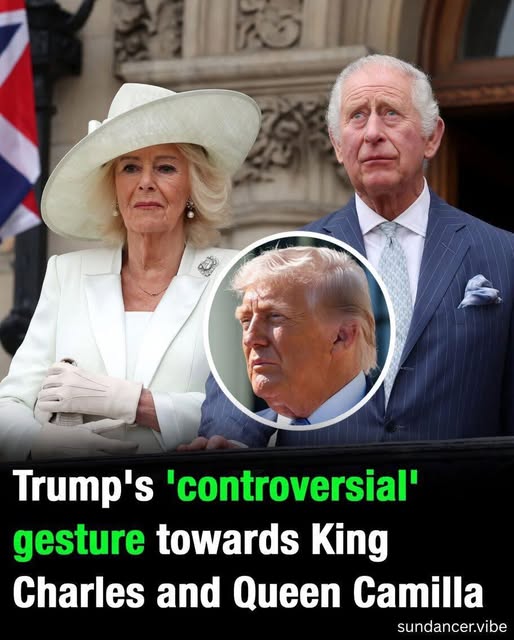
The highly anticipated meeting between Donald Trump and King Charles III, joined by Queen Camilla, unfolded under intense global scrutiny—yet what ultimately captured the world’s attention was not policy or speeches, but a series of brief, unscripted physical gestures that quickly evolved into a wider cultural and diplomatic debate.
From the outset, the state visit carried symbolic weight. Relations between the United States and the United Kingdom had experienced visible strain in the months leading up to the meeting, with Trump publicly criticizing British leadership, including Keir Starmer. Against that backdrop, the visit was widely viewed as an opportunity to reaffirm what is often called the “special relationship” between the two nations—a partnership rooted in shared history, strategic cooperation, and cultural ties.
Yet amid carefully prepared speeches and formal ceremonies, it was body language that dominated headlines. During public appearances, Trump was seen placing a hand on King Charles’s back while walking, later appearing to touch his knee while seated. In another moment, he lightly touched Queen Camilla’s arm. These actions, though brief and seemingly casual, sparked immediate and polarized reactions.
At the center of the controversy lies the concept of royal protocol—a complex system of traditions governing interactions with members of the British monarchy. While many of these rules are unwritten, they are deeply ingrained. Generally, physical contact with a royal is limited and typically initiated by the royal themselves. Even small gestures, such as guiding touches or pats, can carry unintended implications within this highly formal context.
For critics, Trump’s actions appeared to cross that invisible boundary. Some interpreted the gestures as a breach of decorum, suggesting either a lack of awareness or a deliberate disregard for established norms. In diplomatic settings—particularly those involving centuries-old institutions like the British monarchy—such details are often seen as more than mere etiquette; they are viewed as reflections of respect and understanding.
Supporters, however, offered a different perspective. In American culture, physical gestures like a hand on the back or a light touch on the arm are often interpreted as friendly, confident, and personable. From this viewpoint, Trump’s behavior could be seen not as disrespectful, but as an attempt to create warmth and familiarity in a formal setting. To them, the criticism reflects a cultural mismatch rather than a diplomatic misstep.
This divide quickly played out across media platforms and public discourse. Some observers framed the moment as emblematic of Trump’s broader approach to leadership—direct, informal, and often unconstrained by tradition. Others argued that such an approach can clash with institutions where symbolism and protocol carry significant meaning.
Importantly, there was no visible sign of discomfort from King Charles or Queen Camilla during the interactions, nor were there any official complaints issued. The visit proceeded as planned, with both sides emphasizing cooperation and shared priorities. In that sense, the broader diplomatic objectives remained intact.
Still, the episode highlights a larger truth about modern diplomacy: perception can be as influential as substance. In an era defined by instant media and global connectivity, even fleeting moments can be magnified, dissected, and assigned meaning far beyond their original context. A gesture lasting seconds can shape narratives that endure far longer.
The situation also underscores the contrast between two distinct worlds. On one side is the British monarchy, an institution built on continuity, symbolism, and adherence to tradition. On the other is contemporary political leadership, where authenticity, relatability, and personal style often play a central role. When these worlds intersect, differences in expectation can become especially visible.
Trump’s interaction with the royal family serves as a case study in that intersection. Was it a simple expression of personality in a formal environment, or a misalignment with long-standing customs? The answer depends largely on perspective. Cultural norms, personal expectations, and political views all shape how such moments are interpreted.
Beyond the immediate debate, the incident raises broader questions about leadership in a globalized world. Should public figures strictly adapt to the traditions of every institution they engage with? Or is there space for individual style, even when it challenges established norms?
There is no universal answer. Diplomacy has always involved a balance between respect for tradition and the realities of evolving leadership styles. What remains clear is that symbolism continues to matter—and perhaps more than ever.
Ultimately, the meeting between Donald Trump, King Charles III, and Queen Camilla will be remembered not only for its diplomatic intentions, but for how a few small gestures sparked a much larger conversation. It is a reminder that in highly visible moments, meaning is not just created by words or policies, but by the subtle, human details in between.
And in a world where every interaction is observed, recorded, and interpreted, even the simplest gesture can become a global story.