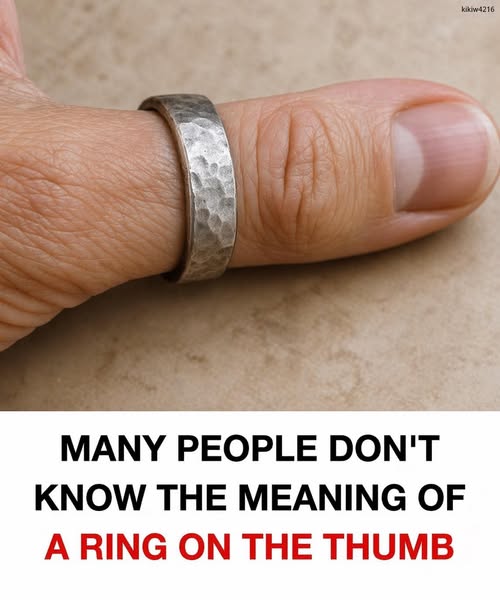
At first glance, a thumb ring might seem like just another fashion detail—an accessory chosen for its aesthetic appeal rather than any deeper meaning. Yet, unlike rings worn on more traditional fingers, a thumb ring has a way of standing out. It draws attention not because it is extravagant, but because it feels intentional. It exists slightly outside the expected, quietly signaling that the person wearing it made a conscious choice rather than following a convention.
That subtle distinction is exactly what gives the thumb ring its unique power.
Across cultures, generations, and personal styles, the thumb has long been associated with qualities like willpower, independence, and control. It is the finger we use to grip, to point, to assert. It plays a central role in how we interact with the world physically—and symbolically, it reflects how we assert ourselves within it. When someone chooses to place a ring on the thumb, they are, in a sense, highlighting that part of themselves.
But what does it actually mean?
The answer is layered. And more importantly, it’s personal.
The Psychology Behind the Thumb Ring
Before diving into gendered meanings or cultural interpretations, it’s important to understand why the thumb itself carries symbolic weight.
In body language and psychology, the thumb is often linked to dominance and confidence. Think about how people gesture when they feel self-assured—thumbs visible, sometimes hooked into pockets, sometimes pointing upward. The thumb is rarely passive. It’s active, expressive, and associated with presence.
Wearing a ring on this finger amplifies that energy.
It turns a natural symbol of agency into a deliberate statement. Even if the wearer isn’t consciously thinking about it, the placement communicates something: awareness, individuality, and a willingness to be seen.
What It Often Means for Women
For many women, a thumb ring carries connotations of independence and self-definition.
Unlike rings that are traditionally tied to relationships—engagement rings, wedding bands—the thumb ring exists outside those expectations. It doesn’t signify belonging to someone else. Instead, it often reflects belonging to oneself.
This is why it’s frequently associated with:
- Confidence: A sense of comfort in one’s identity
- Self-empowerment: Choosing one’s own path rather than following external expectations
- Individuality: A desire to stand out subtly rather than conform
In certain contexts, a thumb ring has also been linked to feminist expression. Not in an overt or universal way, but as a quiet signal of autonomy. It can represent a rejection of restrictive norms and an embrace of personal agency.
For some women, the ring marks a transition—leaving behind a period of doubt, stepping into a stronger sense of self, or reclaiming independence after a major life change. Over time, it becomes more than jewelry. It becomes a reminder.
At the same time, not every choice is symbolic. Many women wear thumb rings simply because they like the look. But even that choice reinforces the core idea: wearing something unconventional because it feels right.
And that, in itself, is a form of independence.
What It Often Means for Men
For men, the thumb ring carries a slightly different historical and modern narrative.
In earlier periods, thumb rings were often associated with power and status. They were sometimes larger, more ornate, and used to signal wealth or rank. In certain cultures, they were even functional—used by archers to protect the thumb while drawing a bow.
Over time, those meanings evolved.
Today, a man wearing a thumb ring is often perceived as:
- Confident in his identity
- Comfortable with self-expression
- Unconcerned with rigid expectations
Rather than signaling dominance in a traditional sense, the modern thumb ring often reflects a relaxed confidence. It suggests someone who doesn’t feel the need to fit into a narrow definition of masculinity.
It can also hint at creativity. Many men who choose thumb rings tend to have a strong sense of personal style—artists, designers, or individuals who view fashion as an extension of identity rather than just function.
In this way, the thumb ring becomes less about status and more about self-awareness.
A Symbol Beyond Gender
While gendered interpretations exist, the most accurate way to understand a thumb ring is to look beyond them.
At its core, the thumb ring represents freedom.
It is one of the few pieces of jewelry that carries no fixed social script. There are no widely accepted rules about when or why it should be worn. That absence of structure is what makes it so meaningful.
It allows the wearer to define its purpose.
For some, it represents independence.
For others, creativity.
For others still, a quiet rebellion against expectations.
It can also symbolize transition. People often adopt new styles during periods of change—new jobs, new relationships, new phases of life. A thumb ring can become part of that shift, marking a moment where identity is being redefined.
The Role of Visibility
Another reason the thumb ring carries such presence is its visibility.
Unlike rings on other fingers, which can be partially hidden or less noticeable, the thumb is almost always in motion. It appears in gestures, in conversation, in everyday actions.
This makes the ring more expressive.
It becomes part of how a person communicates without words. A subtle extension of personality that others pick up on—even if they don’t consciously analyze it.
Because of this, thumb rings often feel more “intentional” than other accessories. They are harder to ignore, and therefore more likely to be interpreted.
Cultural Layers and History
The meaning of thumb rings is not purely modern. They carry historical and cultural significance that adds depth to their interpretation.
In some traditions, the thumb has been associated with:
- Willpower and determination
- Personal direction and decision-making
- The ability to shape one’s own path
Jewelry placed on the thumb was sometimes believed to enhance these qualities or serve as a reminder of them.
In other contexts, thumb rings were practical tools—used by archers or craftsmen. Over time, these functional objects became symbolic, blending utility with identity.
Even today, that history lingers. Whether consciously or not, wearing a thumb ring connects the present to those earlier meanings.
Why People Notice It
One of the most interesting aspects of thumb rings is how they are perceived by others.
People may not always be able to explain why they notice them, but they do. And often, they make assumptions—sometimes accurate, sometimes not.
A thumb ring can suggest:
- Confidence
- Independence
- Creativity
- A nonconforming mindset
But these interpretations are not fixed. They vary depending on context, culture, and individual perspective.
What matters more is the intention behind the choice.
The Risk of Overinterpretation
While thumb rings can carry meaning, it’s important not to overanalyze them.
Not every ring is a statement. Not every wearer is trying to communicate something specific. Sometimes, a ring is just a ring.
However, even in those cases, the act of choosing it still reflects something—if only a preference for standing slightly outside the norm.
The key is balance: recognizing potential meaning without assuming certainty.
A Quiet Form of Self-Expression
What makes the thumb ring so compelling is its subtlety.
It doesn’t demand attention. It doesn’t come with a defined message. But it still communicates.
It exists in that space between intention and interpretation—where personal identity meets external perception.
And that’s where its real power lies.
Final Thoughts
A thumb ring is more than a piece of jewelry, but less than a fixed symbol.
It doesn’t dictate identity—but it can reflect it.
It doesn’t define personality—but it can hint at it.
For some, it represents strength and independence.
For others, creativity and individuality.
For many, it’s simply a choice that feels right.
What unites all these meanings is one idea:
Intention.
Wearing a thumb ring is rarely accidental. It’s a decision—sometimes conscious, sometimes instinctive—that places emphasis on individuality.
And in a world full of expectations and unspoken rules, even a small act of choosing something different can say more than words ever could.