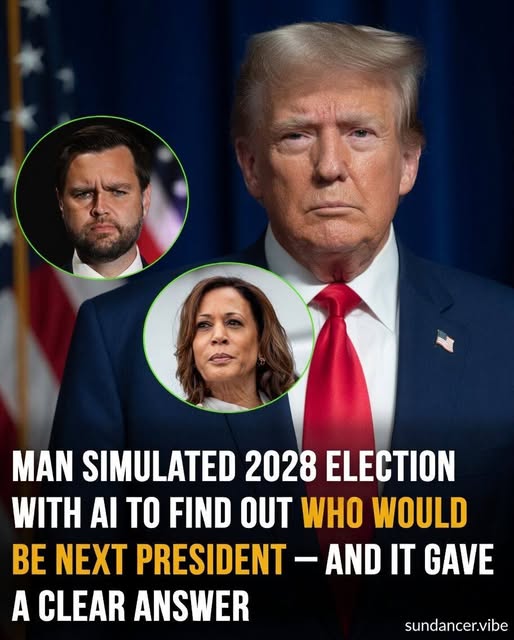
A new wave of discussion has emerged around the future of American politics following an AI-generated simulation that attempts to forecast the outcome of the 2028 United States presidential election. While such projections are inherently uncertain, the scenario has captured widespread attention because it reflects deeper questions about political momentum, leadership transitions, and the evolving mood of the American electorate in the years following Donald Trump’s presidency.
The simulation does not claim to predict the future with certainty. Instead, it offers a structured interpretation of current trends—polling data, political positioning, historical patterns, and voter behavior—to construct a plausible scenario. What makes this particular projection noteworthy is not just the names it highlights, but the underlying assumptions about how American politics may evolve over the next several years.
The Republican Landscape: A Contest of Proximity and Positioning
On the Republican side, the model focuses on two prominent figures: JD Vance and Marco Rubio. Both are widely seen as influential voices within the party, but their projected paths to a potential nomination differ significantly.
According to the simulation, JD Vance’s role as Vice President positions him as a natural successor within the current administration’s political framework. Historically, proximity to the presidency has often translated into stronger name recognition, institutional support, and voter familiarity. This advantage can be particularly powerful in primary elections, where party loyalty and continuity often play a decisive role.
However, that same proximity can also become a liability. The simulation suggests that being closely tied to an administration means sharing both its successes and its challenges. If the years leading up to 2028 are marked by economic struggles, policy controversies, or declining public approval, JD Vance could find it difficult to distance himself from those outcomes.
In contrast, Marco Rubio is portrayed as occupying a more flexible position. Serving as Secretary of State in this scenario, his public image would likely be shaped more by foreign policy than domestic debates. This distinction could allow him to craft a narrative that emphasizes diplomacy, global leadership, and strategic independence from internal political conflicts.
The AI model highlights this difference as a key factor. While Marco Rubio may lack the immediate visibility of a vice president, he may benefit from a broader appeal among voters seeking a shift in tone or direction within the same party.
The Role of Endorsement and Party Influence
A central element of the simulation is the continued influence of Donald Trump. Even after leaving office, his role within the Republican Party is expected to remain significant. The model suggests that an endorsement from him could heavily influence the outcome of the primary race, potentially consolidating support behind a single candidate.
This reflects a broader reality in modern politics: party dynamics are often shaped by influential figures long after their formal terms end. In this scenario, Donald Trump’s endorsement is treated as a decisive variable—one capable of shifting momentum quickly and dramatically.
However, the model also acknowledges uncertainty. Political influence can evolve over time, and voter priorities may shift in ways that reduce or amplify the importance of such endorsements. What remains consistent is the recognition that leadership transitions are rarely clean breaks; they are often extensions of existing political narratives.
The Democratic Perspective: A Candidate of Contrast
On the Democratic side, the simulation identifies Gavin Newsom as the most likely nominee and a potential winner in the general election. This projection is not based solely on policy positions or campaign strategy, but on a broader interpretation of voter psychology.
The concept of “political fatigue” plays a central role in this analysis. After years of highly polarized and emotionally charged political cycles, the model suggests that voters may seek a candidate who represents a change in tone rather than a continuation of existing dynamics.
In this context, Gavin Newsom is framed as a figure who could benefit from that shift. His potential appeal lies not just in his policies, but in the perception of offering a different style of leadership—one that contrasts with the intensity of previous election cycles.
A Narrow and Competitive General Election
The simulation ultimately envisions a closely contested general election, with Gavin Newsom narrowly defeating a Republican opponent. This outcome reflects the deeply divided nature of the American electorate, where elections are often decided by small margins in key battleground states.
Rather than predicting a decisive victory, the model emphasizes uncertainty and volatility. It suggests that the outcome could hinge on factors such as:
- Economic conditions in the years leading up to the election
- Public perception of the outgoing administration
- Candidate messaging and campaign effectiveness
- Unexpected global or domestic events
These variables highlight a fundamental truth about elections: they are shaped as much by timing and context as by individual candidates.
The Limits of AI in Political Forecasting
Despite the attention it has received, the simulation underscores an important limitation: AI cannot predict the future. It can analyze patterns, identify correlations, and generate scenarios, but it cannot account for the full complexity of human behavior and unpredictable events.
Political landscapes can change rapidly. A single event—a financial crisis, a major policy shift, or an unexpected candidate—can alter the trajectory of an entire election cycle. What appears likely today may become irrelevant tomorrow.
This is particularly true when projecting outcomes several years in advance. The further away an election is, the greater the uncertainty. Data becomes less reliable, assumptions become more speculative, and the range of possible outcomes expands significantly.
Why These Predictions Still Matter
If AI cannot predict elections with certainty, why do these simulations matter?
The value lies in perspective. By highlighting key variables—such as candidate positioning, voter sentiment, and political fatigue—the model encourages deeper thinking about what drives electoral outcomes.
For example, the emphasis on proximity to power raises questions about how voters interpret continuity versus change. The focus on political fatigue invites discussion about how long-term trends in public sentiment influence decision-making. And the consideration of endorsements underscores the enduring role of party dynamics.
In this way, the simulation functions less as a prediction and more as a framework for understanding.
The Broader Context: A Changing Political Environment
The 2028 election, regardless of its outcome, will take place in a political environment shaped by years of rapid change. Technological advancements, shifting media landscapes, and evolving voter demographics are all influencing how campaigns are conducted and how messages are received.
Social media continues to play a central role in shaping public discourse, often amplifying both information and misinformation. At the same time, traditional campaign strategies are adapting to a more fragmented and fast-moving communication environment.
These changes add another layer of complexity to any attempt at forecasting. The factors that influenced elections in the past may not operate in the same way in the future.
Public Reaction and Interpretation
Public reaction to the simulation has been mixed. Some view it as an interesting thought experiment, while others interpret it as a meaningful indicator of future trends. This difference in interpretation reflects a broader challenge: understanding what AI-generated content represents.
There is a tendency to assign greater authority to outputs that appear data-driven. However, it is important to remember that these models are only as reliable as the data and assumptions they are built upon.
Critical thinking remains essential. Rather than accepting predictions at face value, it is more useful to examine the reasoning behind them and consider alternative possibilities.
The Role of Uncertainty in Democracy
One of the defining features of democratic systems is uncertainty. Elections are not predetermined; they are shaped by the collective decisions of millions of individuals. This unpredictability is not a flaw—it is a fundamental aspect of the system.
The AI simulation, despite its structured approach, ultimately reinforces this point. By presenting one possible scenario among many, it highlights the range of outcomes that remain open.
Conclusion: A Snapshot, Not a Verdict
The AI-generated projection of the 2028 U.S. presidential election offers a snapshot of current possibilities rather than a definitive forecast. By focusing on figures like JD Vance, Marco Rubio, and Gavin Newsom, it reflects existing political dynamics while acknowledging the many uncertainties that lie ahead.
What makes the simulation compelling is not its conclusion, but its exploration of the factors that could shape the next chapter of American politics. It invites discussion about leadership, voter behavior, and the evolving nature of political competition.
Ultimately, the future of the 2028 election will not be determined by algorithms, but by people—voters, candidates, and the complex interactions between them. And in that sense, the most accurate prediction remains the simplest one: the outcome is still unwritten.