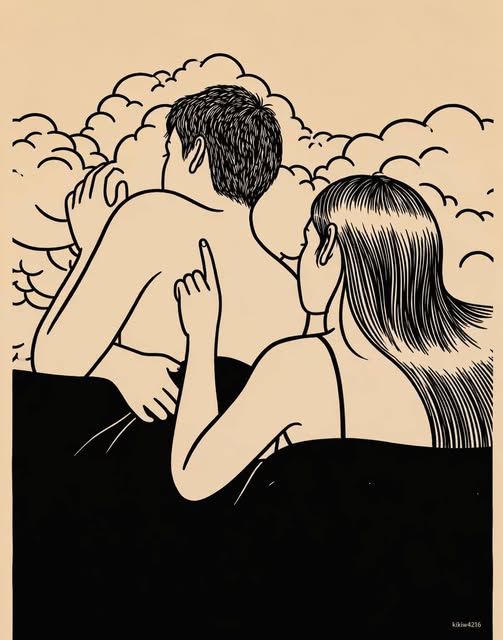
Few moments in a relationship feel as quiet—and as revealing—as the ones that happen just before sleep. The lights are off, conversation fades, and the outside world recedes. In that stillness, even the smallest movement can seem significant. A shift of the shoulder, a subtle repositioning, or a partner turning their back can suddenly feel loaded with meaning.
It’s a common experience: you’re lying beside your partner, and they turn away, facing the opposite direction. Instantly, questions begin to surface. Are they upset? Are they distancing themselves? Does this mean something about how they feel?
While these thoughts are natural, they often say more about our instincts than about the actual situation. The truth is far less dramatic—and far more reassuring.
Sleep Is About the Body First, Not the Relationship
The most important thing to understand is that sleep is primarily a biological process. When the body prepares for rest, it prioritizes comfort, recovery, and regulation. Heart rate slows, breathing deepens, and muscles begin to relax. The brain shifts focus from conscious thought to restoration.
In this state, positioning becomes a matter of physical need rather than emotional expression.
Turning away from a partner is often simply the body’s way of finding the most comfortable posture. It might relieve pressure on the spine, reduce strain on the neck, or allow for better breathing. For many people, side sleeping—often facing outward—is the most natural and sustainable position.
In other words, the body is solving a physical problem, not sending a message.
The Role of Comfort and Habit
Over time, people develop preferred sleeping positions. These habits can be shaped by years of experience, physical conditions, or even subconscious patterns formed in childhood. Once the body finds a position that promotes deep, uninterrupted sleep, it tends to return to it consistently.
Turning one’s back may simply be part of that routine.
Temperature also plays a major role. Human bodies generate heat, and sharing a bed can intensify that warmth. Facing outward can help regulate temperature, allowing cooler air to reach the face and chest. For some individuals, this makes a noticeable difference in sleep quality.
There are also practical considerations. Breathing comfort, sensitivity to movement, and even mattress type can influence positioning. A partner who tosses and turns may unintentionally encourage the other to face away to avoid disruption.
None of these reasons are emotional—they are functional.
Why It Feels Personal
Despite these practical explanations, the reaction to a turned back often feels deeply emotional. This happens because, in the absence of conversation, the mind searches for meaning.
Humans are wired to interpret body language. During the day, we rely on facial expressions, tone of voice, and gestures to understand others. At night, those cues disappear. What remains is posture.
A turned back, in waking life, can sometimes signal disengagement or withdrawal. So when that same posture appears in bed, the brain connects it to similar meanings—even if the context is entirely different.
This is where misunderstanding begins.
When It Might Reflect Emotional Space
While most sleep positions are driven by comfort, there are situations where changes in nighttime behavior can reflect emotional shifts.
If a couple typically falls asleep facing each other or in close contact, and one partner suddenly and consistently turns away following tension or conflict, it could indicate a need for space. Not necessarily rejection, but processing.
Sleep is a vulnerable state. When someone feels emotionally overwhelmed, they may unconsciously create physical distance as a way to regulate themselves. This is not unusual, and it is often temporary.
However, it’s important to look at the bigger picture.
A single behavior—like turning away—rarely tells the whole story. Emotional distance, when it exists, tends to show up in multiple ways:
- Less communication during the day
- Reduced physical affection
- Avoidance of shared activities
- Irritability or withdrawal
Without these accompanying signs, a sleep position alone is not a reliable indicator of relationship issues.
The Surprising Meaning of Back-to-Back Sleeping
Interestingly, many relationship experts view back-to-back sleeping not as a negative sign, but as a positive one.
Couples who sleep this way often maintain some level of physical contact—touching backs, legs, or feet—while still facing opposite directions. This position reflects a balance between closeness and independence.
It suggests comfort.
When partners feel secure in their relationship, they don’t need to maintain constant physical connection to feel close. They trust the bond enough to relax fully, even if that means turning away.
In long-term relationships, this kind of ease is common. The need for continuous face-to-face positioning often fades, replaced by a more natural, flexible approach to physical space.
In this sense, turning away can actually signal stability rather than distance.
Individual Differences Matter
Every person has unique preferences when it comes to sleep and physical closeness.
Some individuals find comfort in constant contact—arms wrapped around each other, facing inward, maintaining connection throughout the night. Others prefer a sense of personal space, even within intimacy.
Neither approach is better or healthier. They are simply different.
Problems arise only when these preferences are misunderstood.
If one partner interprets space as rejection, while the other sees it as comfort, tension can develop—not because of the behavior itself, but because of the meaning assigned to it.
This is why communication is so important.
The Power of a Simple Conversation
If a turned back triggers concern, the most effective response is not assumption, but curiosity.
A gentle question can quickly clarify the situation:
“Hey, I noticed you’ve been turning away when we fall asleep—are you more comfortable that way?”
In most cases, the answer will be simple and reassuring. Perhaps they’re avoiding shoulder pain. Maybe they sleep better on one side. Maybe they didn’t even realize they were doing it.
What feels significant internally often has a very ordinary explanation externally.
By addressing the question directly, uncertainty is replaced with understanding.
Sleep Quality and Relationship Health
It’s also worth considering the broader impact of sleep on a relationship.
Quality rest is essential for emotional regulation, patience, and communication. A well-rested person is more likely to be attentive, responsive, and engaged. Poor sleep, on the other hand, can lead to irritability, misunderstandings, and increased conflict.
If turning away helps someone sleep better, it ultimately benefits the relationship.
Prioritizing comfort at night is not a sign of disconnection—it’s a form of self-care that supports connection during the day.
The Danger of Overinterpretation
One of the most common pitfalls in relationships is overanalyzing isolated behaviors.
A single moment, taken out of context, can easily be misinterpreted. The mind fills in gaps, often leaning toward negative explanations. This tendency is amplified in quiet moments, like bedtime, when there are fewer distractions.
But relationships are not defined by single actions. They are shaped by patterns over time.
Warmth, affection, communication, and shared experiences during waking hours carry far more weight than a sleep position.
Trusting the Bigger Picture
Instead of focusing on one behavior, it’s more helpful to ask:
How do we connect during the day?
Do we communicate openly?
Do we show care and affection?
Do we feel secure with each other?
If the answers to these questions are positive, then a turned back at night is unlikely to hold deeper meaning.
It becomes just another detail—one of many small, practical choices the body makes without intention.
The Quiet Strength of Comfortable Love
There is something quietly powerful about a relationship where both partners can fall asleep in whatever position feels right.
It reflects trust.
It shows that connection does not depend on constant physical alignment. That closeness exists beyond posture. That love is not measured by whether two people face each other in the dark.
Sometimes, the most genuine form of intimacy is the ability to relax completely—without needing to perform closeness.
Final Thoughts
A partner turning their back while sleeping can feel significant in the moment. It can trigger questions, doubts, and interpretations that seem convincing in the quiet of the night.
But in most cases, the explanation is simple.
It’s about comfort.
It’s about habit.
It’s about the body doing what it needs to rest.
While body language can carry meaning, it must always be understood in context. A single sleep position, on its own, rarely reflects emotional distance or hidden issues.
What matters far more is what happens when the lights are on—how partners speak, connect, and support each other in everyday life.
Because in the end, a healthy relationship is not defined by how two people face each other while sleeping.
It’s defined by how they show up for each other when they’re awake.