The enduring popularity of Wheel of Fortune is not built solely on its iconic spinning wheel or the satisfying reveal of letters across its puzzle board. Instead, its lasting appeal comes from something far more human: the quiet, persistent tension that unfolds as everyday contestants are placed under extraordinary pressure. Each episode is a blend of strategy, instinct, timing, and composure, where even the smallest decision can shift the outcome. While many episodes follow a familiar rhythm, occasionally one stands out—transforming a routine broadcast into a memorable display of suspense, skill, and emotional stakes.
In this particular episode, that transformation came through the performance of a contestant named Adam Wredberg. From the opening moments, it was clear that he possessed a strong grasp of the game’s mechanics. His early success in solving the first puzzle was more than just a win—it was a statement. Establishing momentum at the beginning of the game is crucial, as it sets both the financial and psychological tone. By stepping ahead quickly, he not only built his score but also placed subtle pressure on his competitors, who were left trying to catch up in an environment where opportunities can vanish in a single spin.
The structure of the game rewards consistency, and Adam demonstrated that quality throughout the early rounds. Rather than relying on risky spins or bold, uncertain guesses, he maintained a measured approach. This strategy often goes unnoticed compared to more dramatic gameplay, but it is frequently the foundation of success. Knowing when to guess, when to pass, and when to take calculated risks requires both awareness and discipline. It is easy, under the glare of studio lights and the presence of a live audience, to become overconfident or overly cautious. Striking the right balance is what separates strong contestants from the rest.
The Mystery Round further highlighted his ability to manage risk. This segment introduces an added layer of uncertainty, tempting players with hidden rewards while also threatening sudden setbacks. Choosing whether to flip a Mystery wedge involves weighing potential gains against possible losses—a decision that must be made quickly and confidently. Adam navigated this challenge with composure, successfully increasing his total winnings while avoiding the pitfalls that often derail contestants. Moments like these reveal how much of the game extends beyond vocabulary; it becomes a test of decision-making under pressure.
As the game progressed, his steady performance translated into a commanding lead. Unlike some contestants who rely on late surges, he built his advantage incrementally, puzzle by puzzle. This methodical accumulation of points created a buffer that allowed him to play with a degree of control. Even when faced with uncertainty, he did not appear rattled. His demeanor remained calm, focused, and deliberate—a reflection of someone who understood not just the rules of the game, but its rhythm.
However, the very nature of Wheel of Fortune ensures that no lead is ever entirely secure. The game’s design introduces elements of chance that can quickly alter the scoreboard. A single unlucky spin can wipe out earnings, while a fortunate turn can propel another contestant forward. This unpredictability is part of what keeps both players and viewers engaged. It creates an environment where every decision carries weight, and where even the most confident lead must be defended until the very end.
By the time Adam secured his place in the Bonus Round, he had already delivered a performance that many contestants aspire to achieve. Yet, reaching this stage is only part of the challenge. The Bonus Round represents a shift in pace and intensity, compressing the experience into a brief, high-pressure moment. Unlike the earlier rounds, where players have time to build momentum, the final puzzle demands immediate clarity and quick thinking.
Standing at the center of the stage, often accompanied by supportive family members, contestants face a unique kind of pressure. The stakes are higher, the time is shorter, and the margin for error is virtually nonexistent. The selection of a category becomes a critical choice, shaping how the puzzle is interpreted and influencing the strategy for choosing additional letters. Even seasoned viewers can feel the tension rise during these moments, as the outcome hinges on a matter of seconds.
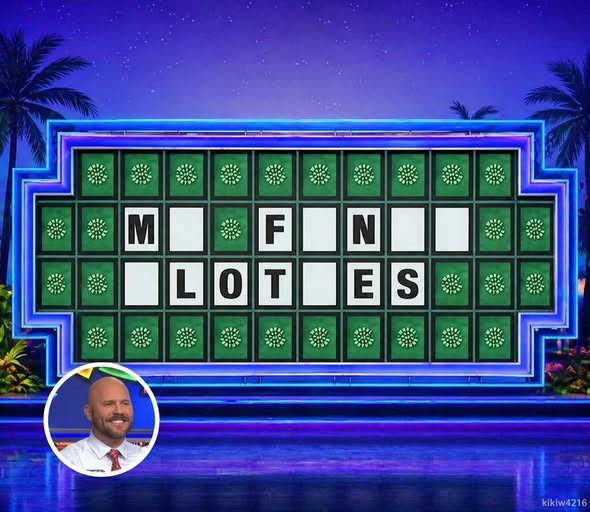
In this episode, the Bonus Round puzzle introduced a level of complexity that sparked immediate discussion among viewers. The partially revealed phrase seemed, at first glance, solvable. Yet as the seconds ticked away, it became clear that the puzzle contained subtle challenges. Language, by its nature, allows for multiple interpretations, and the arrangement of letters can suggest several plausible answers. Under normal circumstances, a contestant might have the time to explore these possibilities. In the Bonus Round, however, hesitation can be costly.
Adam’s attempt to solve the puzzle reflected both his preparation and the inherent difficulty of the challenge. He worked through the available letters, trying to bridge the gaps with logical guesses. For a moment, it seemed as though he might succeed, that the puzzle would come together just in time. But as the final seconds expired, the correct phrase remained just out of reach. It was a near miss—a moment where success felt tangible, only to slip away at the last instant.
This outcome underscored one of the defining characteristics of Wheel of Fortune: the razor-thin line between victory and disappointment. The difference between solving a puzzle and falling short can be as small as a single letter or a fleeting hesitation. For contestants, this reality adds an emotional dimension to the game. For viewers, it creates a shared experience of anticipation and reaction, as they mentally engage with the puzzle alongside the player.
The aftermath of the Bonus Round often extends beyond the immediate result. Episodes like this tend to spark debate among audiences, with viewers offering differing opinions on what could have been done differently. Some argue that the puzzle was straightforward, that the answer should have been apparent. Others contend that the phrasing was deceptively tricky, especially under the constraints of time. These discussions are part of what keeps the show relevant, as they invite audiences to participate in the experience even after the episode has ended.
It is also worth considering the psychological aspect of these high-pressure moments. Contestants must manage not only the challenge of the puzzle but also the awareness of being watched by millions of viewers. The presence of cameras, lights, and an audience creates an environment that is far removed from everyday life. Even individuals who are confident and articulate in normal settings can find themselves second-guessing their instincts. The ability to remain composed under such conditions is a skill in itself—one that cannot be fully replicated through practice alone.
Adam’s performance, despite the final outcome, serves as a reminder of what makes the show compelling. Success on Wheel of Fortune is not solely defined by winning the Bonus Round. It is also measured by the journey—by the decisions made, the challenges navigated, and the moments of tension that captivate both players and viewers. His steady gameplay, strategic awareness, and near victory contributed to an episode that stood out from the ordinary.
The broader appeal of the show lies in its simplicity combined with depth. On the surface, it is a word puzzle game, accessible and easy to understand. Beneath that simplicity, however, is a complex interplay of factors: probability, psychology, language, and human emotion. Each spin of the wheel carries uncertainty, each guess reflects a calculation, and each puzzle represents a test of both knowledge and intuition.
Over the years, Wheel of Fortune has maintained its place as one of television’s most enduring game shows precisely because of this balance. It offers familiarity while still allowing for variation. No two episodes are exactly alike, and every contestant brings a unique approach to the game. This combination of consistency and unpredictability keeps audiences engaged, even after decades on air.
Episodes like this one highlight how even a near win can leave a lasting impression. The emotional arc—from early success to final challenge—creates a narrative that resonates with viewers. It reflects a universal experience: striving toward a goal, coming close, and grappling with the outcome. Whether the result is triumph or disappointment, the journey itself becomes meaningful.
In the end, the significance of this episode extends beyond the individual performance. It reinforces the idea that compelling television does not always require dramatic twists or unexpected outcomes. Sometimes, it is the subtle interplay of skill, chance, and human emotion that creates the most memorable moments. A single contestant, navigating the pressures of the game, can transform a familiar format into something that feels fresh and engaging.
As audiences continue to tune in, drawn by the promise of puzzles and prizes, it is these moments of tension and near victory that sustain the show’s legacy. They remind us that even in a game built on letters and luck, the most important element is the human experience at its core.