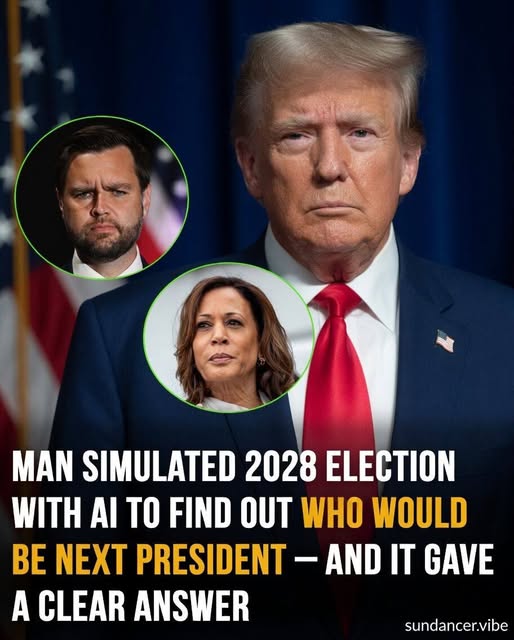
A recent AI-driven simulation attempting to forecast the 2028 United States presidential election has ignited widespread discussion across political circles, media platforms, and online communities. While such projections are far from definitive, the scenario it outlines offers a compelling snapshot of how current political dynamics might evolve over the next several years. By examining patterns in voter behavior, public sentiment, and the positioning of key political figures, the model presents a hypothetical but thought-provoking narrative of what could unfold once Donald Trump’s current political era comes to an end.
At the center of this simulated political landscape are two prominent Republican figures: JD Vance and Marco Rubio. Both represent different facets of the modern Republican Party, and the AI model highlights how their respective roles could shape their chances in a future primary contest. On the Democratic side, the simulation points to Gavin Newsom as a likely nominee, with a narrow edge in a projected general election scenario.
What makes this projection particularly interesting is not the claim that it predicts a specific outcome, but rather how it frames the variables that could influence the race. Unlike traditional polling, which captures a moment in time, AI simulations attempt to extrapolate forward by identifying trends and assigning probabilities. In doing so, they offer a structured way to explore possibilities—even if those possibilities remain highly uncertain.
The Republican Landscape: Continuity vs. Repositioning
Within the Republican Party, the contrast between JD Vance and Marco Rubio reflects a broader tension between continuity and repositioning. Vance, as a figure closely aligned with Trump’s political movement, benefits from strong name recognition and a loyal base of support. His proximity to the current administration, particularly if he continues to play a prominent role, gives him a level of visibility that is difficult for other contenders to match.
However, the same closeness that provides advantages could also present challenges. The simulation suggests that being directly associated with Trump’s presidency means sharing both its successes and its controversies. If the administration navigates the coming years smoothly, that association could strengthen Vance’s position. But if difficulties arise—whether economic, political, or international—those same ties could become a liability.
Marco Rubio, by contrast, represents a different strategic position. His experience in foreign policy and his potential to shape a narrative less tied to domestic controversies could offer him a distinct advantage. The AI model indicates that Rubio’s ability to frame himself as both experienced and somewhat independent from the core of Trump-era politics might resonate with voters seeking stability without complete continuity.
Despite this, the simulation still leans slightly in favor of Vance as the early frontrunner. The reasoning is grounded in historical patterns: candidates who are closely associated with a sitting administration often enjoy a head start in terms of recognition, fundraising, and institutional support. Yet the model emphasizes that this advantage is far from secure. Political momentum can shift rapidly, and even small changes in public perception can alter the trajectory of a primary race.
The Enduring Influence of Donald Trump
One of the most significant factors identified in the simulation is the continued influence of Donald Trump. Even after leaving office, his role within the Republican Party is expected to remain substantial. The AI suggests that a Trump endorsement could play a decisive role in determining the party’s nominee, underscoring the enduring strength of his political brand.
This influence extends beyond individual endorsements. Trump’s impact on the party’s identity, messaging, and voter base is likely to shape the broader context in which candidates operate. For figures like Vance, who are closely aligned with Trump’s approach, this environment may be particularly advantageous. For others, such as Rubio, it presents a more complex challenge: how to appeal to the existing base while also broadening their support.
The simulation also raises an important question about the future direction of the Republican Party. Will it continue along the path defined during Trump’s presidency, or will it gradually evolve into something different? The answer to this question could have a profound impact on the 2028 election, influencing not only who becomes the nominee but also how the party positions itself in the general election.
The Democratic Scenario: Gavin Newsom’s Position
On the Democratic side, the AI model identifies Gavin Newsom as a leading contender. This projection is based less on specific policy positions and more on broader factors such as visibility, communication style, and perceived ability to represent a shift in tone. In a political environment characterized by intense polarization, the idea of a candidate who can present a different kind of narrative holds significant appeal.
The concept of “political fatigue” plays a central role in this part of the simulation. After years of highly charged political discourse, voters may begin to gravitate toward candidates who offer a sense of change—not necessarily in ideology, but in style and approach. Newsom, in this scenario, is seen as someone who could capitalize on that sentiment.
However, the model does not suggest that a Democratic victory would be decisive or guaranteed. On the contrary, it emphasizes that the general election would likely be highly competitive, with margins that could shift based on relatively small changes in voter turnout or public opinion. This reflects a broader trend in recent U.S. elections, where closely contested races have become increasingly common.
The Role of Voter Sentiment and Political Fatigue
Perhaps the most intriguing aspect of the simulation is its focus on voter psychology. Rather than concentrating solely on policy differences or campaign strategies, the model places significant weight on how voters feel. Concepts like fatigue, trust, and perception are treated as key variables, influencing how individuals respond to candidates and issues.
Political fatigue, in particular, is presented as a powerful force. After multiple election cycles marked by intense polarization and constant media attention, some voters may seek a change in tone. This does not necessarily mean a shift in political alignment, but rather a desire for a different kind of leadership experience.
At the same time, the simulation acknowledges that fatigue can manifest in different ways. For some voters, it may lead to disengagement, reducing turnout and making outcomes less predictable. For others, it could increase motivation to support a candidate who represents change. Understanding how these dynamics interact is crucial to interpreting the model’s conclusions.
The Limits of AI Predictions
Despite its detailed analysis, the simulation comes with important limitations. AI models are only as good as the data they are trained on, and the further they attempt to project into the future, the greater the uncertainty becomes. In the case of the 2028 election, there are simply too many unknowns to make any definitive claims.
Economic conditions, for example, could shift dramatically over the next few years, influencing voter priorities and perceptions of leadership. International events could reshape the political landscape in ways that are impossible to predict. Even the candidates themselves may change their positions, strategies, or decisions in response to evolving circumstances.
Moreover, the model cannot account for unexpected events—so-called “black swans”—that have historically played a significant role in shaping elections. From economic crises to global conflicts, such events can alter the course of political history in ways that no algorithm can fully anticipate.
Why These Projections Still Matter
Given these limitations, it might be tempting to dismiss AI election forecasts altogether. However, doing so would overlook their value as analytical tools. Rather than providing answers, they help frame questions. By highlighting key variables and exploring how they might interact, these models encourage deeper التفكير about the factors that drive political outcomes.
In this sense, the simulation serves as a kind of thought experiment. It invites observers to consider how current trends could evolve and what that might mean for the future. It also underscores the complexity of modern elections, where outcomes are shaped by a wide range of interconnected factors.
For political strategists, journalists, and engaged citizens, this kind of analysis can be useful in identifying areas of uncertainty and potential change. It can also help to challenge assumptions, prompting a more nuanced understanding of the political landscape.
A Fluid and Unpredictable Future
Ultimately, the key takeaway from this AI-generated scenario is not who might win in 2028, but how unpredictable the path to that election will be. While figures like JD Vance, Marco Rubio, and Gavin Newsom may currently appear as leading contenders, the reality is that political fortunes can rise and fall quickly.
New candidates could emerge, reshaping the dynamics of both parties. Existing figures could experience shifts in public perception, either strengthening or weakening their positions. External events could redefine the issues that matter most to voters, altering the priorities that drive decision-making.
Even the role of technology itself is likely to evolve. As AI continues to develop, its influence on political analysis, campaigning, and communication could become more pronounced. This adds another layer of complexity to an already intricate process.
Conclusion
The AI simulation of the 2028 U.S. presidential election offers a fascinating glimpse into how the future might unfold, but it should be approached with careful consideration. It is not a prediction in the traditional sense, but rather a structured exploration of possibilities based on current data and trends.
By focusing on figures like Donald Trump, JD Vance, Marco Rubio, and Gavin Newsom, the model highlights the importance of leadership, narrative, and voter sentiment in shaping political outcomes. At the same time, it reminds us that these factors are constantly evolving, influenced by events and decisions that cannot be fully anticipated.
In the end, the value of such simulations lies not in their ability to predict the future, but in their capacity to deepen our understanding of the present. They encourage us to think critically about the forces shaping politics and to recognize the uncertainty that defines any attempt to look ahead.
As the 2028 election approaches, the political landscape will continue to change in ways both expected and surprising. And while AI may help illuminate some of those possibilities, the final outcome will ultimately be determined by the complex, unpredictable interplay of people, events, and ideas that define democracy itself.