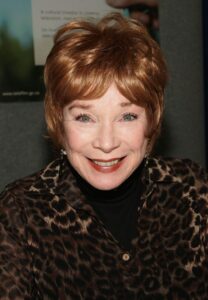
Few figures in the history of film and entertainment have managed to sustain relevance, admiration, and individuality across as many decades as Shirley MacLaine. At 91 years old, she stands not only as a symbol of longevity in Hollywood, but as a testament to something far more meaningful—authenticity. In an industry often driven by fleeting trends and an intense focus on youth, she represents a rare kind of endurance, one rooted not in appearance alone, but in presence, confidence, and an unwavering commitment to being herself.
Her story is not simply about fame or success. It is about evolution. It is about the willingness to grow, to change perspectives, and to embrace every stage of life without apology. While discussions about aging, beauty standards, and cosmetic procedures continue to dominate public conversations, her journey offers a broader, more thoughtful perspective—one that acknowledges both personal choice and self-acceptance without contradiction.
Born in 1934, her early life was shaped by creativity and discipline. Growing up in an environment where performance and expression were encouraged, she developed an interest in the arts at a young age. Ballet, in particular, played a significant role in her childhood. Starting at just three years old, she immersed herself in the demanding world of dance, learning lessons that would stay with her long after she stepped away from the studio.
Ballet is not simply about movement—it is about control, resilience, and endurance. It requires a deep level of commitment, often demanding more from the body and mind than most people realize. For a young girl, this discipline instilled habits that would later define her approach to acting and life itself. Precision, patience, and the ability to push through discomfort became second nature to her, forming a foundation that would support her through the unpredictable nature of the entertainment industry.
After completing her early education, she made the decision to pursue her dreams more seriously by moving to New York City. At the time, this was not an easy or guaranteed path. The world of performance was competitive, uncertain, and often unforgiving. Yet, for her, it felt like the only natural direction to take. She had already developed a sense of independence and self-trust that allowed her to step into the unknown without hesitation.
Her breakthrough came in a way that perfectly captures the unpredictable nature of opportunity. While working as an understudy in a Broadway production, she was suddenly called upon to step into a leading role due to an unexpected absence. It was the kind of moment that tests not just talent, but readiness. She delivered a performance that immediately drew attention, demonstrating not only skill but a distinctive presence that set her apart.
From there, her transition into film was swift. Her early roles showcased a combination of charm, intelligence, and emotional depth that resonated with audiences. She did not conform to the traditional expectations of what a leading actress should be at the time. Instead, she brought something different—something more nuanced and authentic. This uniqueness became one of her greatest strengths, allowing her to carve out a place in an industry that often favors familiarity over individuality.
As her career progressed, she continued to build an impressive body of work. Her performances reflected a wide range of emotions and experiences, demonstrating her ability to adapt and evolve as both an actress and a person. She was not defined by a single role or genre. Instead, she embraced complexity, taking on characters that challenged both herself and the audience.
Recognition followed naturally. Awards, nominations, and critical acclaim became part of her journey, but they never seemed to define her entirely. What stood out more was her consistency—the ability to remain relevant across changing eras, shifting expectations, and evolving cultural landscapes. While many careers fade with time, hers adapted, finding new ways to connect with audiences across generations.
Yet, beyond her professional achievements, it is her personal outlook that continues to capture attention.
In a culture that often treats aging as something to resist or conceal, she has approached it with honesty. She has spoken openly about her experiences, including her decision to undergo a facelift earlier in life. Rather than framing it as something to hide or regret, she has presented it simply as a choice—one made at a particular moment, influenced by the circumstances and mindset of that time.
This openness is significant. In an industry where appearance is closely scrutinized, many individuals feel pressure to maintain a certain image. Decisions about cosmetic procedures are often kept private or denied altogether. By speaking candidly, she removes some of that stigma, allowing for a more balanced conversation about personal choice and societal expectations.
At the same time, her perspective has evolved. Over the years, she has expressed a growing appreciation for natural aging. Wrinkles, once seen by many as imperfections, have become, in her view, a reflection of experience—evidence of a life lived fully. This shift highlights an important truth: our relationship with ourselves changes over time. What feels important in one phase of life may become less so in another.
This ability to adapt—to reassess, to grow, to let go of previous concerns—is one of the defining qualities of her journey. It reflects a deeper understanding of identity, one that is not fixed but continuously shaped by experience.
Even at 91, she remains active and engaged. While many people step away from demanding careers at a much earlier stage, she continues to explore new opportunities, demonstrating that passion does not have an expiration date. Her ongoing involvement in creative work is not just impressive—it is inspiring. It challenges the idea that age should limit ambition or curiosity.
Her daily life also reflects a sense of balance that is often overlooked in discussions about success. Rather than focusing solely on achievements or recognition, she has emphasized the importance of personal fulfillment. Travel, reflection, and simple pleasures have played a central role in her life, providing a sense of grounding that complements her professional accomplishments.
This perspective offers an important lesson. Success is not only about what we achieve, but about how we experience our lives. It is about the freedom to explore, to learn, and to find meaning beyond external validation.
In many ways, her story serves as a counter-narrative to the dominant messages often associated with aging in the public eye. Instead of presenting it as a decline, she demonstrates that it can be a period of continued growth, exploration, and self-discovery. Her life shows that vitality is not defined by youth, but by engagement—by the willingness to remain curious, active, and open to new experiences.
There is also a deeper layer to her enduring appeal.
Authenticity.
In an environment where image is carefully curated and often controlled, she has maintained a sense of honesty that feels rare. She does not attempt to fit into expectations that do not align with her identity. Instead, she moves through life on her own terms, guided by her own values.
This authenticity resonates across generations. Younger audiences see in her a model of independence and self-acceptance. Older audiences recognize the strength required to maintain that identity over time. In both cases, the message is clear: living authentically is not always easy, but it is deeply rewarding.
Her legacy, therefore, is not limited to her roles or accolades. It extends into the broader cultural conversation about what it means to age, to evolve, and to remain true to oneself. She represents the idea that life does not lose its richness with time—in many ways, it gains depth.
As society continues to grapple with questions about beauty, relevance, and the passage of time, her story offers a different perspective. It suggests that the focus should not be on preserving youth at all costs, but on embracing each stage of life with curiosity and confidence.
At 91, she is not simply a figure from the past.
She is a living example of what it means to continue forward.
To remain engaged.
To keep exploring.
To keep becoming.
And perhaps most importantly, to do so without losing sight of who you are.
In the end, what makes her truly remarkable is not just her longevity or her achievements, but her approach to life itself. She reminds us that aging is not something to fear or resist, but something to understand, to accept, and ultimately, to embrace.
Because a life well-lived is not measured by how long we appear unchanged, but by how fully we allow ourselves to grow.
And in that sense, her story continues—not as a reflection of the past, but as an ongoing journey that still has more to offer.