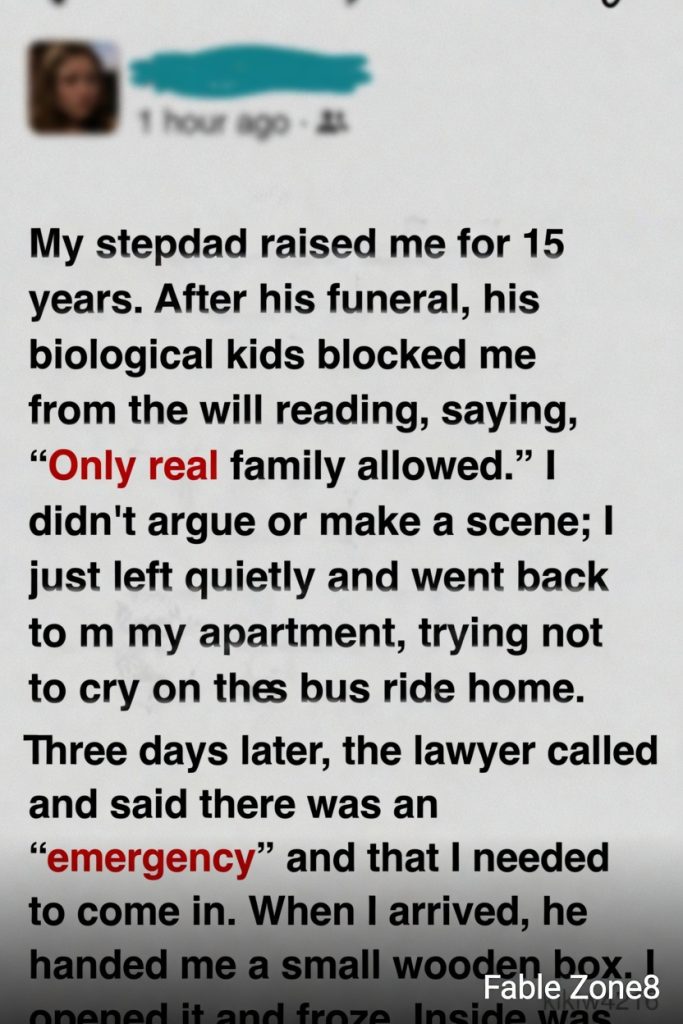
They didn’t raise their voices when they told me to leave.
That would have been easier to process—anger is at least clear, direct, something you can respond to. Instead, their words were calm, controlled, almost rehearsed.
“Only real family is allowed inside.”
For a moment, I thought I had misheard them. The hallway outside the lawyer’s office was quiet, the kind of silence that makes everything feel more permanent. I looked from one face to another, searching for hesitation, for doubt, for anything that suggested this was a misunderstanding.
There was none.
They stood there—his children by blood, people I had shared a home with for years—forming a quiet barrier between me and the room where his life was being summarized into legal language. Their expressions were not cruel. If anything, they were distant, as though this decision had already been settled long before I arrived.
I could have argued.
I could have reminded them of the years we spent under the same roof, of the routines we shared, of the man we all claimed to know. I could have listed every moment that proved I belonged there just as much as they did.
But something inside me resisted that instinct.
Because belonging, I realized in that moment, should not have to be proven in a doorway.
So I nodded, stepped back, and left.
The walk away from that building felt longer than it should have been. Not because of the distance, but because of what it represented. Each step carried a question I had never allowed myself to fully ask before:
Had I imagined my place in his life?
Grief has a way of distorting everything. It doesn’t just take the person you’ve lost—it reshapes your understanding of what you had with them. Sitting on the bus, staring out at streets I barely registered, I felt something heavier than sadness.
I felt erased.
Not by him—but by the people who believed they had the authority to define what he meant to me.
He had never used the word “step.”
Not once.
From the moment he entered my life, there was no distinction, no careful boundary that separated me from something more “real.” He didn’t treat me like an addition to his world. He made space for me within it, naturally, without hesitation.
He was there in ways that didn’t draw attention to themselves.
Standing behind me as I learned to ride a bike, his hand hovering just close enough to catch me if I fell. Sitting beside me at the kitchen table, turning numbers into something that finally made sense after hours of quiet patience. Checking the locks at night, not because I asked, but because he knew it made me feel safe.
There were no grand speeches.
No declarations.
Just consistency.
The kind that builds trust so slowly, so steadily, that you don’t notice it forming until it becomes something you rely on completely.
At his funeral, people spoke about him with admiration.
They talked about his career, his discipline, his reputation. They described a man who had earned respect in every room he entered.
And they were right.
But as I listened, I felt a strange distance from their version of him. It wasn’t wrong—it was just incomplete.
They didn’t talk about the man who noticed when I was pretending to be okay. The one who sat on the edge of my bed when something felt too heavy to carry alone. The one who never made me feel like I had to earn my place in his life.
Their stories were polished.
Mine were personal.
And in that crowded room, surrounded by people who knew him, I realized how differently one person can exist in many lives at once.
The days after the will reading passed in a kind of quiet suspension.
I moved through routines without fully engaging with them. Simple tasks felt distant, like they belonged to someone else’s life. Every now and then, the memory of that hallway returned—the calm dismissal, the certainty in their voices.
“Not real family.”
The words lingered, not because I believed them, but because they forced me to question something I had always taken for granted.
What defines family?
Is it blood?
Shared history?
Recognition from others?
Or is it something quieter, less visible, but far more enduring?
Three days later, my phone rang.
The lawyer’s voice was measured, careful.
“There’s something you need to come in for,” he said.
He didn’t explain further.
And somehow, that made it feel more significant.
When I arrived, the office was different from what I remembered.
Quieter.
Empty.
There was no tension in the air, no unspoken hierarchy determining who belonged where. Just a stillness that felt deliberate.
He greeted me, asked me to sit, and disappeared briefly into another room.
When he returned, he was holding a small wooden box.
It wasn’t ornate. In fact, it looked worn, as though it had been handled often over the years. He placed it gently in front of me, his expression shifting slightly—softer now, almost respectful.
“This was left for you,” he said.
“For you specifically.”
My hands hesitated before opening it.
Not because I was afraid of what was inside, but because I already sensed that whatever it contained would matter in a way I wasn’t prepared for.
Inside were photographs.
Simple ones—moments that had never been framed or displayed, but carefully kept. There we were by the river, both of us smiling in that unguarded way that only happens when you’re not aware of being photographed. Another showed me holding up something small and insignificant, while he looked at me as if it were the greatest achievement in the world.
Beneath them were school papers, certificates I barely remembered earning.
But he had kept them.
All of them.
As if they meant something more than the moment they represented.
And then there were the letters.
One for every year.
Each written in his handwriting—steady, familiar, unmistakably his.
I opened the first one slowly, unsure of what I would find.
What I found was him.
Not the version people described at the funeral.
Not the one defined by accomplishments or reputation.
But the one I had known all along.
He wrote about watching me grow. About the moments he worried, the ones that made him proud, the times he didn’t have the right words but stayed anyway.
He didn’t describe his role as something he had taken on.
He described it as something he had chosen.
Again and again.
By the time I reached the last letter, my understanding of everything that had happened began to shift.
The exclusion.
The doubt.
The quiet question of whether I had imagined my place in his life.
All of it started to lose its weight.
Because his words made one thing unmistakably clear:
I had never been an outsider in his world.
Not even for a moment.
At the bottom of the box was a copy of the will.
I unfolded it carefully, aware that whatever it said would either confirm what I had felt—or challenge it completely.
The language was simple.
Direct.
Everything was to be divided equally between his children.
All three of them.
Including me.
There was no hesitation in the wording.
No condition.
No explanation needed.
Just a decision that had been made long before anyone else had the chance to question it.
The lawyer confirmed it quietly.
“This was always his intention,” he said.
I left the office holding the box close, not because of what it contained, but because of what it represented.
Clarity.
Not about money.
Not about validation from others.
But about something far more important.
Love does not need to be announced to be real.
It does not rely on recognition, approval, or agreement.
It exists in the quiet, consistent choice to show up.
In the moments no one else sees.
In the years that pass without acknowledgment.
They had called me “not real family.”
But he had never needed to say otherwise.
He had lived it.
Every day.
And in the end, that mattered more than any room I was kept out of.
Because belonging is not decided in a doorway.
It is built over time.
And once it is real, it does not disappear just because someone else fails to recognize it.
I was never outside his life.
I was part of it.
Not by accident.
Not by circumstance.
But by choice.
And that is the kind of family no one can take away.