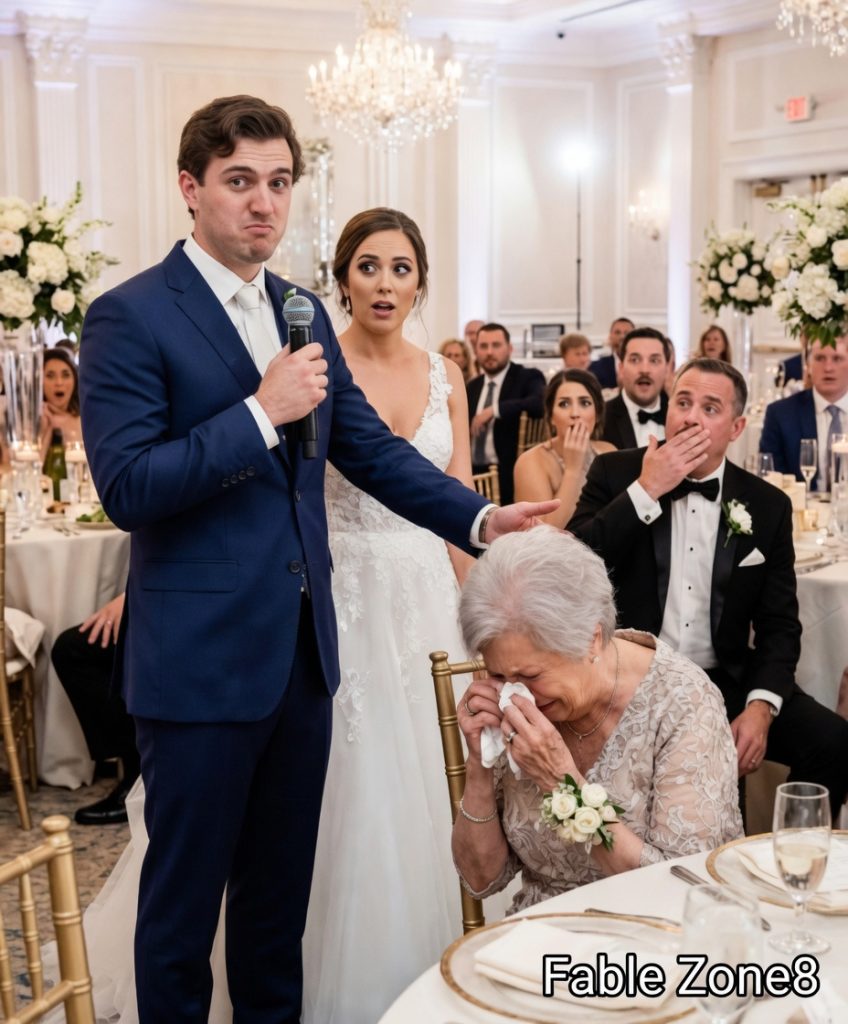
Stephanie had spent most of her life mastering the art of quiet endurance.
By the time she turned seventy, she had become the kind of woman people described with soft, dismissive admiration—“kind,” “selfless,” “always there.” What they rarely understood was the cost of becoming that person. It was not a natural state. It was built over decades of choosing others first, of swallowing disappointment, of telling herself that love meant giving more even when there was little left to give.
So when her son stood beneath the soft glow of crystal chandeliers on his wedding day and publicly thanked another woman as his “real mother,” something inside Stephanie did not break.
It clarified.
She sat perfectly still at her table, her posture unchanged, her expression calm. Around her, the room buzzed with discomfort disguised as celebration. Guests shifted in their seats, glancing between her and the elegantly dressed woman seated near the front—Carol, the woman Ethan had just honored.
No one approached Stephanie.
No one needed to.
They were waiting—for tears, for anger, for a scene that would make sense of what they had just witnessed.
But Stephanie gave them nothing.
Because for the first time in decades, she understood that her silence did not belong to them.
It belonged to her.
She met Ethan when he was five years old.
He had arrived at the shelter withdrawn and fragile, a child shaped by loss too early to understand it. His parents had died suddenly, leaving behind not just absence but confusion, fear, and a kind of emotional stillness that made other adults hesitate.
Stephanie didn’t hesitate.
At twenty-five, she had little to offer by conventional standards. She worked long shifts at a factory, lived in a cramped apartment, and counted every dollar. But she had something else—patience, steadiness, and a quiet kind of resilience that didn’t need to announce itself.
She took him home.
The early years were not easy. Ethan barely spoke at first. He resisted touch, avoided eye contact, and carried a constant tension in his small body as if bracing for something that never came. Stephanie adapted without complaint. She learned how to sit beside him without demanding conversation, how to offer comfort without overwhelming him, how to create a sense of safety that didn’t rely on words.
Progress came slowly, then all at once.
By the time he started school, Ethan was laughing again. By adolescence, he was confident, social, and increasingly independent. To the outside world, he was a success story—a boy who had overcome tragedy with the help of a devoted mother.
Stephanie never corrected anyone when they assumed she was his biological parent.
To her, it didn’t matter.
Love, she believed, was proven through presence, not biology.
But there were moments—small, sharp ones—that she chose to ignore.
At eighteen, after she showed him the official adoption papers, Ethan had shrugged and said casually, “I kind of figured you weren’t my real mom.”
It was not said with cruelty.
It was said with indifference.
And somehow, that hurt more.
Stephanie smiled, nodded, and carried on.
Because that was what she always did.
Years passed, and the balance in their relationship shifted in ways so gradual they were almost invisible.
Ethan built his life—college, career, relationships—while Stephanie remained the steady foundation beneath it all. She contributed where she could, often beyond what she could comfortably afford. Small financial help turned into larger sacrifices. Occasional support became expectation.
Still, she gave.
Because she believed that one day, it would be recognized—not with grand gestures, but with simple acknowledgment.
A thank you.
A moment of understanding.
Something that said: I see you.
The wedding was meant to be that moment.
She had contributed nearly everything she could—nineteen thousand dollars pulled from savings built over decades of careful living. It wasn’t just money. It was postponed dreams, skipped comforts, years of choosing practicality over desire.
She told no one.
Not Ethan. Not his fiancée. Not even herself, fully.
Because if she named the sacrifice, it might have felt too heavy.
And then came the speech.
“I want to thank my real mother—Carol—for making this day perfect.”
The words landed softly.
But their meaning echoed loudly.
Stephanie did not react—not because she didn’t feel it, but because she finally understood something she had avoided for years.
Recognition, when forced, is not real.
Love, when conditional, is not love.
And a lifetime of giving does not guarantee being seen.
The next morning, Ethan called.
His voice was casual, almost cheerful.
He spoke about future plans, about buying a house, about how Ashley’s family had covered the wedding and honeymoon.
“And we were thinking,” he added, “maybe you could help with the down payment. Just to make things fair.”
Fair.
The word lingered in the silence that followed.
Stephanie listened.
Then, calmly, she said, “I’ll think about it.”
It was the first boundary she had ever set with him.
And it felt unfamiliar—but right.
That night, she opened a box she had not touched in years.
Inside were documents—carefully preserved, quietly maintained. Investments. Land. Savings that extended far beyond what anyone, including Ethan, believed she had.
She had never revealed them.
Not out of secrecy, but out of habit.
She had spent so long being “less” in the eyes of others that she had never corrected the assumption.
But now, for the first time, she saw it differently.
She was not less.
She had simply chosen not to prove otherwise.
A few days later, she sat in a lawyer’s office.
Her voice was steady as she explained her wishes.
A trust would be established.
Ethan would not inherit automatically.
Any future support would be conditional—not on obedience or obligation, but on demonstrated change.
Not punishment.
Accountability.
When she signed the documents, she did not feel anger.
She felt clarity.
The calls began soon after.
At first, they were demanding. Then confused. Eventually, apologetic.
Stephanie listened to none of them.
Instead, she began to build something new.
Not a life defined by sacrifice—but one defined by choice.
She spent mornings in her small garden. Afternoons reading books she had long postponed. Evenings volunteering at the same shelter where she had first met Ethan.
For the first time in decades, her time belonged entirely to her.
And in that space, something unexpected happened.
She felt lighter.
When Ethan finally came to see her in person, his confidence had softened.
He spoke carefully, searching for the right words.
“I’m sorry,” he said.
Stephanie listened.
Not for the words—but for the understanding behind them.
When he finished, she spoke gently, but honestly.
She told him what it had felt like—to give everything and be erased in a single moment. To be present for every stage of his life, only to be acknowledged as optional when it mattered most.
He did not interrupt.
For once, he simply listened.
When he asked if she would reconsider the will, she shook her head.
“Some things,” she said quietly, “aren’t about money.”
In the years that followed, their relationship changed.
It became quieter. More honest. Less dependent on what she could give—and more grounded in who she was.
Ethan learned, slowly, to show up differently.
Not perfectly.
But genuinely.
And Stephanie continued to live a life that no longer revolved around being needed.
She traveled. Reconnected with old parts of herself. Found joy in small, intentional moments.
For the first time, she was not someone’s background.
She was her own center.
Looking back, she did not regret the years she had given.
They had shaped her, strengthened her, and taught her what love could be.
But she also understood something she wished she had learned sooner:
Love without boundaries becomes invisibility.
And being needed is not the same as being valued.
The day her son called another woman his “real mother” was not the day Stephanie lost something.
It was the day she stopped losing herself.
And in that quiet, unwavering decision to finally be seen—by herself first—she found something far more lasting than recognition.
She found her voice.