The morning of my wedding felt like the beginning of something sacred. It carried a quiet kind of beauty, the kind that doesn’t need to announce itself loudly to be felt deeply. Sunlight slipped gently through the curtains, casting a soft glow across the room as if the day itself had agreed to be kind. I remember sitting still for a moment before everything began, my wedding dress resting across my lap, my fingers tracing the intricate stitching as though trying to anchor myself in the reality of it all.
This was the day I had imagined countless times—not in a grand, unrealistic way, but in the steady, hopeful sense that one day I would stand at the edge of something meaningful and step forward with certainty. Every detail had been planned with care. The venue, the music, the flowers, even the smallest elements had been chosen to reflect not just beauty, but intention. It wasn’t about perfection—it was about meaning.
Friends and family filled the space with warmth. There was laughter, reassurance, and that subtle emotional undercurrent that exists when people gather for something that matters. I felt supported, held in a way that made everything seem aligned. My partner had always been someone who made me feel seen—attentive, affectionate, and confident in a way that drew people in. Our relationship had felt like something built thoughtfully, layer by layer, through shared conversations about the future and a mutual belief that we were moving toward the same life.
Even my older brother, who had always carried a quiet skepticism toward anyone I dated, had softened over time. He never fully let go of his protective instincts, but he showed up that day with a calm acceptance that meant more to me than any spoken approval. It was his way of saying he trusted me—even if he was still watching closely.
Walking down the aisle, I felt grounded. It wasn’t just about the person waiting for me at the end—it was about the life we were choosing to build together. The ceremony was everything I had hoped for: sincere, emotional, and deeply personal. When we exchanged vows, I believed them fully. I believed in us.
At that moment, nothing suggested that the day would hold anything other than joy.
The reception began like something out of a film. Music filled the air, glasses clinked in celebration, and conversations overlapped into a comforting hum. I moved from table to table, hugging relatives, thanking friends, trying to stay present in a moment that seemed to move faster than I could hold onto it.
Everything felt effortless.
My partner was at the center of it all—laughing, engaging, pulling people into conversation with that natural charisma I had always admired. It was part of who they were: someone who could command attention without seeming to try. Most of the time, I found it endearing. Occasionally, it made me slightly uneasy, but I had always brushed that feeling aside, telling myself it was simply a difference in personality.
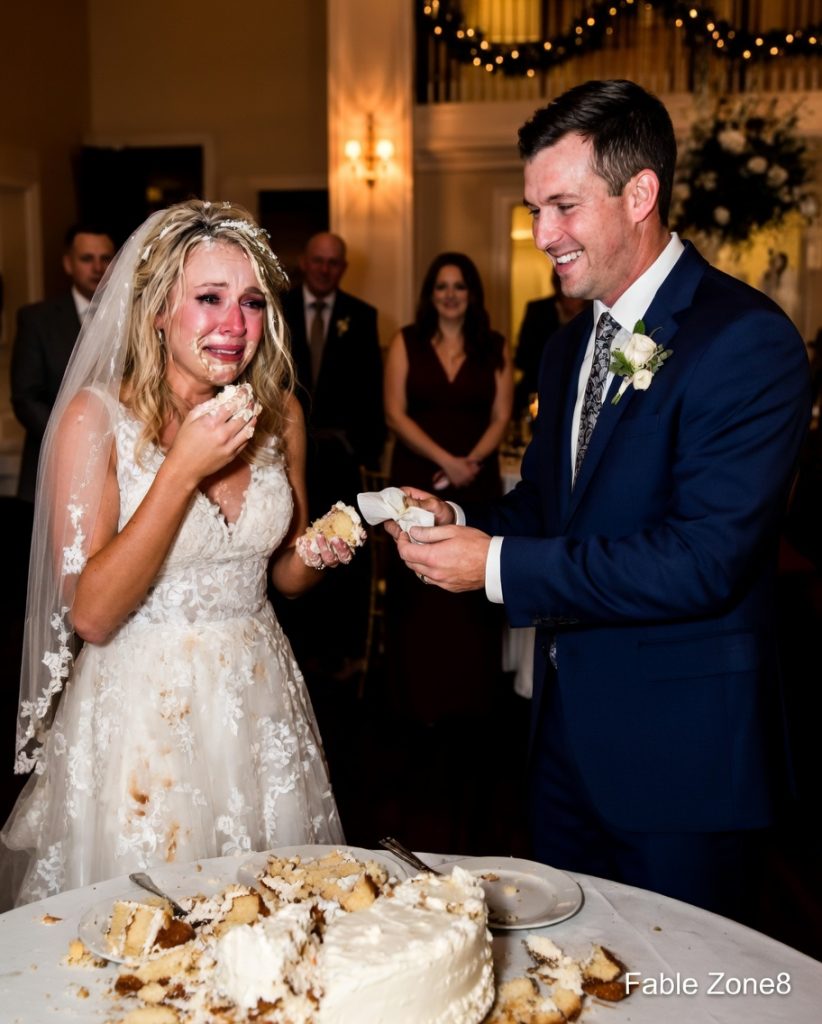
As the evening unfolded, the energy grew. Speeches were heartfelt, the dance floor filled quickly, and there was a sense that everything was unfolding exactly as it should. Then came the cake-cutting—a simple tradition, one that is often playful and lighthearted.
We stood side by side, smiling for the cameras, surrounded by people who were rooting for us. There were cheers, laughter, and the familiar sense of anticipation that comes with small ceremonial moments. It should have been easy. It should have been one of those memories we’d look back on and laugh about.
But in a matter of seconds, something shifted.
What started as a gesture—something that might have been intended as humor—landed in a way that I wasn’t prepared for. The laughter around me felt distant, almost disconnected from my own experience of the moment. Instead of joining in, I felt something tighten inside me.
Embarrassment came first. Then confusion. And then something deeper, something harder to name but impossible to ignore.
I became acutely aware of the room—of the people watching, of the subtle shifts in expression, of the way some laughter hesitated just a second too long. It wasn’t just about what had happened; it was about what it meant.
In that instant, I didn’t feel like a partner being celebrated. I felt exposed. Reduced to the subject of a joke I hadn’t agreed to be part of.
I tried to smile. I tried to match the energy that seemed expected of me. But there’s a kind of internal silence that takes over when something doesn’t feel right—a quiet heaviness that separates you from everything happening around you.
And that’s where I was. Standing next to the person I had just married, trying to reconcile the moment with everything I thought I knew.
Before I had the chance to process it fully, my brother stepped forward.
He didn’t raise his voice. He didn’t create a scene. But his presence alone shifted the atmosphere. He had always been observant, someone who could read situations quickly and act without unnecessary noise.
The way he positioned himself, the look he gave, and the calm firmness in his tone created an immediate pause. It wasn’t confrontational—it was clarifying.
He acknowledged what had happened without exaggerating it. Without humiliating anyone. But also without dismissing it.
And in that moment, he did something I hadn’t yet managed to do for myself—he made it clear that what I was feeling mattered.
The room adjusted. The laughter softened. Conversations shifted.
It wasn’t dramatic, but it was undeniable.
For the rest of the evening, the celebration continued, but something underneath it had changed. There was a subtle awareness now—a sense that something real had surfaced beneath the surface-level perfection.
Later that night, when everything quieted and the day finally caught up with us, we sat down together. Still dressed in the symbols of what was supposed to be a flawless beginning, now facing something imperfect and real.
The conversation wasn’t easy.
I explained how I felt—not just the embarrassment, but the deeper sense of being overlooked. Of feeling like my comfort had been secondary to a moment of humor.
It wasn’t about the act itself. It was about what it represented.
To my surprise, the response wasn’t defensive. Not in the way I had feared. There was confusion at first, then realization. The kind that doesn’t come instantly, but settles in as the moment is replayed from a different perspective.
That conversation became one of the most honest we had ever had.
In the days that followed, the moment stayed with me. Not as a sharp pain, but as something persistent—something that asked to be understood rather than ignored.
It would have been easy to dismiss it. To call it insignificant in the context of everything else. But doing that would have meant ignoring what it revealed.
It made me reflect on other moments—small things I had previously brushed aside. Not out of denial, but out of a desire to preserve the image I had of our relationship.
That day forced us to ask questions we hadn’t fully explored before:
What does respect look like when it’s tested in public?
Where are the boundaries that shouldn’t be crossed, even in humor?
How do we ensure that love doesn’t come at the cost of someone’s dignity?
To my partner’s credit, there was a willingness to engage with those questions. Growth didn’t happen overnight, but it began with awareness.
We started communicating more openly. Checking in with each other in ways we hadn’t before. Learning not just how to love each other, but how to respect each other in visible, consistent ways.
Because love, on its own, isn’t always enough.
It needs structure. Awareness. Intent.
Years later, I no longer see that moment as something that ruined my wedding.
If anything, it revealed something important at exactly the right time.
A wedding marks the beginning of a shared life, but it also has a way of exposing the dynamics that will shape that life. It puts everything under a spotlight—the good, the overlooked, the assumed.
What matters isn’t whether everything goes perfectly.
What matters is what happens when it doesn’t.
That moment taught me how to recognize when something doesn’t feel right, even when everyone around me is laughing. It taught me the importance of speaking up, of valuing my own experience even when it complicates the narrative.
It also showed me what it means to have someone stand up for you—not loudly, not aggressively, but clearly and without hesitation.
My brother’s intervention wasn’t just about protection. It was a reminder.
A reminder that respect is not optional. That love should never come at the cost of dignity.
And what we did afterward, as a couple, mattered even more.
Because a strong relationship isn’t defined by avoiding mistakes. It’s defined by what you do after they happen.
By whether you’re willing to listen. To reflect. To change.
That single moment didn’t break us.
It challenged us.
And in doing so, it gave us the opp