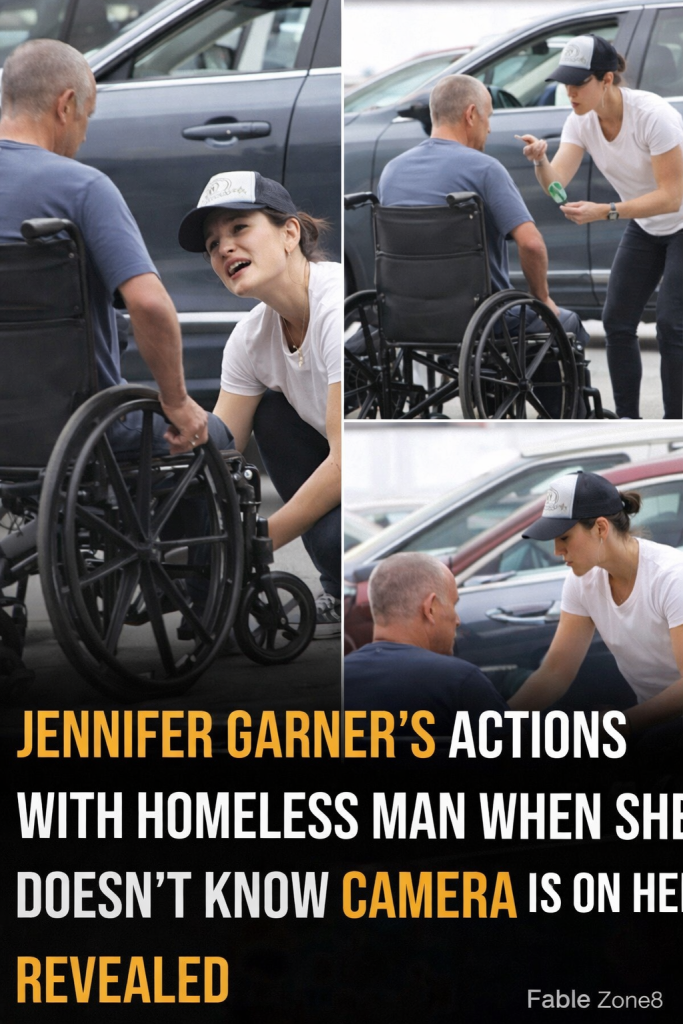
In September 2023, Jennifer Garner reminded the world that true character is often revealed in the quiet, unplanned moments when no one is watching—or at least when no one is expected to be watching. What began as an ordinary drive through Santa Monica quickly transformed into a powerful example of compassion that resonated across the globe.
The moment, later captured and shared widely, showed Garner stopping her car after noticing a homeless man in a wheelchair. He appeared to be struggling, not just with mobility but with a lack of basic necessities—most notably, proper footwear. His feet were bare, exposed to the rough pavement, and vulnerable to injury.
Without hesitation, Garner pulled over.
A Simple Decision That Spoke Volumes
For many people, such a situation might have passed unnoticed or been acknowledged only with a fleeting glance. Life moves quickly, and it’s easy to become desensitized to the hardships visible on city streets. But Garner’s response was immediate and instinctive.
She stepped out of her car and approached the man, not with hesitation or distance, but with genuine concern. She spoke to him, listened, and began to assess what he needed most in that moment.
From her vehicle, she retrieved a care package—something she is known to keep on hand. Inside were essential items: toiletries, snacks, and small necessities that can make a significant difference for someone living without stable shelter.
But Garner didn’t stop there.
As she looked more closely, she noticed his bare feet. It wasn’t just a detail—it was a problem demanding immediate attention. Shoes are something most people take for granted, yet for someone without them, every step can bring pain, risk, and discomfort.
Without pausing to consider appearances or inconvenience, she removed her own shoes.
An Act of Empathy in Real Time
Garner offered her shoes to the man, an act that was both simple and profound. It wasn’t about charity in the abstract—it was about direct, human connection. She was willing to give something of her own, something she needed, to help someone else in a tangible way.
However, reality intervened.
The shoes didn’t fit.
It was a small but important moment—one that could have ended the interaction. Many people might have stopped there, having already “done enough.” But Garner’s response demonstrated something deeper than surface-level generosity.
She adapted.
Looking around, she noticed a videographer nearby who had been capturing the moment. Without hesitation, she offered to buy his shoes so that the man could have a properly fitting pair.
It was an unusual request, but one rooted in urgency and practicality. Garner wasn’t concerned with social norms or potential awkwardness—her focus remained entirely on solving the problem in front of her.
Kindness That Sparked More Kindness
What happened next turned a single act into a chain reaction.
The videographer, visibly moved by Garner’s sincerity, declined her offer of payment. Instead, he chose to give his shoes freely. Not only that, but he also provided additional clothing—socks, pants, and a shirt—further ensuring that the man’s immediate needs were met.
In that moment, something powerful unfolded: one person’s compassion inspired another’s generosity.
It wasn’t planned. It wasn’t orchestrated. It simply happened.
And that authenticity is what made the moment so impactful.
Why the Moment Resonated
When the footage surfaced online, it quickly went viral. Viewers from around the world shared the video, praising Garner’s humility and genuine concern for another human being.
But the reaction went beyond admiration.
People were moved because the act felt real.
In an age where public gestures are often scrutinized for signs of performance or publicity, this interaction stood out. Garner didn’t appear to be aware that she was being filmed. There were no staged angles, no rehearsed lines, no carefully crafted narrative.
It was spontaneous.
And that made all the difference.
A Pattern of Quiet Compassion
While the moment may have seemed extraordinary to many, those familiar with Garner’s public life recognized it as part of a larger pattern.
Throughout her career, Jennifer Garner has consistently demonstrated a commitment to kindness and community support. Known for her roles in films like 13 Going on 30, Alias, and Juno, she has also built a reputation as one of Hollywood’s most grounded and approachable figures.
Beyond her work in entertainment, she has been actively involved in philanthropy and advocacy, particularly in areas related to children, nutrition, and poverty. Her lifestyle brand, Once Upon a Farm, focuses on providing healthy food options and supporting families in need.
But perhaps more telling than her large-scale efforts are the smaller, personal actions—like the care packages she keeps in her car.
These “kindness kits,” as she has encouraged others to create, are practical tools for helping people in everyday situations. They reflect a mindset that values preparedness and empathy, turning good intentions into immediate action.
Humanizing a Complex Issue
Garner’s interaction also brought renewed attention to the broader issue of homelessness, particularly in cities like Los Angeles, where thousands of individuals live without stable housing.
Homelessness is a complex and multifaceted problem, shaped by factors such as housing shortages, economic inequality, mental health challenges, and limited access to support services. It is not something that can be solved by a single act of kindness.
And yet, moments like this matter.
They humanize the issue.
They shift the focus from statistics to individuals—from abstract problems to real people with immediate needs.
The man Garner helped was not a symbol or a headline. He was a person in that moment, facing discomfort and vulnerability.
By addressing something as basic as footwear, Garner highlighted a reality often overlooked: small necessities can have a profound impact on quality of life.
Dignity Through Direct Action
One of the most powerful aspects of the encounter was the way Garner engaged with the man—not as a problem to be solved, but as a person to be respected.
She spoke with him, listened, and responded thoughtfully. Her actions conveyed dignity, not pity.
This distinction matters.
True compassion is not about elevating oneself through acts of giving—it is about recognizing the inherent worth of others and responding with care.
Garner’s willingness to kneel down, remove her shoes, and problem-solve in real time demonstrated a level of presence that is often missing in hurried interactions.
The Ripple Effect of Kindness
As the video spread, it sparked conversations far beyond the initial moment. Social media users shared their own stories of helping others, inspired by what they had seen.
Some began assembling their own care kits.
Others donated clothing, shoes, or time to local shelters.
Many simply reflected on how they might respond differently the next time they encountered someone in need.
This is the ripple effect of kindness.
It doesn’t end with one action—it expands outward, influencing others in ways that are often impossible to measure.
Authenticity in a Public World
In today’s media landscape, where celebrity actions are frequently filtered through layers of branding and strategy, authenticity has become increasingly rare—and increasingly valuable.
Garner’s moment stood out because it lacked those layers.
There was no announcement, no campaign, no expectation of recognition.
Just a person, a need, and a response.
That simplicity is what made it powerful.
It reminded people that kindness does not require wealth, fame, or influence. It requires attention, willingness, and empathy.
Lessons We Can Carry Forward
While not everyone can replicate the exact circumstances of Garner’s act, the principles behind it are universal.
Pay attention.
Be prepared.
Act when you can.
Even small gestures—offering a pair of socks, a bottle of water, or a few minutes of conversation—can make a meaningful difference.
More importantly, these actions reinforce a sense of shared humanity. They remind us that, despite differences in circumstance, we are all connected by the same basic needs and emotions.
A Moment That Endures
Long after the video stopped trending, the message it carried continued to resonate.
Jennifer Garner didn’t set out to inspire millions that day. She simply responded to a situation with kindness.
And yet, that response became a powerful example of what it means to care—not in theory, but in practice.
In a world often defined by speed, distraction, and division, her actions offered something different.
A pause.
A connection.
A reminder.
That sometimes, the most meaningful things we can do are also the simplest.
And that even in the busiest moments of our lives, we always have the choice to stop, to see, and to help.