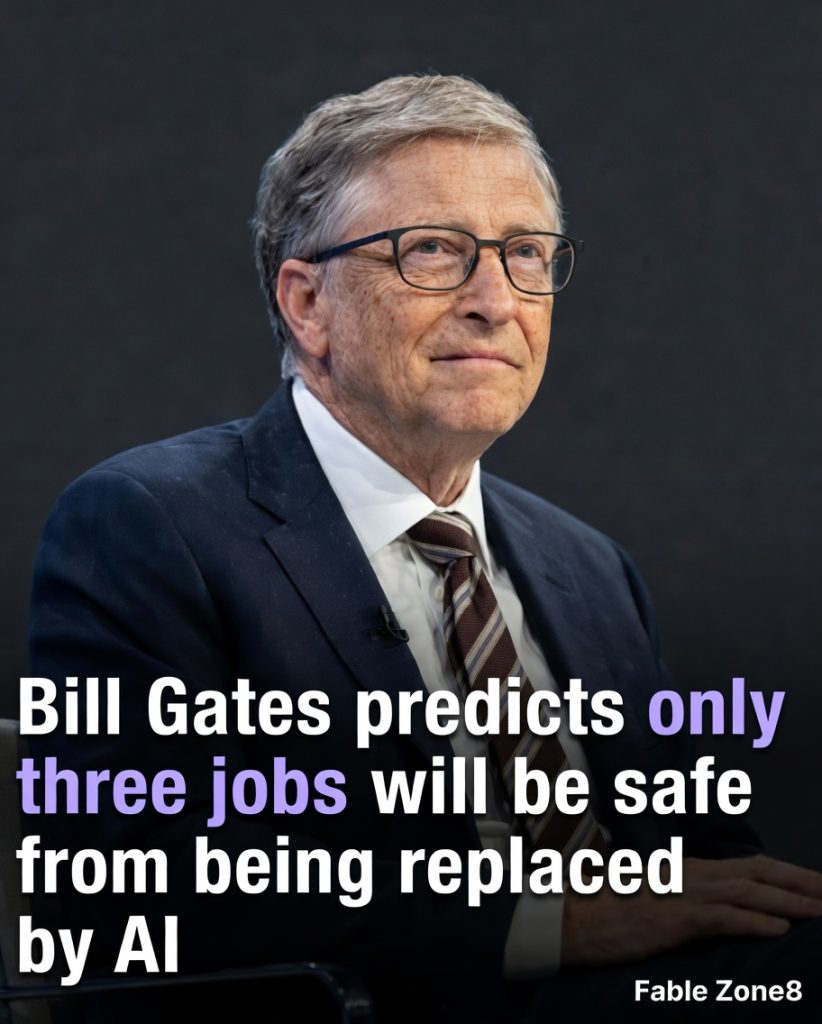
As artificial intelligence continues to evolve at an unprecedented pace, conversations about the future of work have shifted from speculation to urgency. Among the most influential voices shaping this discussion is Bill Gates, whose insights into technology and society have long guided how people understand innovation. In recent years, Gates has focused increasingly on how AI will redefine careers, reshape industries, and challenge long-standing assumptions about what it means to be valuable in the workforce.
At the heart of his perspective lies a simple but powerful idea: the future will not belong to those who compete with machines, but to those who learn to collaborate with them.
Gates often describes the rise of AI as the emergence of “free intelligence”—a world in which advanced knowledge, once limited to highly trained experts, becomes widely accessible. In practical terms, this means that tools powered by artificial intelligence can perform tasks that previously required years of education and experience. From analyzing medical data to generating written content, AI systems are rapidly expanding their capabilities, making expertise more available than ever before.
This transformation is both exciting and unsettling.
On one hand, it promises to democratize access to information, reducing inequality and enabling more people to participate in fields that were once difficult to enter. On the other hand, it raises questions about the future of traditional roles. If machines can perform complex tasks quickly and efficiently, what happens to the humans who once specialized in those areas?
Gates does not believe that humans will become obsolete. Instead, he argues that the nature of work will change, shifting toward roles that emphasize uniquely human qualities.
One of the clearest examples of this shift can be seen in healthcare.
AI systems are already capable of analyzing medical images, identifying patterns, and suggesting diagnoses with remarkable accuracy. In some cases, these systems rival or even surpass human specialists in speed and precision. Yet, according to Gates, the most successful medical professionals of the future will not be those who rely solely on technical expertise.
They will be those who combine AI-driven insights with empathy.
A machine can detect abnormalities in a scan, but it cannot fully understand the emotional weight of a diagnosis. It cannot comfort a patient, navigate complex ethical decisions, or consider the broader context of someone’s life. Doctors who can integrate technological tools with compassionate care will remain indispensable, offering something that no algorithm can replicate.
A similar transformation is underway in education.
Gates envisions a future where AI-powered tutors provide personalized learning experiences tailored to each student’s needs. These systems can adapt in real time, offering explanations, practice exercises, and feedback that align with an individual’s pace and learning style. Such advancements have the potential to close long-standing achievement gaps and make high-quality education more accessible.
However, the role of teachers will not disappear.
Instead, it will evolve.
Educators will become facilitators of deeper learning, focusing on skills that extend beyond information delivery. They will guide students in critical thinking, foster creativity, and support emotional development. They will create environments where curiosity thrives and collaboration is encouraged—areas where human interaction remains essential.
In this new landscape, the value of a teacher will not be measured by how much information they can provide, but by how effectively they can inspire and connect.
The business world is also experiencing rapid change.
Tasks that involve routine data processing, basic coding, or repetitive analysis are increasingly being handled by AI systems. This automation allows companies to operate more efficiently, but it also shifts the demand toward roles that require oversight, interpretation, and strategic thinking.
Gates predicts that professionals who can “orchestrate” AI—those who understand how to use it, guide it, and apply its outputs creatively—will be in high demand.
These individuals will act as bridges between technology and real-world application.
For example, a data analyst in the age of AI may spend less time gathering information and more time interpreting results, identifying trends, and making decisions based on insights generated by machines. Similarly, a software developer might focus more on designing systems and solving complex problems, while relying on AI to handle routine coding tasks.
This shift emphasizes a broader trend: the importance of adaptability.
In a world where tools and technologies evolve rapidly, the ability to learn continuously becomes one of the most valuable skills a person can possess. Gates frequently highlights the need for lifelong learning, encouraging individuals to remain curious and open to change.
Those who resist this shift may find themselves struggling to keep up.
Those who embrace it, however, will discover new opportunities.
Beyond traditional professions, entirely new career paths are emerging.
Fields such as AI ethics, human-AI interaction design, and sustainable technology development are gaining prominence. These roles require not only technical knowledge but also an understanding of human values, societal impact, and ethical considerations.
As AI becomes more integrated into daily life, questions about fairness, accountability, and transparency become increasingly important. Professionals who can navigate these challenges will play a crucial role in shaping how technology is used and regulated.
Another area of growth lies in human-centered services.
While machines excel at processing information, they struggle with tasks that require emotional intelligence and personal connection. Careers in mental health support, caregiving, coaching, and community engagement are likely to remain resilient, if not expand.
In these roles, the human element is not just valuable—it is essential.
Creative industries also stand at an interesting crossroads.
AI tools can now generate art, music, writing, and design elements with impressive speed. This has led to concerns about the future of creative professions. However, Gates sees this not as a threat, but as an opportunity.
Rather than replacing creativity, AI can enhance it.
Artists, writers, and designers can use these tools to experiment, iterate, and refine their ideas more efficiently. By automating repetitive tasks, AI frees creators to focus on originality, storytelling, and emotional depth—qualities that resonate most with audiences.
The key, once again, is collaboration.
Those who learn to work alongside AI, using it as a partner rather than a competitor, will be better positioned to succeed.
Looking ahead, Gates emphasizes the importance of preparation.
Governments, educational institutions, and businesses must invest in training programs that equip people with the skills needed for this new era. This includes not only technical knowledge but also soft skills such as communication, leadership, and critical thinking.
For individuals, the message is clear: focus on what makes you uniquely human.
Empathy, creativity, adaptability, and the ability to navigate complex situations are qualities that machines cannot easily replicate. By developing these skills, people can remain relevant and valuable in a rapidly changing world.
At the same time, it is important to acknowledge the challenges.
The transition to an AI-driven economy will not be seamless. Some jobs will be displaced, and certain industries will undergo significant disruption. Ensuring that workers have access to retraining opportunities and support systems will be critical in managing this transition.
Gates has repeatedly called for proactive measures, including investments in education and policies that promote equitable access to technology. The goal, he argues, should not be to resist change, but to guide it in a way that benefits society as a whole.
Ultimately, his outlook remains optimistic.
He believes that AI has the potential to improve lives, increase productivity, and unlock new possibilities across a wide range of fields. But realizing this potential requires a shift in mindset.
Instead of viewing technology as a replacement for human effort, it should be seen as a tool that amplifies human capability.
The future of work, as Gates envisions it, is not defined by competition between humans and machines. It is defined by partnership.
In that partnership, the most successful individuals will be those who understand how to combine the strengths of both—leveraging the speed and precision of AI while bringing empathy, creativity, and judgment to the table.
As the world continues to adapt to these changes, one thing becomes increasingly clear: the qualities that define meaningful work are not disappearing. They are becoming more important than ever.
And in a future shaped by intelligent machines, it is human intelligence—in all its emotional, creative, and ethical dimensions—that will ultimately determine success.