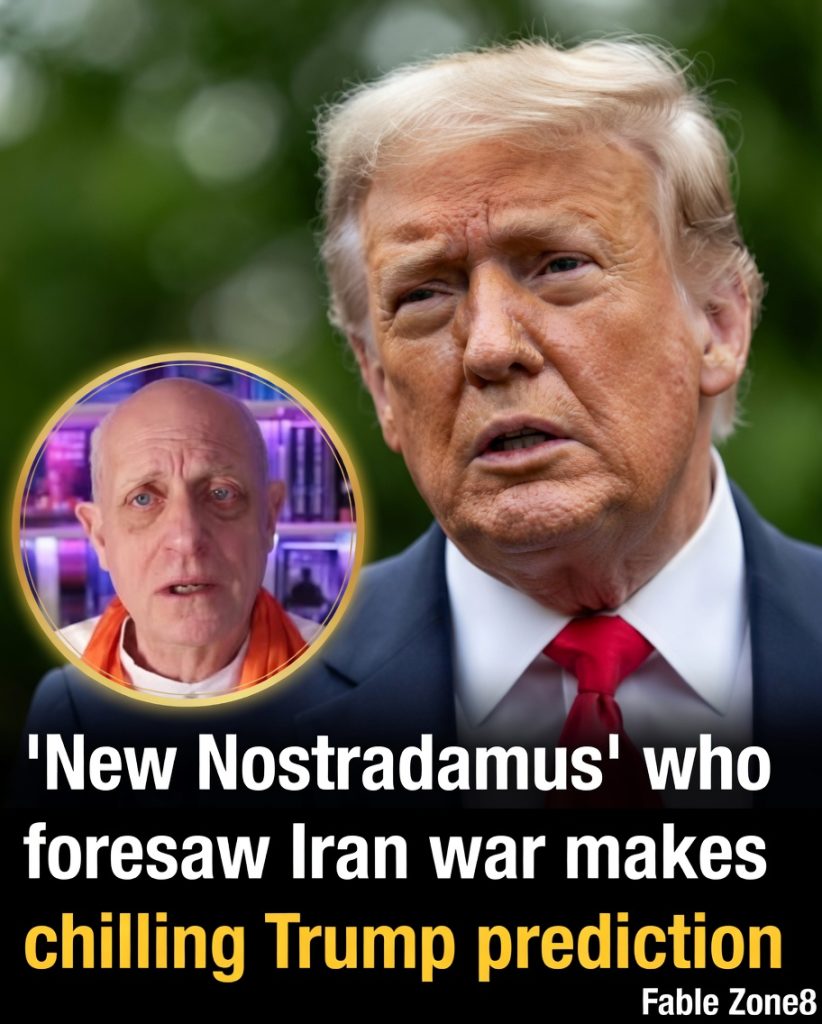
In an age where information travels faster than ever and headlines compete fiercely for attention, few things capture the public imagination quite like a bold prediction about the future—especially when it involves global conflict, political upheaval, and powerful figures. Recently, a claim from Craig Hamilton-Parker—often labeled by followers as a “New Nostradamus”—has ignited widespread discussion. His suggestion that Donald Trump could somehow secure a third presidential term, despite existing constitutional limits, has left many people questioning not only the claim itself but also why such ideas gain traction so quickly.
At first glance, the prediction feels dramatic, almost cinematic. It combines elements of uncertainty, power, and disruption—ingredients that naturally draw attention. But beneath the surface, it reveals something deeper about human psychology, the influence of media, and the ways in which fear and speculation can blur into perceived reality.
The appeal of such predictions lies in their ability to connect with existing anxieties. The world today is marked by rapid change—geopolitical tensions, economic instability, technological disruption, and shifting social dynamics. In such an environment, people often look for narratives that make sense of the chaos. A prediction that suggests a major political shift, especially one involving a recognizable figure like Donald Trump, taps directly into that need for explanation.
Hamilton-Parker’s claim is built on the idea that global conflict or crisis could create conditions so extreme that traditional political norms might be disrupted. According to this line of thinking, extraordinary circumstances could lead to extraordinary decisions, potentially allowing for outcomes that would otherwise be impossible. While this may sound plausible in a fictional or speculative sense, it does not align with how constitutional systems actually operate—particularly in the United States.
The U.S. political system is designed with layers of protection precisely to prevent sudden or unchecked changes in power. The 22nd Amendment to the Constitution clearly states that no person can be elected president more than twice. This rule is not a suggestion or a flexible guideline—it is a binding legal limit. Changing it would require a formal constitutional amendment, a process that involves approval by two-thirds of both houses of Congress and ratification by three-fourths of the states.
This is not something that can happen quietly, quickly, or without widespread public awareness. Even during times of national crisis, the constitutional framework remains in place. In fact, it is during such times that these safeguards become even more important, ensuring that power does not become concentrated in ways that could undermine democratic principles.
Despite this, the idea of a third term continues to circulate in discussions, often fueled by speculation rather than evidence. This highlights a key issue: the difference between what is possible in theory and what is realistic in practice. While history has shown that political systems can evolve, those changes are driven by legal processes, public debate, and institutional decisions—not by predictions or prophecies.
Hamilton-Parker’s methods further underscore this distinction. His forecasts are rooted in spiritual and intuitive practices, including systems like astrology and other belief-based frameworks. These approaches may hold personal meaning for some individuals, but they are not recognized as reliable tools for predicting political outcomes. Unlike data-driven analysis or historical modeling, they do not provide verifiable or testable evidence.
Another factor contributing to the spread of such claims is the perception of past accuracy. Supporters often point to instances where Hamilton-Parker appeared to predict major events, such as political shifts or global developments. However, a closer examination reveals that many of these predictions were broad or open-ended, allowing for multiple interpretations. In some cases, they were made during periods when the outcomes were already being widely discussed, making them less predictive and more reflective of existing trends.
At the same time, incorrect predictions are often overlooked or forgotten. This selective memory creates an illusion of consistency and accuracy, reinforcing belief in the predictor’s abilities. It is a pattern seen not only with psychics but also with other figures who make frequent forecasts. Over time, the successes are highlighted while the failures fade into the background.
Media and social platforms play a significant role in amplifying these narratives. In a competitive digital landscape, attention-grabbing headlines are essential for engagement. Phrases like “shocking prediction” or “unprecedented outcome” are designed to spark curiosity and encourage clicks. However, this emphasis on drama can sometimes come at the expense of context.
When a speculative claim is presented without clear clarification, it can take on a sense of legitimacy it does not inherently possess. Readers may interpret it as a credible warning rather than what it actually is—a personal interpretation or belief. This transformation from speculation to perceived reality is subtle but powerful, shaping how information is understood and shared.
It is also important to consider how such predictions are framed by the person making them. Hamilton-Parker himself has suggested that the future is not fixed and that outcomes can change depending on circumstances. This indicates that his predictions are not intended to be definitive statements but rather possibilities within a broader range of outcomes.
However, once these statements are shared widely, that nuance is often lost. Instead of being seen as speculative, they are interpreted as concrete forecasts. This shift in perception can lead to unnecessary concern or confusion, particularly when the prediction involves significant political or global implications.
From a practical standpoint, the idea of a third presidential term remains highly implausible. The constitutional barriers are substantial, and any attempt to alter them would require a level of consensus that is difficult to achieve even under normal conditions. In times of crisis, the focus of government typically shifts toward stability and continuity, not radical structural changes.
Furthermore, the checks and balances within the system ensure that no single individual can unilaterally override established rules. Courts, Congress, and state governments all play a role in maintaining the integrity of the constitutional framework. This distributed authority is a fundamental feature of democratic governance, designed to prevent precisely the kind of scenario being suggested.
Beyond the specifics of this prediction, the broader issue lies in how people respond to uncertainty. When the future feels unpredictable, there is a natural tendency to seek out narratives that provide clarity or direction. Even if those narratives are speculative, they can offer a sense of understanding or control.
Psychic predictions, with their dramatic tone and confident delivery, can be particularly compelling in this context. They present a version of the future that feels defined, even if it is not grounded in evidence. This contrast between emotional certainty and factual uncertainty is what makes such claims resonate so strongly.
At the same time, this dynamic underscores the importance of critical thinking. Distinguishing between speculation and reality requires an awareness of how information is presented and an understanding of the systems being discussed. In the case of political predictions, this means looking at legal frameworks, historical precedents, and institutional processes rather than relying on intuition or belief.
It also means recognizing the role of emotion in shaping perception. Fear, curiosity, and fascination can all influence how we interpret information. By acknowledging these factors, it becomes easier to approach claims with a balanced perspective, evaluating them based on evidence rather than impact.
Ultimately, the story of a “New Nostradamus” predicting a third presidential term is less about the prediction itself and more about the environment in which it spreads. It reflects a world where information is abundant, attention is limited, and narratives compete for influence. In such a landscape, even unlikely ideas can gain momentum if they capture the right combination of emotion and curiosity.
The real takeaway is not that such an outcome is likely, but that the way we engage with information matters. Understanding the difference between possibility and probability, between belief and evidence, is essential for navigating a rapidly changing world.
As headlines continue to evolve and new claims emerge, the challenge remains the same: to look beyond the surface, question assumptions, and seek clarity in a space often defined by noise. Because while predictions may come and go, the ability to think critically and stay grounded in reality is what ultimately shapes how we understand the future.
And in that sense, the most important lesson is not about what might happen—but about how we choose to interpret what we hear.