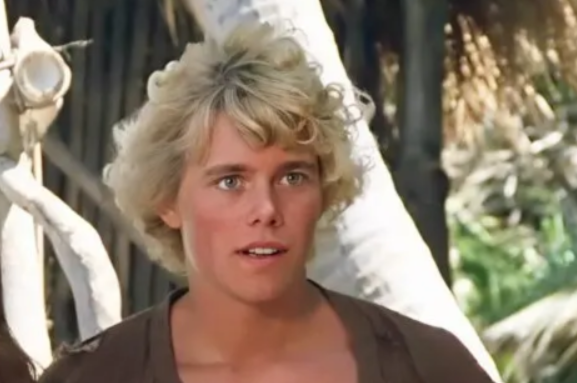
In the early 1980s, Christopher Atkins became a symbol of youthful allure almost overnight, a face and physique that seemed tailor-made for the era’s fascination with idyllic romance and cinematic escapism. At just 18 years old, he was cast opposite Brooke Shields in The Blue Lagoon, a film that would catapult both young actors into global fame while simultaneously igniting controversy that would follow them for decades. The movie’s lush tropical backdrop, its themes of innocence and isolation, and its provocative framing of adolescence ensured that it would be discussed as much for what it represented culturally as for its box-office success. Critics debated the ethics of its production, audiences flocked to theaters in droves, and Atkins suddenly found himself transformed from an unknown teenager into an international heartthrob whose image was plastered across magazines, posters, and bedroom walls around the world.
The success of The Blue Lagoon was undeniable. Made on a modest budget, the film went on to gross nearly $59 million, an enormous sum for its time, and firmly established Atkins as one of Hollywood’s most recognizable young faces. Interviews followed, photo shoots became routine, and the machinery of celebrity moved quickly to define him. Yet fame arrived with expectations that proved difficult to escape. His blond hair, athletic build, and clean-cut image made him an easy target for typecasting, and industry decision-makers often saw him less as a developing actor and more as a visual commodity. This became especially evident when, in 1982, he posed nude for a men’s magazine. While the decision amplified his visibility, it also reinforced a narrative that centered his physical appearance above all else, narrowing the range of opportunities offered to him and subtly undermining efforts to be taken seriously as a performer.
As the years progressed, Atkins attempted to break free from the confines of the teen idol mold. He explored different avenues, including musical theater and more varied acting roles, hoping to demonstrate depth beyond the image that had been so firmly cemented by his early success. However, Hollywood can be unforgiving to those whose fame arrives too quickly and too young. The same spotlight that once burned brightly began to dim, and the roles that once seemed abundant grew fewer and farther between. For Atkins, this gradual retreat from the center of the entertainment world was not marked by scandal or dramatic collapse, but by a quiet realization that the industry’s version of success did not align with the life he wanted to lead. The relentless pressure to maintain an image, compete for relevance, and live under constant scrutiny slowly lost its appeal.
Rather than clinging to a fading version of celebrity, Atkins chose a different path—one defined by stability, privacy, and personal fulfillment. He stepped away from Hollywood’s front lines and built a life far removed from red carpets and casting calls. Marriage and fatherhood became central pillars of his world, offering a sense of purpose and grounding that fame had never truly provided. In this quieter chapter, he discovered satisfaction in tangible, hands-on work, designing swimming pools, crafting fishing lures, and engaging in pursuits that required patience, skill, and creativity without the judgment of an audience. These endeavors, though modest compared to blockbuster films, offered something far more enduring: control over his time, pride in his craftsmanship, and the freedom to define success on his own terms.
Decades after his initial rise, Atkins has spoken with striking clarity and good humor about his early years in Hollywood. A reunion with Brooke Shields on a podcast served as a reflective moment for both actors, as they revisited The Blue Lagoon not with embarrassment or bitterness, but with a shared understanding of their youth and the cultural storm that surrounded them. They laughed at their naivety, acknowledged the complexities of the film’s legacy, and demonstrated how time and distance can soften even the most intense public scrutiny. For Atkins, these moments are no longer about reclaiming fame, but about integrating his past into a broader, more balanced life story—one where youthful stardom is a chapter, not the defining theme.
Now in his early sixties, Christopher Atkins carries the remnants of his boyish charm, tempered by experience and perspective. His life stands as a quiet counter-narrative to the traditional Hollywood arc, proving that fulfillment does not have to be measured in awards, headlines, or constant visibility. Instead, his journey suggests that stepping away can be an act of strength rather than surrender. Fame, once so central to his identity, has faded into the background, replaced by peace, purpose, and a sense of self that no longer depends on external validation. In choosing a slower, intentional life, Atkins has achieved something many stars never do: a lasting contentment rooted not in who the world once wanted him to be, but in who he chose to become.