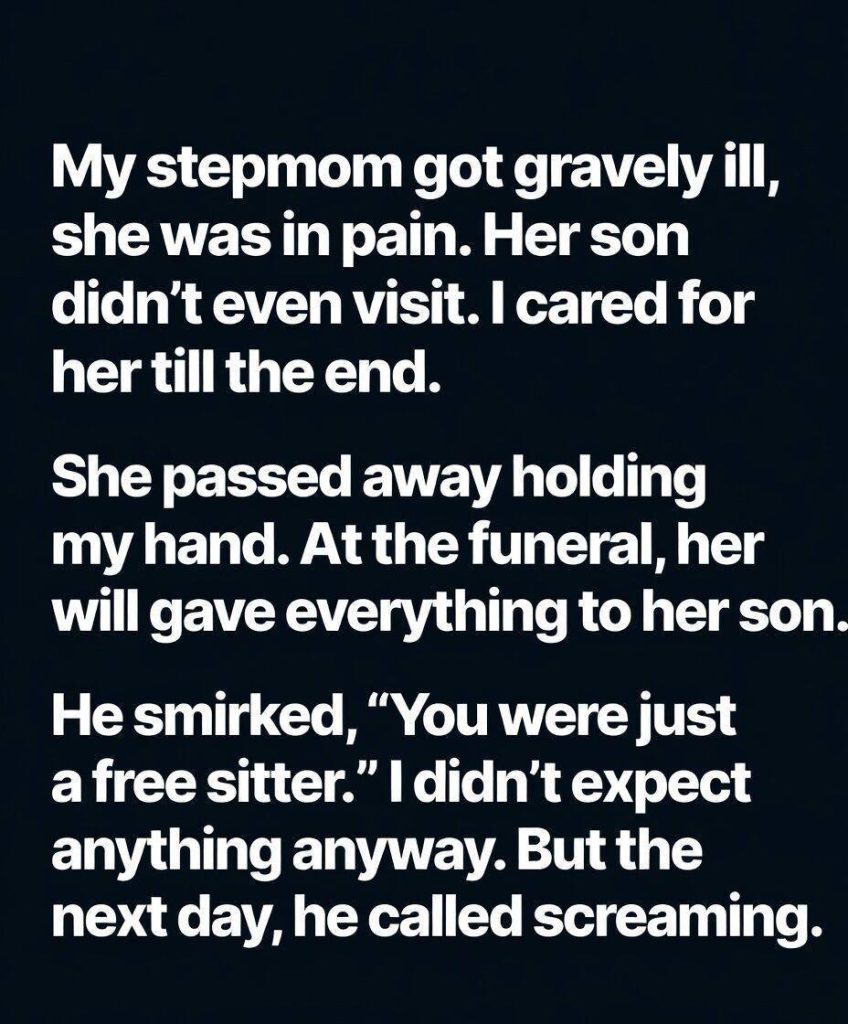
Grief has a way of stripping life down to its most honest form. It removes pretense, silences distractions, and leaves behind only what truly mattered. When my stepmother fell ill, that truth became clear in ways I wasn’t prepared for.
Her son, the one she always defended, was absent.
Not entirely gone—he existed somewhere within driving distance, living his life uninterrupted—but absent in every way that mattered. Days turned into weeks without a visit. Calls went unanswered. Messages, if they were sent at all, were brief and distant. I never confronted him. It wasn’t my place. But I saw what was happening, and I wondered if she saw it too.
I think she did.
Because in those final months, it was just the two of us.
Illness has a rhythm. At first, it arrives with resistance—appointments, treatments, hope wrapped in fragile optimism. Then it settles into something quieter, more consuming. Energy fades. The body weakens. Time begins to feel measured, not in days, but in moments.
I was there for all of it.
I cooked when she couldn’t eat. I cleaned when she was too tired to stand. I sat beside her through sleepless nights, listening to her breathing, waiting for the next shift in her condition. There were moments when she tried to apologize for being a burden, and I would gently stop her, reminding her that she wasn’t.
Because she wasn’t.
She was family.
Our relationship had never been perfect. There were years of distance, misunderstandings, the quiet tension that sometimes exists between people connected by circumstance rather than blood. But time has a way of softening edges. And in those final months, whatever had once stood between us disappeared.
What remained was something simple and real.
Care.
Presence.
Connection.
Sometimes, she would reach for my hand and hold it longer than necessary, as if grounding herself in something steady. Other times, she would smile faintly and say things that felt like reflections rather than conversations.
“You have your father’s heart,” she once whispered.
I didn’t know how to respond to that. So I just stayed.
The night she passed was calm. There was no drama, no sudden urgency. Just a quiet stillness that settled over the room. I was reading to her, my voice low, steady, more for comfort than comprehension. At some point, her breathing slowed.
Then it stopped.
There are moments in life that don’t feel real even as they happen. That was one of them. I sat there, holding her hand, waiting for something to change. But nothing did.
She was gone.
The days that followed were a blur of arrangements, condolences, and the strange, hollow rhythm of mourning. People came and went, offering kind words, sharing memories, filling the space with noise that didn’t quite reach where the grief lived.
Her son arrived.
He stepped into the role effortlessly. The grieving heir. The composed figure in a dark suit, accepting sympathy, nodding solemnly, performing sadness in a way that felt rehearsed rather than lived. I watched from a distance, not out of judgment, but out of detachment.
We were mourning the same person, but not the same relationship.
At the funeral, I kept to myself. I didn’t need recognition. I didn’t need acknowledgment. What I had shared with her in those final months was enough.
Then came the reading of the will.
It was a formal moment, structured and precise. The lawyer spoke in measured tones, listing assets, properties, possessions. Everything was outlined clearly, leaving little room for interpretation.
The house.
The savings.
The jewelry.
Every item was left to her son.
There was no mention of me.
For a brief moment, something stirred—a flicker of emotion, not quite disappointment, but something close to it. Not because I expected anything, but because absence, when stated so plainly, carries its own weight.
But the feeling passed quickly.
Because I hadn’t been there for a reward.
I had been there because she needed someone.
And that was enough.
Then he laughed.
Not loudly, not dramatically—but enough to be heard. Enough to cut through the room. He leaned toward me, his expression sharp with satisfaction.
“Looks like you were just the help after all,” he said. “Guess that didn’t pay off.”
There are moments when words demand a response.
And there are moments when silence says more.
I chose silence.
Not out of weakness, but out of clarity. Because nothing I could say in that moment would change him. And more importantly, nothing he said could change what I had done.
That night, I slept deeply.
For the first time in months, there was no responsibility waiting for me. No late-night worries. No quiet listening for changes in breathing. Just rest.
And then morning came.
The phone rang.
Once. Twice. Again and again, insistent, urgent. When I finally answered, his voice was different. Gone was the confidence. In its place was something unsteady.
“You need to come here,” he said.
There was something in his tone that I couldn’t ignore. So I went.
The house felt different.
Not just empty—but unsettled.
He was waiting outside, pacing, his composure gone. When he saw me, he didn’t speak immediately. Instead, he gestured toward the attic.
“There’s something you need to see,” he said.
We climbed the stairs together, the air growing heavier with each step. In the corner of the attic sat an old chest—something I vaguely remembered, but had never opened.
Inside was a letter.
My name was written on it.
He admitted he had opened it. Not fully—just enough to realize it wasn’t meant for him.
I took the envelope, my hands unsteady in a way they hadn’t been even at the funeral. There was something about the moment that felt different. Not dramatic. Not shocking.
But important.
I opened it.
Her handwriting was unmistakable. Steady. Familiar. Personal in a way that made it feel like she was speaking directly to me again.
She explained everything.
The will had not been entirely her choice. There were legal constraints, decisions made long before her illness that she couldn’t undo. But she had found another way.
A hidden one.
The lake cottage.
A place I hadn’t even known existed.
It was mine.
Not because of obligation.
But because of intention.
Because she had seen something in me that mattered to her.
I finished reading in silence. Then I handed the letter to him.
He read it quickly, his expression shifting with each line. By the end, the confidence he had carried the day before was gone entirely.
“Why you?” he asked.
The question wasn’t angry.
It was lost.
“Because I was there,” I said.
There was nothing more to explain.
The cottage was everything she described. Quiet. Peaceful. Filled with traces of her life that felt more personal than anything left in the house. It wasn’t about value.
It was about meaning.
Over time, things changed.
Not suddenly. Not dramatically. But gradually, in small, quiet ways. He began to understand something he hadn’t before. Not through punishment, but through realization.
The letter hadn’t just given me something.
It had shown him something.
That love isn’t measured by entitlement.
That presence matters more than proximity.
That inheritance is not the same as legacy.
He came back, again and again. At first uncertain, then more comfortable. Conversations replaced silence. Understanding replaced arrogance.
We didn’t become what we once were supposed to be.
But we became something honest.
And in the end, that mattered more.
Because what she left behind wasn’t division.
It was a final lesson.
One that neither of us could ignore.
He received the house.
I received the truth.
And in time, we both came to understand which one truly mattered.