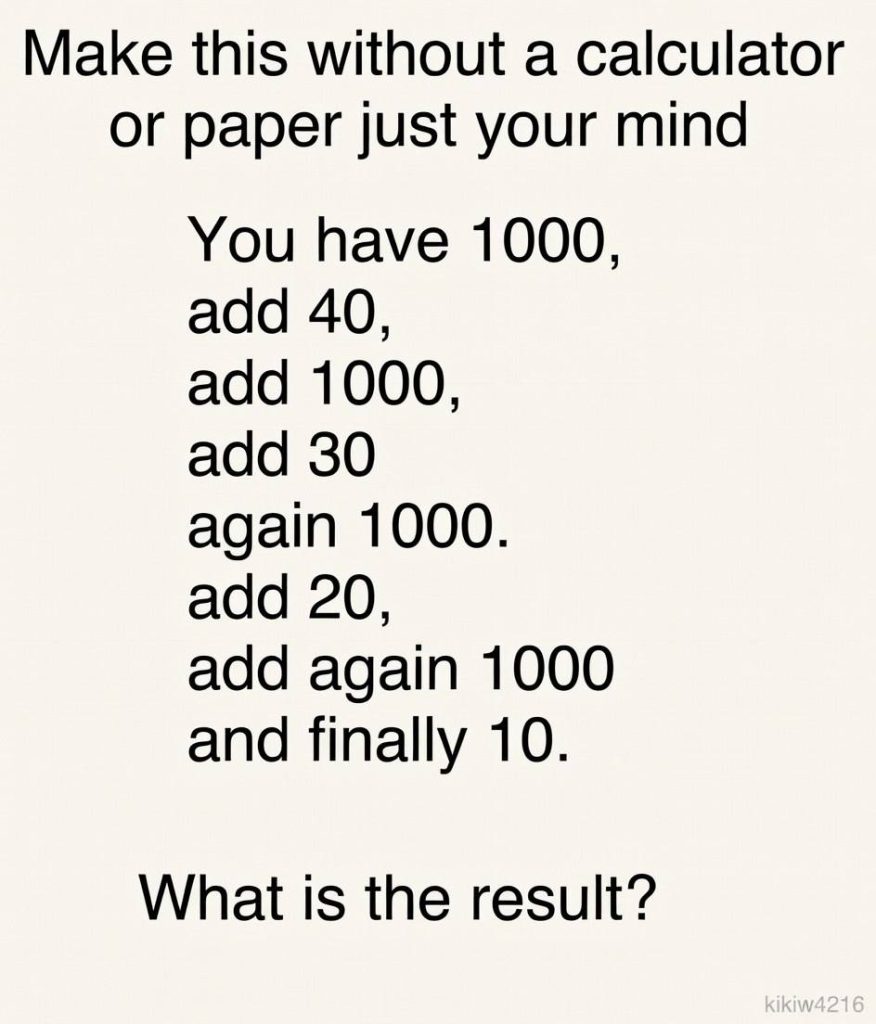
“Test your math skills.” It sounds harmless, almost playful—an invitation rather than a challenge. The phrase carries a certain lightness, suggesting something quick and satisfying, a momentary pause in the day where the mind gets to stretch and then move on. But hidden beneath that simplicity is something far more revealing than a correct answer. It is not the equation itself that matters most. It is how we approach it.
In a world that increasingly rewards speed, the instinct is to respond immediately. The brain recognizes familiar patterns and fills in the blanks before the full picture is even processed. We see numbers, symbols, and structure, and we assume we already understand what’s being asked. That assumption becomes the first misstep. Not because the problem is inherently difficult, but because we treat it as if it isn’t worth careful attention.
This is where the illusion begins.
At first glance, these puzzles appear designed for quick success. They are clean, minimal, and accessible. There is no intimidating language, no complex formatting, nothing that signals difficulty. In fact, their simplicity invites overconfidence. The reader feels capable before they have even started. And that feeling—quiet, subtle, almost reassuring—is exactly what leads them astray.
The mistake is rarely about knowledge. It is about process.
People often believe that intelligence reveals itself through speed. The faster the answer, the sharper the mind. But in reality, speed can just as easily mask carelessness. When we rush, we rely on instinct instead of structure. We prioritize completion over comprehension. And in doing so, we trade accuracy for the illusion of efficiency.
This pattern does not belong only to math. It extends into nearly every aspect of life.
Consider how often we skim messages instead of reading them fully. How often we respond before truly understanding what someone meant. How frequently we assume context based on familiarity rather than confirming details. The result is the same: misunderstandings, mistakes, and the quiet realization that we acted too quickly.
The viral nature of these puzzles amplifies this behavior. When a problem is presented with urgency—“Don’t skip this,” “Most people get it wrong,” “The answer will surprise you”—it creates pressure. That pressure doesn’t encourage careful thinking. It encourages reaction. The reader feels compelled to respond, to prove themselves, to arrive at an answer before anyone else.
And so they do.
They answer quickly. Confidently. Incorrectly.
What follows is often surprise, sometimes embarrassment, and occasionally defensiveness. But rarely does the focus shift to the real issue: not the answer, but the approach.
The truth is, most of these puzzles are not difficult. They rely on basic principles—often something as simple as order of operations. The challenge lies not in complexity, but in discipline. In the ability to slow down when everything else is urging speed.
This is where the metaphor of cooking—specifically, making a stew—becomes unexpectedly powerful.
A stew begins with simple ingredients. Nothing about it feels complicated. Meat, vegetables, seasoning, liquid. Anyone can recognize the components. But the final result depends entirely on how those components are handled.
If everything is thrown into a pot at once, the stew will still exist. It will still be edible. But it will lack depth. It will lack character. It will lack the richness that comes from doing things in the right order.
The same is true of solving a problem.
The first step in cooking a proper stew is preparation. Reading the recipe. Understanding the sequence. Recognizing that timing matters. This mirrors the act of reading a problem carefully—fully absorbing what is being asked before attempting to answer.
Skipping this step is where most mistakes begin.
Next comes the process itself. The meat must be browned, not rushed. This stage builds flavor, creating a foundation for everything that follows. In mathematical terms, this is like handling the most important operations first—the parts of the equation that define the structure.
If you skip this, the rest may still come together, but something essential will be missing.
Then come the layers. Onions, garlic, spices—each added at the right moment, each contributing something specific. The order is not arbitrary. It is intentional. Just as in problem-solving, where each step builds upon the last, and rearranging them leads to a different outcome.
And finally, there is time.
The stew must simmer. Not boil aggressively, not be rushed, but allowed to develop slowly. This stage cannot be forced. It requires patience. Trust. The understanding that some results cannot be accelerated without consequence.
This is perhaps the most important lesson.
Because in both cooking and thinking, time is not the enemy. It is the tool.
When we slow down, we notice details. We catch inconsistencies. We question assumptions. We give ourselves the opportunity to correct mistakes before they become final answers.
But slowing down feels unnatural in a fast-paced environment. It feels inefficient. It feels like hesitation. And so we resist it.
We answer quickly.
We move on.
And we miss the deeper truth.
The phrase “the answer is in the first comment” is itself part of the illusion. It suggests that there is a hidden shortcut, a secret insight that will change everything instantly. It encourages the reader to look outward for the solution rather than inward at their own process.
But the real “answer” is not hidden in a comment. It is revealed through attention.
Through patience.
Through the willingness to engage fully with something that appears simple.
Because simplicity can be deceptive.
A basic equation can contain layers of structure. A short sentence can carry multiple meanings. A straightforward task can expose complex patterns of behavior. What matters is not how something looks, but how it is approached.
This is why these puzzles are so effective.
They are not tests of intelligence. They are tests of discipline.
They reveal how we think under pressure. How we handle familiarity. How we respond to perceived ease. And perhaps most importantly, they show whether we are willing to pause.
In a broader sense, this lesson extends far beyond numbers and symbols.
In relationships, misunderstandings often arise not from lack of care, but from lack of attention. We hear what we expect to hear, rather than what is actually being said. We respond to assumptions instead of realities.
In work, mistakes often come not from incompetence, but from haste. Deadlines create urgency, urgency creates shortcuts, and shortcuts create errors that require even more time to fix.
In decision-making, the same pattern appears. Quick choices feel decisive, but they are not always informed. Slower decisions may feel uncertain, but they are often more accurate.
The difference lies in process.
Returning to the original idea—the simple math puzzle—the real takeaway is not the correct answer. It is the recognition that the correct answer comes from doing things properly.
Reading carefully.
Following structure.
Respecting order.
Taking time.
These are not dramatic actions. They do not feel impressive in the moment. But they are what lead to clarity.
And clarity is far more valuable than speed.
In the end, the most surprising part of these puzzles is not the solution itself. It is the realization that we are often our own obstacle. That the error was not in the problem, but in our approach to it.
That we rushed when we should have paused.
Assumed when we should have verified.
Finished when we should have understood.
This realization can be uncomfortable. It challenges the idea that being quick is always being smart. It forces us to reconsider habits that feel natural but are not always effective.
But it is also empowering.
Because once we recognize the pattern, we can change it.
We can choose to slow down.
To read fully.
To think deliberately.
To value accuracy over immediacy.
And in doing so, we begin to see things differently.
Problems become clearer.
Mistakes become less frequent.
Understanding becomes deeper.
The answer, then, is not hidden in a comment.
It is hidden in the moment you decide to stop rushing.
To engage.
To think.
To respect the process.
That is the small clue that changes everything.
And once you see it, you begin to realize that the real challenge was never the puzzle itself—but the way you approached it all along.