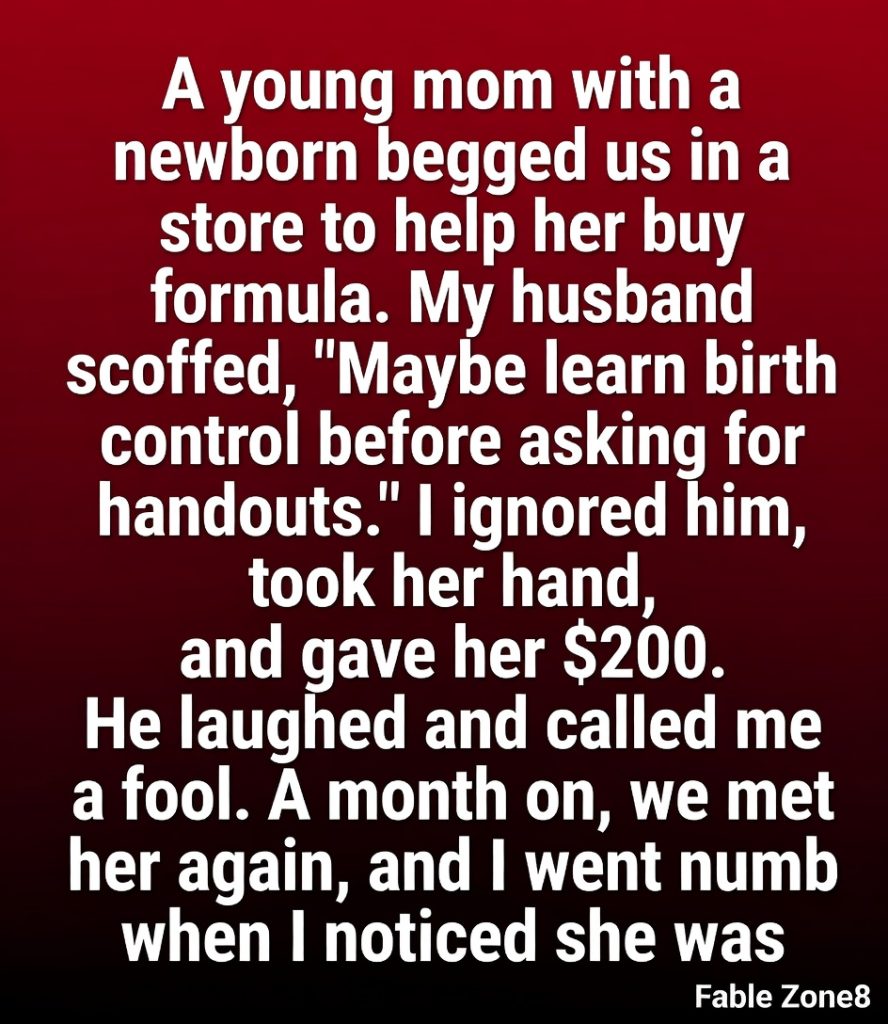
I remember the exact moment my life split into a “before” and an “after,” though at the time it seemed like nothing more than an ordinary afternoon errand. The grocery store was crowded, fluorescent lights humming softly overhead, carts rattling against tiled floors as people moved through their routines without a second thought. I was standing in the baby aisle, comparing brands of formula for a colleague who had recently become a mother, when I noticed her.
She looked exhausted.
Not the kind of tired that a good night’s sleep could fix, but the deep, hollow fatigue that comes from carrying too much for too long. A newborn rested in her arms, wrapped in a thin blanket, tiny fingers peeking out as if reaching for something steady in a world that clearly wasn’t. Her eyes darted between the shelves and the price tags, her lips pressed together in quiet panic.
She hesitated before approaching us.
“Excuse me,” she said softly, her voice barely rising above the noise of the store. “I’m really sorry to ask… but could you help me buy some formula? I don’t have enough.”
Before I could respond, my husband let out a short, dismissive laugh.
“Maybe learn birth control before asking for handouts,” he muttered, not even trying to lower his voice.
The words hit harder than they should have, sharp and cold, but not entirely surprising. He had always been like that—skeptical, dismissive, convinced that most people asking for help were just looking for an easy way out. I had spent years excusing it as practicality, as realism, as something less harsh than what it truly was.
But in that moment, standing in front of a young mother who looked like she might collapse under the weight of everything she was carrying, I couldn’t ignore it.
I reached for her hand.
“It’s okay,” I told her gently. “Let me help.”
Without overthinking it, I pulled out my wallet and handed her two hundred dollars. It was more than she needed for formula, I knew that, but something about her situation made me want to give her a little breathing room, even if just for a few days.
Her eyes filled with tears instantly.
“Thank you,” she whispered, her voice trembling. “You don’t know how much this means.”
I smiled, squeezing her hand briefly before letting go. “Take care of your baby,” I said.
As we walked away, my husband shook his head, a smirk playing on his lips.
“You’re too soft,” he said. “People like that will take advantage of you every time.”
I didn’t argue.
At the time, I didn’t feel the need to.
Because kindness, I believed, didn’t require justification.
For weeks after that, the moment faded into the background of daily life. It became just another small story, one I might have shared with friends over coffee as an example of how unpredictable life could be. My husband, however, didn’t let it go so easily.
He brought it up at dinner.
At random moments.
Always with that same tone—half amusement, half ridicule.
“Remember your charity case?” he would say with a chuckle. “Hope she spent it wisely.”
I would roll my eyes and move on, refusing to let his cynicism dull something I still believed was right.
But looking back now, those moments feel different.
They feel like clues.
A month later, I found myself back in the same store.
It was late afternoon again, the same soft hum of activity filling the space, the same aisles lined with products that suddenly felt strangely familiar. I wasn’t thinking about that day anymore. Not consciously.
Not until I saw her again.
She was standing near the checkout this time, gently rocking the same baby in her arms. For a moment, I didn’t fully register who she was. Something about her presence felt familiar, but distant, like a memory just out of reach.
Then our eyes met.
Recognition flickered instantly.
Her expression changed—subtle, but unmistakable. A mix of surprise, discomfort, and something deeper I couldn’t quite place at first.
I smiled automatically and stepped closer.
“Hi,” I said. “Do you remember me?”
She nodded slowly.
“Yes,” she replied, her voice quieter now. “I remember.”
And then I saw it.
The bracelet.
A delicate gold chain wrapped around her wrist, catching the light as she adjusted the baby in her arms.
My breath caught.
Because I knew that bracelet.
I had seen it before.
I had held it in my hands.
It belonged to my husband.
Or at least, it had—until he told me he lost it during a business trip the year before.
The world didn’t stop.
It didn’t slow down.
But something inside me did.
Everything sharpened at once—the sound of carts rolling past, the distant beep of scanners, the murmur of conversations blending into a dull roar. My heart began to pound, each beat louder than the last, as pieces of something I hadn’t even realized I was missing began to fall into place.
Late nights.
Unexplained absences.
Phone calls he took in another room.
Cash withdrawals that didn’t match any visible expense.
I looked at her again, really looked this time.
And suddenly, I knew.
“Where did you get that bracelet?” I asked, my voice steadier than I felt.
She froze.
Her fingers instinctively moved to cover it, as if she could hide the truth by simply concealing the evidence.
For a moment, neither of us spoke.
Then she sighed.
And in that single breath, everything unraveled.
“I didn’t want you to find out like this,” she said softly.
The words hit like a physical blow.
Find out.
Not guess.
Not suspect.
Find out.
I felt something inside me go completely still.
“How long?” I asked.
“Almost a year,” she admitted, her eyes dropping to the floor. “It started during a conference. He told me… he told me things weren’t good between you two. That he was going to leave.”
I let out a slow breath, though it felt like I wasn’t getting enough air.
“And the baby?” I asked, even though I already knew the answer.
She nodded.
“He’s his.”
I don’t remember walking out of the store.
I don’t remember loading the groceries into the car.
I don’t remember the drive home.
All I remember is the silence.
A heavy, suffocating silence filled with thoughts I couldn’t yet fully process.
Every memory of our marriage began to shift, like a picture being slowly rewritten. Moments that once felt ordinary now carried a different weight, a different meaning.
How long had I been living alongside a lie?
How many times had I looked at him and seen only what I wanted to see?
When he walked through the door that evening, everything felt surreal.
He was smiling.
Relaxed.
Completely unaware.
I placed the bracelet on the kitchen table between us.
For a split second, he didn’t react.
Then his face changed.
The color drained instantly, his expression collapsing into something raw and exposed.
“Where did you get that?” he asked, though his voice lacked conviction.
“I saw her again,” I said.
Silence.
Then came the denial.
Quick.
Instinctive.
Clumsy.
“It’s not what you think,” he said.
But it was.
And we both knew it.
The truth came out in fragments.
An affair that started casually.
A mistake that turned into something more.
A pregnancy he hadn’t planned for.
A double life he thought he could manage indefinitely.
He had been supporting her quietly, sending money, meeting her in secret, convincing himself that he could maintain both realities without consequence.
And the day I gave her two hundred dollars?
He had recognized her immediately.
But he said nothing.
Instead, he stood there and watched as I unknowingly helped support the life he had hidden from me.
Then he mocked me for it.
In the days that followed, something unexpected happened.
I didn’t break.
I didn’t scream.
I didn’t beg.
I became… clear.
The numbness that had settled over me began to shift into something sharper, something steadier. For the first time in months—maybe years—I saw everything exactly as it was, without excuses or softened edges.
And what I saw was simple.
I couldn’t stay.
He begged.
Promised change.
Suggested therapy.
Swore it meant nothing.
But it meant everything.
Because it wasn’t just the betrayal.
It was the deception.
The manipulation.
The way he had made me question my own instincts while hiding an entire life behind my back.
I packed his things quietly.
Box by box.
Memory by memory.
And when he finally left, the silence that filled the house felt different.
Not empty.
Free.
Months have passed since then.
I still shop at that same store, though I avoid the baby aisle now. Not out of pain, but out of respect for the version of myself that stood there that day—kind, open, unaware of what was about to unfold.
I started volunteering at a women’s shelter.
Helping in a way that felt more grounded.
More sustainable.
More real.
Because I still believe in kindness.
I just understand it differently now.
Sometimes I think about her.
About the young mother who stood in that aisle, asking for help.
She reached out once after everything came to light, offering to return the money. I told her to keep it.
Not because it didn’t matter.
But because it did.
That moment—however painful its consequences—revealed a truth I might have otherwise continued to ignore.
And for that, strangely, I’m grateful.
My ex-husband still sends messages occasionally.
Short.
Careful.
Hopeful.
I don’t respond.
Because some doors, once closed, are not meant to be reopened.
If there’s one thing I’ve learned, it’s this:
Compassion is never wasted.
Even when it leads you to uncomfortable truths.
Even when it breaks something you thought was unshakable.
Because sometimes, the most painful revelations are also the most necessary.
And sometimes, the moment you feel yourself going numb…
is the moment you finally begin to see clearly.