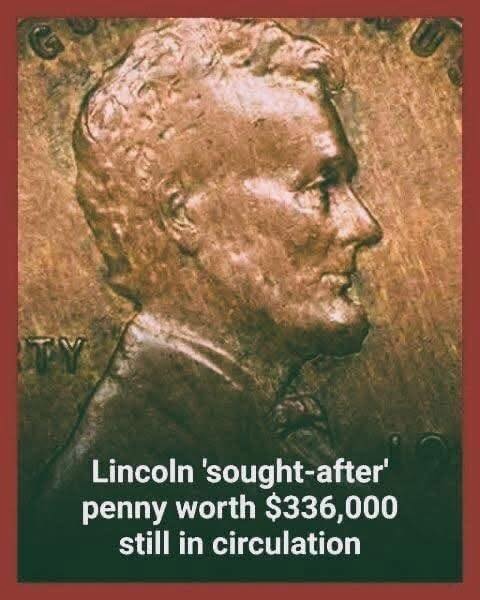
There are moments in history when necessity reshapes even the smallest details of everyday life. During the height of World War II, the United States found itself in exactly such a moment—when every resource mattered, every material was accounted for, and even something as ordinary as a penny became part of a larger national effort.
In 1943, the United States Mint made a decision that would ripple through history in a way no one could have anticipated. Copper, a key component in the production of pennies, was urgently needed for wartime manufacturing—used in everything from ammunition to communication wiring. To conserve this vital resource, the Mint replaced the traditional bronze composition of the one-cent coin with zinc-coated steel.
The result was the distinctive 1943 steel penny—silvery in appearance, lightweight, and unlike anything Americans had seen before.
But amid this large-scale shift in production, a small and nearly invisible mistake occurred.
A few leftover bronze planchets—metal blanks intended for coin striking—remained in the minting machinery from the previous year. These were not meant to be used again. They were simply overlooked, caught in the transition between materials. And when they passed through the presses alongside the new steel blanks, they were struck with the 1943 date.
The outcome was something that should not have existed.
The 1943 Bronze Lincoln Cent was born—not through intention, but through oversight.
At the time, no one noticed.
The coins entered circulation quietly, indistinguishable from ordinary pennies to the untrained eye. They passed from hand to hand, spent on small purchases, dropped into jars, carried in pockets—living ordinary lives despite their extraordinary nature.
It wasn’t until a few years later, around 1947, that whispers began to circulate.
Collectors and curious individuals started reporting sightings of a “copper 1943 penny.” At first, these claims were met with skepticism. The Mint itself denied their existence, suggesting that such coins were either altered or misunderstood. After all, the official records showed no intention to produce bronze cents that year.
But the reports didn’t stop.
Eventually, experts began examining these coins more closely. Through metallurgical testing and authentication processes, they confirmed what many had begun to suspect: the coins were real.
They were not counterfeits.
They were genuine mint errors.
And they were incredibly rare.
Estimates suggest that fewer than 20 authentic 1943 bronze cents exist across all mint locations—Philadelphia, Denver, and San Francisco. Each carries subtle identifying marks, such as the absence or presence of a mintmark, indicating where it was struck.
This rarity transformed the coin from a curiosity into a legend.
Among collectors, it quickly became known as one of the most coveted pieces in American numismatics—a “holy grail” that symbolized both historical significance and the thrill of discovery.
But what makes the story truly compelling is not just the rarity.
It’s the possibility.
Unlike many valuable artifacts that are locked away in museums or private collections, the 1943 bronze cent entered the world through circulation. It was not hidden behind glass from the beginning. It was part of everyday life.
And that means—at least in theory—it could still be out there.
The idea that a coin worth hundreds of thousands of dollars could be sitting unnoticed in a jar, tucked into an old drawer, or mixed in with loose change has fueled decades of fascination.
Stories have emerged over the years that reinforce this possibility.
One of the most famous involves a teenager who discovered such a coin in his lunch money. At the time, he didn’t fully understand its value. He simply held onto it. Decades later, that same coin would be authenticated and sold for a substantial sum, transforming a small moment of chance into a lasting legacy.
These stories blur the line between myth and reality.
They invite people to look more closely at the ordinary.
To question whether something overlooked might, in fact, be extraordinary.
Part of what makes the 1943 bronze cent so identifiable—at least in theory—is its contrast with the standard steel pennies of that year. While the steel cents have a silvery, almost gray appearance and are magnetic due to their composition, the bronze versions retain the warm, reddish-brown hue of traditional copper coins.
This difference has led to one of the simplest tests used by enthusiasts: the magnet test.
If a 1943 penny sticks to a magnet, it is almost certainly a steel cent.
If it does not, it could warrant further examination.
But even this method comes with caution.
Over the years, countless counterfeit versions have been created. Some involve copper-plating steel pennies to mimic the appearance of bronze. Others involve altering the date on a 1948 penny, reshaping the “8” to resemble a “3.”
These imitations have flooded the market, making genuine examples even more difficult to identify.
As a result, authentication by professional numismatists has become essential.
Organizations like the American Numismatic Association play a critical role in verifying such coins, using advanced techniques to analyze composition, weight, and structural details.
Without proper verification, even a convincing coin remains uncertain.
Yet the presence of counterfeits has not diminished interest.
If anything, it has heightened the sense of intrigue.
Because behind every imitation lies the possibility—however small—that a real one might still be found.
The historical context of the coin adds another layer of meaning.
During World War II, the United States underwent a transformation that touched every aspect of life. Industries shifted production, households adapted to rationing, and even the smallest objects were reconsidered in terms of their contribution to the war effort.
The penny, often overlooked in everyday transactions, became part of that transformation.
Switching from bronze to steel was not just a technical decision—it was a reflection of national priorities.
And the accidental creation of a few bronze coins during that transition captures something uniquely human: the inevitability of error, even in the most carefully managed systems.
It is a reminder that history is not always precise.
That even in moments of intense focus and discipline, small deviations can occur.
And sometimes, those deviations become the most interesting stories of all.
Today, surviving examples of the 1943 bronze cent are held in a mix of public and private collections. Some are displayed in institutions like the Smithsonian Institution, where they are preserved as part of the nation’s historical record.
Others remain in the hands of collectors, occasionally appearing at auction and drawing significant attention.
Prices have varied over the years, but they consistently reach into the hundreds of thousands—and sometimes beyond. One example famously sold for over a million dollars, cementing its status as one of the most valuable coins in American history.
These sales reignite public interest each time they occur.
Headlines spread quickly, reminding people that such treasures exist—and that they once circulated freely among ordinary coins.
This is where the story becomes personal.
Because unlike many historical artifacts, the 1943 bronze cent invites participation.
It encourages people to look at their own possessions differently.
To examine what they might otherwise ignore.
To consider the possibility that value is not always obvious.
That something small, something seemingly insignificant, might carry a story far greater than its appearance suggests.
In a broader sense, the coin represents more than just monetary worth.
It symbolizes the intersection of history, chance, and human curiosity.
It reflects a moment when global events reshaped everyday objects.
It embodies the idea that mistakes can lead to unexpected outcomes.
And it sustains a sense of wonder that continues across generations.
For seasoned collectors, it remains a prized objective.
For casual observers, it serves as a reminder to pay attention.
And for everyone, it tells a story that is both specific and universal.
A story about how something ordinary can become extraordinary.
About how history can hide in plain sight.
And about how, sometimes, the smallest discoveries can carry the greatest impact.
So the next time you come across a handful of coins—whether in your pocket, your car, or a forgotten jar—it might be worth taking a closer look.
Not because you expect to find a fortune.
But because, every now and then, history has a way of showing up where you least expect it.
And occasionally, it arrives in the form of a single, unassuming penny.