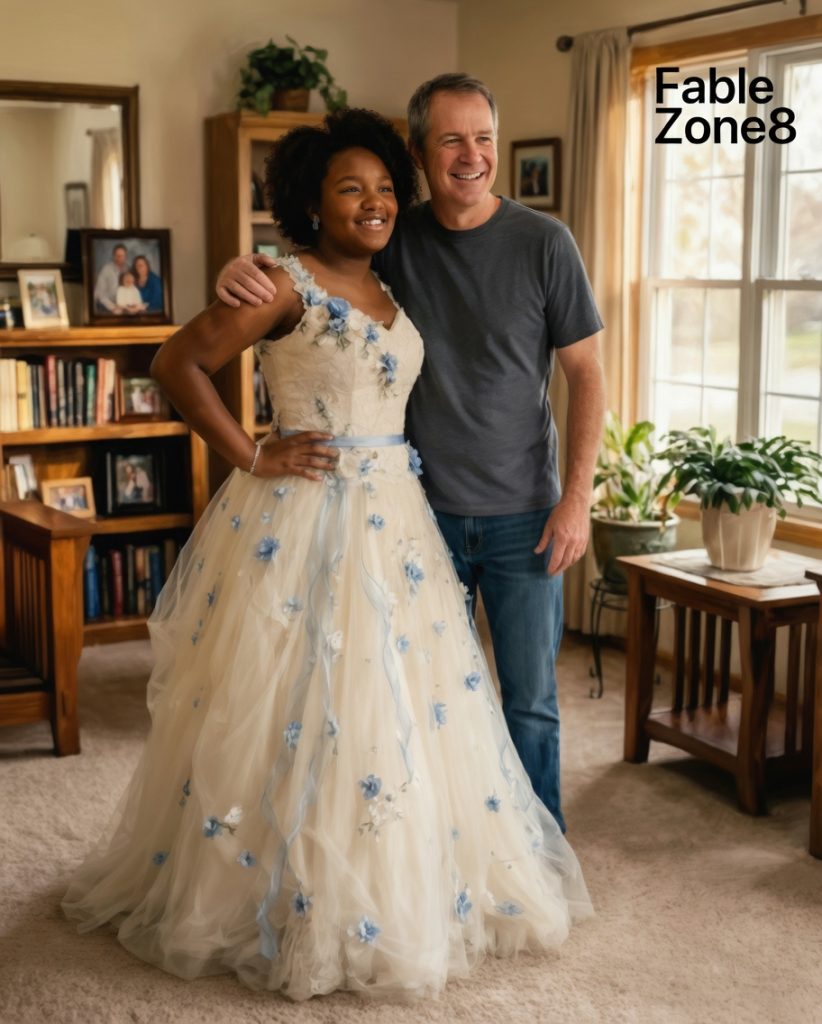
Grief does not always arrive loudly. Sometimes, it settles into the quiet corners of a home, reshaping routines, softening voices, and changing people in ways that are almost imperceptible—until one day, you realize nothing is quite the same as it once was.
After my mother passed away, my father became a quieter version of himself. Not absent, not distant—just quieter. He still showed up in all the ways that mattered. He made breakfast every morning, even when he was running late for work. He reminded me about assignments, checked in about my day, and learned how to braid my hair after watching a video more times than he’d ever admit. He wasn’t expressive with words, but he never let me feel alone.
Still, there were things he didn’t know how to replace.
There were moments in my life where my mother’s absence felt heavier than usual—school dances, parent-teacher meetings, and the quiet, ordinary conversations that other girls seemed to have so easily. I learned early not to dwell on those gaps too much. Life had already taken enough.
So when prom season approached, I kept my expectations low.
I told myself I didn’t need a special dress. I didn’t need the full experience. I could borrow something, keep things simple, and let the night pass like any other event. It felt easier that way—safer, even.
One evening, I mentioned it casually while we were cleaning up after dinner.
“I’ll probably just borrow a dress,” I said, shrugging as if it didn’t matter.
My father paused for a moment, his hands resting on the edge of the sink. Then he nodded, but not in the way I expected.
“Leave the dress to me,” he said.
I laughed.
Not because I doubted him as a father—but because the idea seemed impossible. My dad could fix anything mechanical. He could build, repair, assemble. But sewing? Designing a dress? It didn’t fit into the version of him I knew.
“Okay,” I said lightly, assuming the conversation would fade.
But it didn’t.
A few days later, I noticed something strange in the living room.
A sewing machine.
It sat on the small table near the window, completely out of place among the tools and practical items that usually filled our home. At first, I thought maybe he was fixing something—adjusting a tear in fabric or repairing an old curtain.
But then I saw the material.
Ivory.
Delicate.
Familiar.
I didn’t need to ask where it had come from.
My mother’s wedding dress had been stored carefully for years, tucked away in a box we rarely opened. It had always felt like something sacred—untouchable, preserved in time. Seeing it now, draped across the table under my father’s hands, felt like witnessing something deeply personal.
He didn’t explain.
And I didn’t ask.
There was something about the way he worked—quietly, patiently, night after night—that made it clear this wasn’t just a project. It was something more. Something he needed.
The soft hum of the sewing machine became part of our evenings. I would do my homework while he worked nearby, occasionally pausing to adjust the fabric or examine a seam with careful attention. His hands, so used to rough materials and solid tools, moved with surprising gentleness.
It wasn’t perfect.
Sometimes the thread would bunch. Sometimes he would undo a section and start again. But he never seemed frustrated. If anything, he seemed focused in a way I hadn’t seen since before my mother passed.
Like he had found a purpose hidden inside the act itself.
Weeks passed like this.
Then one night, he called me into the living room.
He was standing beside the sewing machine, holding a garment bag. There was something in his expression I hadn’t seen before—nervousness. Not uncertainty, exactly, but the kind that comes from caring deeply about how something will be received.
“I think it’s ready,” he said.
I stepped closer, my heart beating faster than I expected.
When I unzipped the bag and pulled the dress out, everything else faded.
It was beautiful.
Not in the polished, perfect way you’d see in stores or magazines—but in a way that felt real, intentional, and deeply meaningful. The ivory fabric had been reshaped into something new, something that fit me perfectly while still carrying echoes of what it had once been.
He had added small blue flowers along the bodice, each one stitched by hand.
“They were your mom’s favorite,” he said quietly.
I ran my fingers over the fabric, noticing the tiny imperfections—the slightly uneven stitching, the places where the seams weren’t perfectly aligned. But those details didn’t take anything away.
If anything, they added to it.
Because every stitch told a story.
Every detail was proof of effort, of time, of love that had been poured into something tangible.
“It’s perfect,” I said, my voice barely above a whisper.
He smiled, relief softening his features.
And in that moment, I realized something important.
This wasn’t just a dress.
It was a bridge—between past and present, between memory and possibility. It carried my mother’s presence in a way that felt comforting rather than painful. And it carried my father’s love in a way that didn’t need words.
On the night of prom, I wore that dress with a kind of quiet confidence I hadn’t expected.
For the first time, I didn’t feel like I was missing something.
I felt complete.
The venue was filled with lights and music, laughter echoing off the walls as groups of students gathered and moved together. For a while, everything felt easy. Natural.
People noticed the dress.
Not in a dramatic way—just small glances, quiet compliments, curious smiles. It felt good, but more than that, it felt right.
Until it didn’t.
Mrs. Tilmot, my English teacher, approached me with a smile that never quite reached her eyes.
She had always been like that—carefully critical, delivering comments that hovered just on the edge of acceptability. Enough to sting, not enough to be easily challenged.
She looked at my dress, tilting her head slightly.
“Oh,” she said, her voice carrying just enough to draw attention. “That’s… interesting. It looks like something pulled out of an attic.”
The words landed harder than I expected.
It wasn’t just an insult.
It felt like something deeper—like she had reached into a space that was personal, fragile, and meaningful, and dismissed it with a single sentence.
For a moment, I couldn’t speak.
Heat rose to my face, and I became acutely aware of the people around me. The music seemed quieter, the room smaller.
I wanted to say something.
To defend the dress.
To explain what it meant.
But the words didn’t come.
Then, before the silence could settle into something heavier, another voice cut through.
“That’s enough.”
Officer Warren stepped forward, his tone calm but firm. The assistant principal stood beside him, her expression serious.
They addressed Mrs. Tilmot directly, asking her to step outside.
There was no argument.
No hesitation.
Just a quiet shift in the room—a sense that something important had been acknowledged.
As they led her away, I felt something I hadn’t expected.
Relief.
Not just because the moment had been interrupted, but because it confirmed something I had questioned for a long time.
It wasn’t me.
It had never been me.
There had been patterns, complaints, concerns—things I hadn’t fully known or understood. But now, in that moment, it became clear that her behavior wasn’t isolated.
And it wasn’t acceptable.
When she was gone, the atmosphere changed.
The tension dissolved, replaced by something softer.
People approached me again, but this time with genuine interest.
“Where did you get your dress?” someone asked.
“My dad made it,” I said.
Their reactions shifted instantly.
Surprise.
Admiration.
Respect.
When I explained that it had been my mother’s wedding dress, transformed into something new, the meaning of it seemed to resonate in a way no explanation could fully capture.
My best friend grabbed my hand.
“Come on,” she said, pulling me toward the dance floor.
And this time, I didn’t hesitate.
As I moved through the rest of the night, something inside me felt different.
Stronger.
The dress no longer felt fragile, like something that could be diminished by a single comment. It had already proven what it was worth.
Not through perfection.
But through meaning.
When I got home, the house was quiet.
My father was sitting in the living room, waiting.
He looked up as I walked in, his expression searching mine for any sign—good or bad.
“How was it?” he asked.
I smiled.
“It was good,” I said.
He nodded, then hesitated before asking the question that mattered most to him.
“The dress… did it hold up?”
I stepped closer, still wearing it, still feeling everything it represented.
“It did more than that,” I said.
And I meant it.
Because the dress hadn’t just carried me through the night.
It had reminded me of something far more important.
That love doesn’t have to be perfect to be powerful.
That effort matters more than appearance.
And that the things made with the most care—no matter how imperfect they may seem—are often the ones that stay with us the longest.
That night didn’t just give me a memory.
It gave me something stronger.
A quiet understanding that no one’s words could take away what had been created with love.
And that, in the end, is what truly lasts.