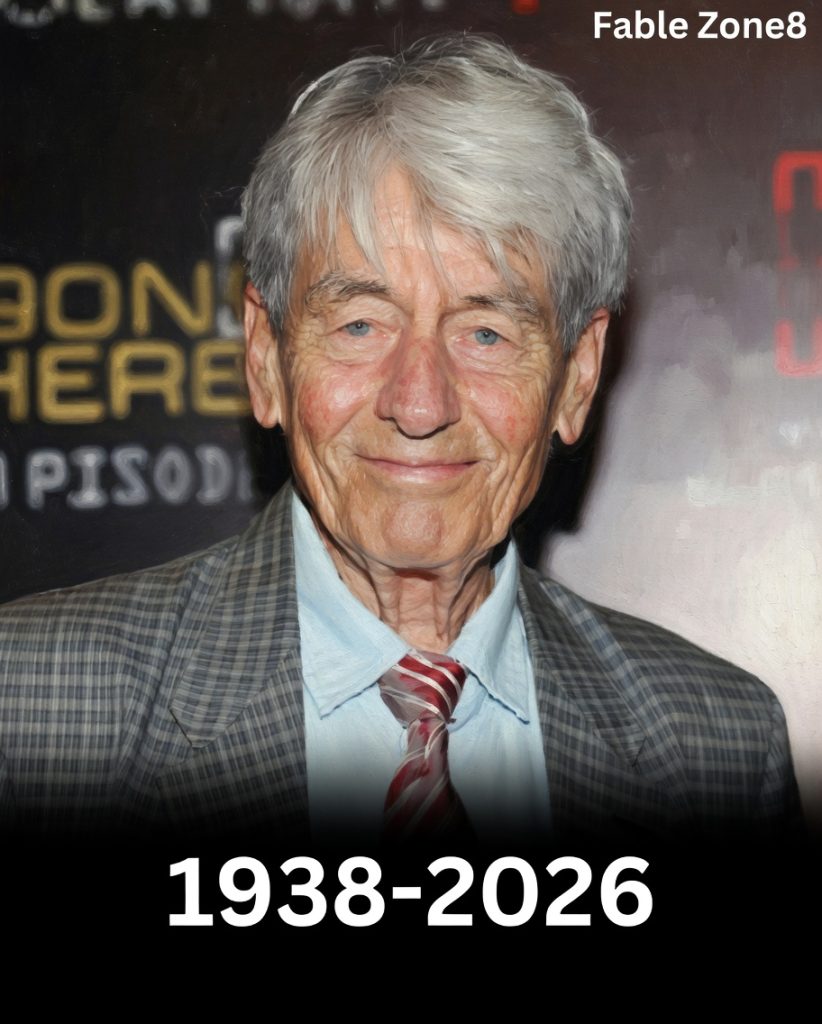
The passing of John Nolan at the age of 87 marks the end of a long and steady career that quietly but meaningfully spanned more than half a century. Though never defined solely by leading roles or headline status, Nolan’s work resonated across generations, connecting traditional theater audiences with modern viewers through a body of performances that reflected both discipline and adaptability.
Born on May 22, 1938, in London, Nolan came of age in a period when British acting was still deeply rooted in stage tradition. His early training at the Drama Centre London provided him with a rigorous foundation, emphasizing technique, emotional depth, and versatility. This environment shaped not only his skills but also his approach to the craft—one that would remain consistent throughout his career.
Like many actors of his generation, Nolan began on the stage, where the demands of live performance require a particular kind of presence and discipline. He toured with theater companies and took on classical roles that tested both range and endurance. Among his early highlights was performing as Romeo opposite Francesca Annis at the Richmond Theatre. These experiences were formative, immersing him in the rhythms of Shakespearean language and classical storytelling.
His commitment to theater led him to join some of the most respected institutions in British performing arts. At the Royal Court Theatre, Nolan became part of a creative environment known for pushing boundaries and exploring contemporary themes. He later spent two years with the Royal Shakespeare Company, where he appeared in productions such as Julius Caesar, The Merry Wives of Windsor, and The Relapse. These roles placed him firmly within the classical tradition, allowing him to refine his craft among some of the most skilled actors and directors of the time.
While theater remained central to his identity, Nolan gradually expanded into television—a medium that was rapidly growing in both reach and influence during the latter half of the 20th century. His early breakthrough came with the BBC adaptation of Daniel Deronda, in which he played the title role. This performance introduced him to a wider audience and demonstrated his ability to carry complex narratives on screen.
Television in Britain during this era offered actors opportunities to explore a range of genres, from science fiction to social drama. Nolan appeared in series such as Doomwatch, where he portrayed scientist George Harcastle, and Shabby Tiger, among others. His performances were often marked by a composed, deliberate style that reflected his theatrical background while adapting effectively to the more intimate demands of the camera.
As his career progressed, Nolan also ventured into film. His appearances in productions like Bequest to the Nation, Terror, and The World Is Full of Married Men demonstrated his willingness to work across different formats and genres. While these roles did not always place him in the spotlight, they contributed to a steady and reliable presence within the industry.
A significant turning point in Nolan’s later career came through his connection to his nephews, Christopher Nolan and Jonathan Nolan. This familial link brought him into some of the most high-profile productions of the 21st century, introducing him to a new generation of viewers.
In Batman Begins and The Dark Knight Rises, Nolan portrayed Douglas Fredericks, a board member of Wayne Enterprises. Though a supporting role, his presence in these films placed him within a globally recognized franchise, connecting his long-standing career to one of the most influential cinematic universes of modern times.
His collaboration with Jonathan Nolan extended further into television with Person of Interest. In this series, he took on the role of John Greer, a former intelligence officer who becomes a central figure in a shadowy organization built around advanced artificial intelligence. The character was complex and quietly menacing, requiring a performance that balanced restraint with underlying intensity.
Nolan’s portrayal of Greer stood out for its subtlety. Rather than relying on overt displays of power, he conveyed authority through calm speech and controlled presence. This approach aligned well with the show’s themes of surveillance, control, and moral ambiguity, making his character a memorable part of the narrative.
Beyond his on-screen work, Nolan remained deeply connected to the theater. In the early 1980s, he co-wrote and starred in a trilogy based on the works of Fyodor Dostoyevsky for the Bristol New Vic company. This project reflected his ongoing interest in literary adaptation and his commitment to exploring complex material through performance.
His voice also became a medium through which he reached audiences. Nolan contributed narration to projects associated with the Discovery Channel, including recordings used in international airline entertainment systems. These roles, while less visible than his acting work, demonstrated the versatility of his talents and his ability to engage audiences in different ways.
Throughout his career, Nolan exemplified a particular kind of actor—one who prioritizes craft over recognition, consistency over fame. He was not defined by a single iconic role but by the accumulation of performances that, taken together, formed a rich and varied body of work.
His personal life remained relatively private. He is survived by his wife, Kim Hartman, their children Miranda and Tom, and grandchildren Dylan and Kara. Those closest to him remember not only his professional achievements but also his dedication to family and the quiet integrity with which he approached both life and work.
In reflecting on his legacy, it becomes clear that Nolan’s impact lies not in moments of spectacle but in sustained contribution. He was part of an era when actors moved fluidly between stage and screen, adapting to the evolving landscape of entertainment while maintaining a strong connection to traditional techniques.
His journey—from the stages of London to internationally recognized film and television productions—mirrors the broader evolution of the industry itself. It is a testament to the value of adaptability, persistence, and a deep respect for the craft of acting.
For audiences who encountered him in the Batman films, he may be remembered as a familiar face within a vast cinematic world. For viewers of Person of Interest, he will remain the voice and presence behind one of the show’s most intriguing characters. And for those who saw him on stage or in earlier television work, he represents a generation of performers who built their careers through dedication and discipline.
In the end, John Nolan’s career serves as a reminder that influence in the arts is not always measured by visibility alone. Sometimes, it is found in the steady presence of an actor who brings authenticity to every role, regardless of size or prominence.
His work endures—not as a single defining moment, but as a continuous thread woven through decades of storytelling.
And in that continuity, his legacy remains.