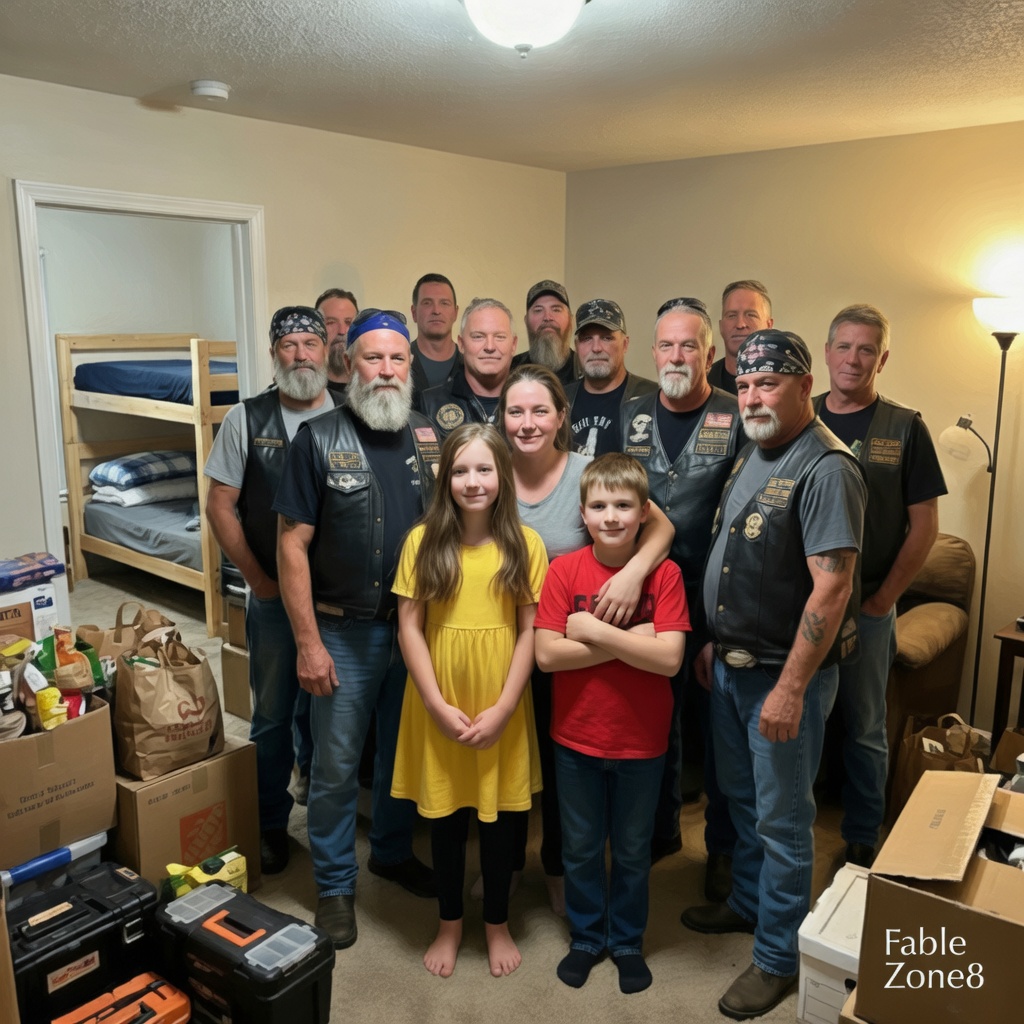
At seven on a cold Tuesday morning, I stood in the doorway of my apartment holding my four-year-old daughter on my hip while my seven-year-old son clung tightly to my legs. The hallway light flickered overhead, casting weak shadows that stretched and trembled along the cracked walls. The building always smelled faintly of dust and old paint, but that morning it felt heavier, like the air itself had thickened with something unspoken.
Then I heard it.
Boots.
Not one or two, but many—heavy, deliberate, echoing up the stairwell. Each step seemed louder than the last, as if the sound itself was announcing something I wasn’t ready to face. My son pressed closer, trembling so hard I could feel it through my clothes. My daughter buried her face in my shoulder, her small fingers gripping my sweater.
And then they appeared.
Nearly thirty bikers filled the narrow hallway as they reached our floor, their presence overwhelming. Leather vests, worn boots, broad shoulders—figures that blocked what little light filtered in. At the front stood my landlord, Rick, his expression flat, his posture rigid. He didn’t waste time.
The rent was overdue, he said.
My time was up.
These men were here to remove our belongings and place them on the curb.
The words hit harder than I expected. I tried to explain—about the new job, about the paycheck coming in just a week, about how I only needed a little more time. My voice felt small, almost distant, as if it didn’t belong to me. Rick barely looked at me as I spoke.
My daughter started to cry softly into my shoulder.
My son tightened his grip around my legs as if letting go would mean losing everything.
In that moment, fear wasn’t just an emotion—it was something physical, something that wrapped itself around my chest and made it hard to breathe. I couldn’t think beyond the next few minutes. I couldn’t imagine where we would go, what we would do, or how I would protect my children from what was about to happen.
The hallway fell into a tense silence.
Then one of the bikers stepped forward.
He was tall, broad-shouldered, with a gray beard that framed a face shaped more by experience than harshness. His vest bore the name Marcus. There was something steady about him—something that didn’t match the tension around us.
His voice, when he spoke, was firm but not cruel. He asked me to step aside so they could begin.
I opened my mouth, ready to beg again, to say anything that might buy us even a few more minutes.
But before I could speak, my son let go of my legs.
He ran forward.
In a heartbeat, he wrapped his small arms around Marcus’s leg, pressing his face into the worn leather. His voice broke as he pleaded, asking him not to take our home.
The entire hallway went still.
Marcus froze.
For a moment, it seemed like no one knew how to react. Then slowly, Marcus looked down at my son. His expression changed—not dramatically, but enough to notice. His eyes shifted past us, into the apartment behind me.
He stepped inside.
One by one, the other bikers followed.
Rick protested loudly from the hallway, insisting they stay focused on the job. But no one listened anymore. Their attention had shifted completely.
Inside my apartment, there was only one thing that mattered.
The wall.
I had covered it with photographs over the years because they were all I had left. Pictures of my husband in uniform, smiling in ways that felt frozen in time. Moments of him holding our children. Memories captured before everything changed. And at the end, the photo I could never bring myself to take down—his military funeral, flags folded, hands raised in salute.
Marcus stood in front of that wall in silence.
Then he called Rick inside.
He pointed at the photographs and asked a simple question.
“Who is he?”
It was a question no one had ever asked.
Not in the months of overdue rent.
Not in the warnings.
Not even now, when everything was about to be taken from us.
My voice felt different when I answered.
I told them I was a widow.
I told them my husband had died in combat.
I told them I was raising our children alone.
The room changed.
One of the bikers stepped closer to the photographs, studying them carefully. Then recognition crossed his face. He spoke my husband’s name with a kind of respect that filled the space.
He talked about overlapping units, about missions, about a moment when my husband had acted without hesitation and saved lives.
The silence that followed was heavy, but not with fear anymore.
Rick tried to brush it off, muttering something about business being business. But Marcus turned to him, his voice calm and unwavering.
“How much is owed?”
Rick answered.
Marcus nodded once and stepped outside with the others. Their conversation was quiet, urgent, focused. I stood there, unsure of what was happening, my children close to me, my heart still racing.
Ten minutes later, Marcus came back.
He held a check.
He handed it to Rick and told him the eviction was over.
Just like that.
The tension that had filled every corner of the apartment dissolved, replaced by something I couldn’t fully process yet—relief, disbelief, something in between.
But they didn’t leave.
Instead, they stayed.
One man asked about my work experience and offered me a job—steady, with benefits, starting immediately. No waiting, no uncertainty.
Others moved through the apartment, fixing things I had learned to ignore. A loose cabinet hinge. A leaking faucet. The heater that barely worked suddenly began to push warm air into the rooms.
Groceries appeared—bags filled with food my children hadn’t seen in weeks.
Someone checked my car and fixed a problem that had been quietly worrying me for months.
They asked about my kids’ schedules and helped arrange after-school care so I could work without fear.
And while they worked, they listened.
They listened as I spoke about my husband, about the life we had, about everything that had changed. They didn’t interrupt. They didn’t offer empty words. They didn’t try to fix something that couldn’t be fixed.
They just listened.
For the first time in a long time, I felt seen.
My children slowly began to relax.
My daughter fell asleep on the couch, surrounded by the quiet hum of voices and a sense of safety returning to her world.
My son, curious again, climbed onto Marcus’s lap and said proudly that his father was a hero.
Marcus smiled, his eyes soft, and agreed.
He told my son that bravery runs in families.
That his father’s courage lived on in him.
When it was time for them to leave, my son tried to give Marcus his father’s dog tags.
Marcus gently refused.
Instead, he knelt down, took a small badge from his vest, and pinned it onto my son’s shirt.
“Honorary member,” he said.
My son stood taller than I had seen in months.
In the weeks that followed, they kept showing up.
Sometimes with calls. Sometimes in person. Sometimes with help, sometimes just to check in.
The job gave me stability.
The support gave me space to breathe.
My apartment no longer felt like a place on the edge of loss—it felt like a home again.
Six months later, they are still part of our lives.
They come to birthdays. They show up for school events. They are there when we need them.
What began as fear—thirty bikers in a narrow hallway, the threat of everything falling apart—became something else entirely.
It became proof that people can choose compassion over force.
That strangers can become protectors.
That family isn’t always something you’re born into.
Sometimes, it’s something that finds you when you need it most.