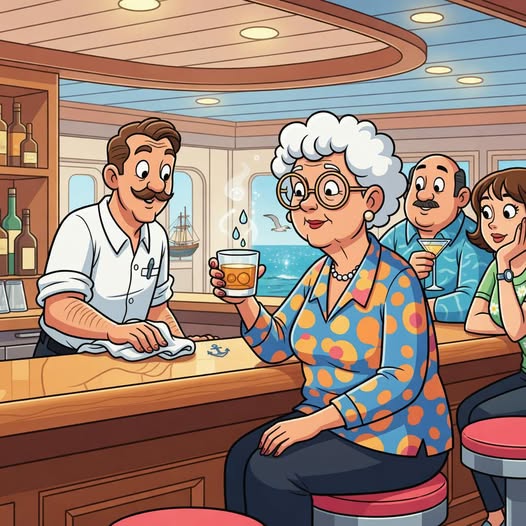
The old woman sat alone at the polished wooden bar of the cruise ship lounge, though “alone” was not entirely accurate. People were everywhere—laughing in clusters, leaning into conversations, clinking glasses in celebration of vacations and temporary freedom—but she existed slightly apart from all of it, as if she were sitting inside a quieter layer of time.
A soft jazz tune drifted through the room, blending with the low hum of the ocean outside. The ship moved steadily forward, cutting through dark water that reflected nothing and everything at once. Above it all, warm amber lighting gave the bar a comforting glow, softening faces and making even strangers feel briefly familiar.
The bartender noticed her almost immediately when she arrived earlier that evening. Not because she demanded attention—she didn’t—but because she didn’t. There was a stillness about her, a kind of calm gravity that made people look twice without knowing why. Now, as she gently swirled the liquid in her glass, he found himself drawn to her again.
He had already refilled her drink once, though she had barely touched it.
“Ma’am,” he said carefully, leaning forward just slightly, “you don’t seem like someone who’s here for the Scotch.”
She smiled faintly, as if she had been expecting the question.
“I suppose I’m not,” she replied.
The bartender hesitated. “Then why drink it?”
She looked down at the glass, watching the amber liquid catch the light. For a long moment she didn’t answer, as if deciding how much of herself she was willing to share with a stranger who would forget her name in a week.
Then she said softly, “Because I’m not really drinking it for the taste anymore.”
That answer alone could have ended the conversation. But instead, it opened something.
The bartender stopped polishing the glass he was holding.
Across the bar, a couple who had been quietly sharing dessert leaned in slightly, sensing the shift in tone. Even the laughter nearby seemed to soften, as if the room itself had unconsciously decided to listen.
The old woman adjusted her glasses with slow precision. Her hands were steady, though aged. “At my age,” she continued, “you learn that most things people call habits… are actually memories in disguise.”
The bartender raised an eyebrow, unsure whether he was hearing philosophy or confession.
“They look like routines,” she added, “but they’re really just echoes.”
She lifted her glass slightly, not drinking yet.
“This,” she said, “is one of them.”
The bartender nodded slowly, still not understanding.
She tapped the glass lightly with her fingernail. “Two drops of water,” she said. “Always two.”
The bartender glanced at the drink, confused. It looked ordinary.
“That’s not for taste,” she continued. “It’s for remembering.”
A silence settled between them.
Then, as if deciding the story no longer belonged only to her, she began.
“I met him when I was twenty-two,” she said.
Her voice shifted slightly, not younger, but lighter—as if the memory itself carried air inside it.
“I was traveling alone. First time I’d ever been truly alone in the world. I thought I was fearless back then. Thought I understood everything important already.”
A faint smile appeared at the corner of her mouth.
“He was sitting at a bar much like this one, arguing with someone about something ridiculous. Music, I think. Or politics. It doesn’t matter now. What mattered was the way he spoke—like he was absolutely certain the world would adjust itself around his opinions.”
She shook her head softly.
“I remember thinking he was unbearable.”
A pause.
“And then I spent the entire night talking to him.”
The bartender chuckled quietly despite himself.
“And by the end of that night,” she said, “I was absolutely certain I would marry him.”
The couple beside her exchanged a look. The kind people make when they realize they’ve accidentally stumbled into something rare.
“He ordered Scotch,” she continued, “and when it arrived, he did something I had never seen before.”
She leaned slightly forward now, as if the memory required closeness.
“He added two drops of water.”
The bartender frowned. “That’s it?”
She smiled. “That’s it.”
She continued, “He did it so carefully. Like it mattered more than the drink itself. Like it was something sacred. I asked him why he did it.”
Her voice softened.
“And he said, ‘Because even strong things deserve a little gentleness.’”
The bartender stopped moving entirely.
Even the couple nearby went quiet.
The old woman let the words settle before continuing.
“We fell in love slowly after that,” she said. “Not like in stories. Not like lightning. More like tide coming in without you noticing until you’re already standing in water.”
She swirled her drink again.
“We got married two years later. Built a life that wasn’t glamorous, but it was ours. We had arguments about dishes, about directions, about nothing that mattered. And we laughed—oh, we laughed constantly. He had this terrible habit of laughing at his own jokes before finishing them.”
A soft, genuine laugh escaped her now.
“I used to pretend I hated it. I didn’t.”
She paused.
“He made a rule,” she said. “Never go to bed angry. No matter how small the argument. No matter how tired we were.”
The bartender nodded slowly, as if absorbing something he didn’t expect to carry with him.
“He said life was too short for unfinished conversations.”
Her gaze drifted for a moment toward the ocean outside the windows.
“He was right,” she added quietly.
The bar felt smaller now. Not physically—but emotionally, as if the story had pulled everyone a little closer together.
“He got sick in our sixties,” she said.
Her tone didn’t break. It steadied.
“One of those illnesses that doesn’t ask permission. It doesn’t wait for preparation. It just arrives and starts taking pieces of the person you love.”
She tightened her grip slightly on the glass.
“It was slow at first. Then it wasn’t.”
The bartender swallowed, suddenly aware of his own breathing.
“But even then,” she continued, “he never stopped noticing small things.”
She looked down at her drink.
“On his last good day, we sat together by the window. The sun was setting. He poured the Scotch himself. His hands were shaking so badly I thought he might spill it.”
A pause.
“But he didn’t forget.”
Her voice softened even further.
“He still added two drops of water.”
The bartender closed his eyes briefly, as if trying to picture it.
“I asked him,” she said, “if it still mattered.”
Silence stretched.
Then she said, “He told me, ‘It always matters. The small things are what make the big things bearable.’”
That sentence seemed to stay in the air longer than sound normally should.
The music continued, but it felt distant now.
“After he died,” she said, “I stopped drinking Scotch.”
Her voice remained calm, but quieter.
“For a long time, I couldn’t even look at it. It felt like betrayal. Like continuing a conversation that someone else had already left.”
She took a breath.
“Then one day, on his birthday, I poured myself a glass.”
She smiled faintly.
“I sat by the window. I didn’t cry. I didn’t speak. I just sat there and looked at nothing in particular.”
Her fingers traced the rim of the glass.
“And I added two drops of water.”
A pause.
“And for the first time since he was gone,” she said, “it didn’t feel like he was missing. It felt like he was simply… elsewhere.”
The bartender leaned lightly against the counter now, no longer pretending to work.
“So you see,” she said gently, “it’s not about Scotch.”
She lifted her glass slightly.
“It never was.”
She took a small sip.
“It’s about remembering that love doesn’t end,” she said. “It changes shape. It becomes quieter. Softer. Less visible, but still there. Like something dissolved into something else—but still present.”
She set the glass down carefully.
“Two drops of water,” she added, “is just my way of making sure I don’t forget that.”
The couple beside her raised their glasses slightly, silently acknowledging the weight of what they had heard.
The bartender finally spoke again, his voice softer than before.
“That’s… probably the most beautiful thing I’ve ever heard,” he admitted.
She smiled, almost embarrassed.
“Oh no,” she said. “It’s not beautiful. It’s just true.”
A pause.
Then she added, almost playfully, “And truth tends to stay with you longer than beauty does.”
She lifted her glass one final time.
The bar around her continued its life—laughing, clinking, moving—but somehow, nothing felt louder than that small, simple ritual.
Two drops of water.
Not for flavor.
Not for show.
But for memory.
For love.
For everything that refuses to disappear, even when time tries to take it away.
And as the ship moved steadily through the dark ocean, carrying all of them forward into the unknown, the old woman sat with her glass, holding eighty years of life in something as small—and as eternal—as a simple, quiet gesture.