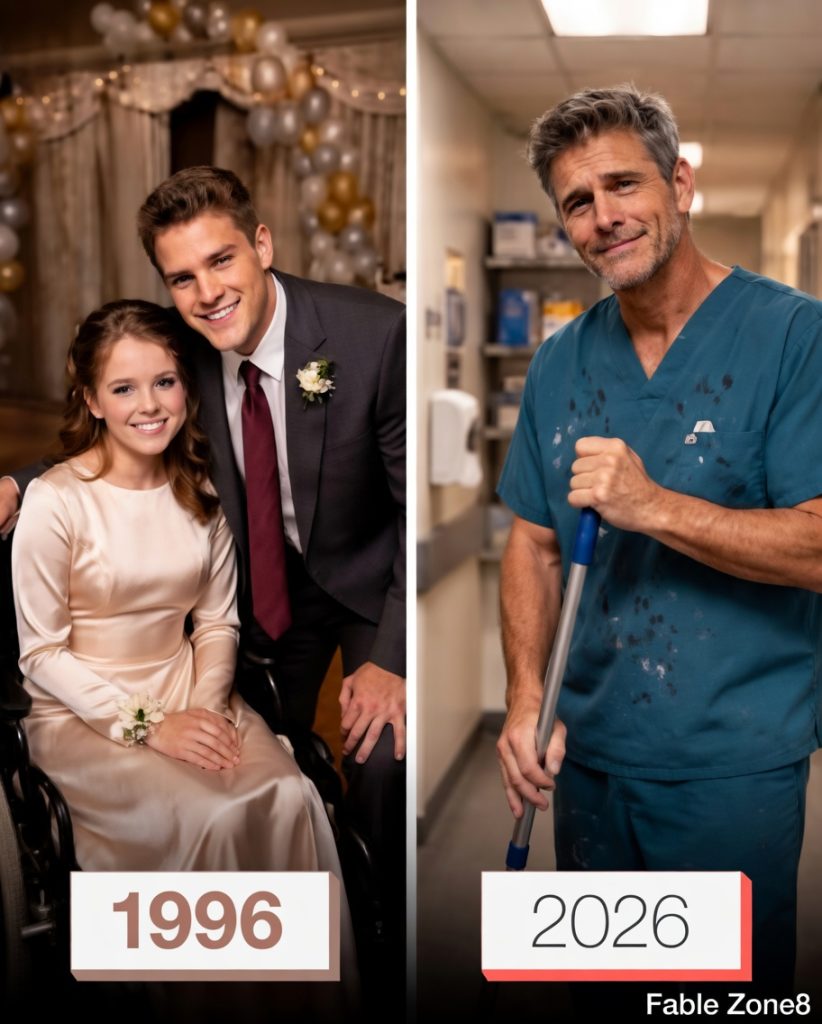
Six months after the accident, I was still learning how to exist in a body—and a life—that no longer felt familiar. Before that day, everything had been simple in the way youth often is. My world was made of routines, friendships, laughter that didn’t need effort, and a quiet confidence I never had to question. Then, in a single moment, that version of me disappeared.
Recovery wasn’t just about healing physically. It was slower, deeper, and far more complicated than anyone could see from the outside. There were days when progress felt real, and others when it felt like I had lost ground entirely. But the hardest part wasn’t learning to move differently—it was learning how to be seen differently.
Or more accurately, how to feel seen at all.
By the time prom season arrived, it felt like an event from another life. The idea of dressing up, stepping into a crowded room, and pretending I still belonged in that version of myself seemed impossible. I didn’t feel like I fit anywhere anymore—not in the life I had before, and not yet in the one I was trying to build.
My mother didn’t push. She didn’t try to convince me with long speeches or forced optimism. She simply reminded me, gently, that life doesn’t wait for us to feel ready. That sometimes, showing up—quietly, imperfectly—is the first step toward finding your place again.
So I went.
Not because I believed it would be magical. Not because I expected anything to change. But because a small, uncertain part of me wondered if she might be right.
The gymnasium looked exactly like it always did—decorations stretched across familiar walls, lights softened to create the illusion of something more elegant, music filling the space with energy. But from where I stood, everything felt distant. Like I was watching a scene unfold that I no longer belonged to.
I stayed near the edge of the room, close enough to observe but far enough to feel safe. People came over, one by one, offering kind words, asking how I was doing. Their intentions were good—I could see that. But their attention was brief. Temporary. They returned to their own moments, their own lives, while I remained in place.
I didn’t resent them.
I just felt separate.
Like I was standing on the outside of something I used to be part of, unsure how to step back in.
And then, without any buildup or expectation, Marcus walked over.
We weren’t close. We had never spent much time together before that night. But there was something about the way he approached me—calm, steady, without hesitation—that felt different from everyone else.
He didn’t look uncomfortable. He didn’t seem unsure of what to say.
He just smiled and asked if I wanted to dance.
For a moment, I froze. Not because I didn’t understand the question, but because I didn’t know how to answer it. I explained quietly that I couldn’t dance the way everyone else was. It was the truth, but it was also something I had come to expect would end the conversation.
Most people didn’t know what to do with that kind of answer.
I expected Marcus to nod politely, maybe say something kind, and then step away.
But he didn’t.
He stayed exactly where he was.
There was no awkward silence, no forced reassurance. Just a simple response that changed everything in a way I didn’t fully understand at the time.
“Then we’ll do it differently.”
It wasn’t dramatic. It wasn’t meant to inspire.
It was just… certain.
At first, I didn’t believe him. But he didn’t rush me. He didn’t pressure me. He just stood there, patient, as if there was nowhere else he needed to be.
So I said yes.
What followed wasn’t perfect. It didn’t match the rhythm of the music or the movements of the crowd around us. But somehow, that didn’t matter. We found something that worked—not by forcing it, but by adjusting, by paying attention, by meeting each other where we were.
He didn’t make me feel like I was slowing him down.
He didn’t treat me like something fragile that needed to be handled carefully.
He just moved with me, naturally, as if this version of dancing was just as valid as any other.
And for the first time in months, I forgot to be self-conscious.
I laughed.
Not the kind of laughter that comes from trying to prove you’re okay—but the kind that happens without permission, without thought.
In that moment, I wasn’t defined by the accident. I wasn’t the girl who had to explain herself or adjust expectations.
I was just… me.
That night didn’t fix everything. It didn’t erase the challenges that came after or suddenly make the world easier to navigate. Recovery still took time. There were still moments when I felt frustrated, isolated, or unsure of who I was becoming.
But something had shifted.
Not loudly. Not dramatically.
Quietly.
That one moment stayed with me—not as a turning point that changed everything overnight, but as a steady reminder that connection was still possible. That I wasn’t as invisible as I sometimes felt.
I carried that with me in ways I didn’t always recognize.
As I moved forward, rebuilding my confidence piece by piece, I found myself drawn to something unexpected: design. Not just in the aesthetic sense, but in the way spaces influence how people feel within them.
I wanted to create environments where no one felt like they had to stand on the edge of the room. Spaces where inclusion wasn’t something people had to ask for—it was built in from the beginning.
It wasn’t just a career choice.
It was personal.
Years passed. Life unfolded in ways that were both challenging and meaningful. I built something I was proud of—a life shaped not by what I had lost, but by what I had learned.
Marcus became a memory.
A good one. An important one.
But still, just a moment in the past.
Until he wasn’t.
It happened on an ordinary afternoon, in a place that didn’t seem significant at the time. A quiet café. The kind of place where people come and go without noticing each other.
I was sitting alone, focused on nothing in particular, when I felt someone stop near my table.
I looked up.
And for a second, nothing made sense.
Time didn’t collapse all at once—it stretched, hesitated, as my mind tried to catch up with what my eyes already knew.
Marcus.
He looked different, of course. Older. So was I. But there was something unmistakable about him. Something steady. Familiar.
He smiled.
And just like that, the years between us didn’t feel as distant.
We started talking. At first, it was simple—where life had taken us, what we had been doing. But underneath those words was something deeper. A shared memory that neither of us had forgotten.
As the conversation unfolded, I learned that his life hadn’t been easy either. He had carried responsibilities early, shaped his path around the needs of others, made choices that required quiet strength.
He didn’t talk about it with bitterness.
Just honesty.
And in that honesty, I saw him more clearly than I ever had before.
We didn’t try to recreate what had happened years ago.
We didn’t need to.
What we built instead was something new—rooted not just in a moment, but in everything we had become since then.
There was no pressure. No expectation.
Just connection.
Over time, that connection grew into something steady and real. We supported each other—not by fixing things, but by understanding them. By respecting the paths we had each taken to get there.
Eventually, our shared values led us to work together. Creating spaces that reflected what we both believed in—places where people felt seen, included, and comfortable just being themselves.
It wasn’t always easy.
But it was meaningful.
And meaning has a way of anchoring you in ways nothing else can.
One evening, at the opening of one of those spaces, the room was full. People moved freely, talking, laughing, existing without hesitation.
Music played softly in the background.
And for a moment, I felt something familiar.
Not the discomfort of that long-ago prom night—but the memory of it. The contrast between who I had been then and who I had become now.
I wasn’t standing on the edge anymore.
I was part of it.
Marcus walked toward me.
The same way he had all those years ago.
No hesitation. No uncertainty.
He didn’t say much.
He didn’t have to.
He simply held out his hand and asked if I wanted to dance.
This time, there was no pause.
No doubt.
Because we already knew how.
And as we moved—imperfectly, naturally, together—I understood something that had taken years to fully reveal itself.
That one small moment, on one ordinary night, hadn’t just mattered in the way I felt at the time.
It had shaped something much bigger.
It had influenced the way I saw myself.
The way I moved through the world.
The choices I made.
The life I built.
Some moments don’t announce their importance when they happen.
They don’t feel like turning points.
They feel small. Quiet. Easy to overlook.
But they stay.
And over time, they grow into something more—guiding us, shaping us, leading us toward futures we couldn’t have imagined in that moment.
And sometimes, if life is kind, we get the chance to return to them.
Not to relive them.
But to understand them.
And to continue the story they quietly began.