The night everything began to unravel did not arrive with shouting or visible chaos. It came quietly, almost invisibly, the way exhaustion settles into a home long before anyone admits something is wrong. I stood in the kitchen long after midnight, staring at the dim glow of the microwave clock, its steady ticking feeling louder than it should have. My husband, Caleb, had already filed for divorce by then. On paper, everything looked composed, almost reasonable. He claimed we had simply grown apart, that our arguments had become too frequent, that I had become overwhelmed, emotionally unstable, unable to manage the pressures of everyday life. He positioned himself as the calm center of a turbulent home—the steady parent, the reliable one. At first, I was too tired to push back, too worn down to recognize how carefully his words were shaping a narrative that left no room for my truth. Each statement he made felt measured, deliberate, like pieces of a story being assembled without me. And somewhere in the middle of all of it was our daughter, Harper—ten years old, observant in ways I didn’t fully understand, quietly absorbing more than any child should have to carry.
Harper had always been thoughtful, the kind of child who noticed small changes—the tone of a voice, the shift in a room’s atmosphere, the silence that follows tension. But during those months, something in her changed. She became quieter, more reserved, as if she were holding something inside that she didn’t know how to express. I mistook it for sadness about the divorce, for confusion about the changes happening around her. I didn’t realize then that it was something deeper. While I was navigating legal documents, court dates, and conversations that felt more like negotiations than reflections of a shared life, Harper was learning how to exist in a space where silence felt safer than speaking. The custody proceedings moved quickly, driven by Caleb’s confidence and the strength of the narrative he had built. His attorney spoke with certainty, describing a home weighed down by my instability, emphasizing his role as the structured, responsible parent. Sitting there, listening to them describe my life, I felt disconnected from the version they presented. It was familiar in fragments but distorted as a whole, as if someone had taken pieces of truth and rearranged them into something unrecognizable. I wanted to speak—to explain the tension that filled the air when his mood shifted, the way I learned to anticipate anger before it surfaced—but those experiences felt intangible, unprovable. The court asked for evidence, not feelings. Facts, not intuition. And I had nothing that fit neatly into those expectations.
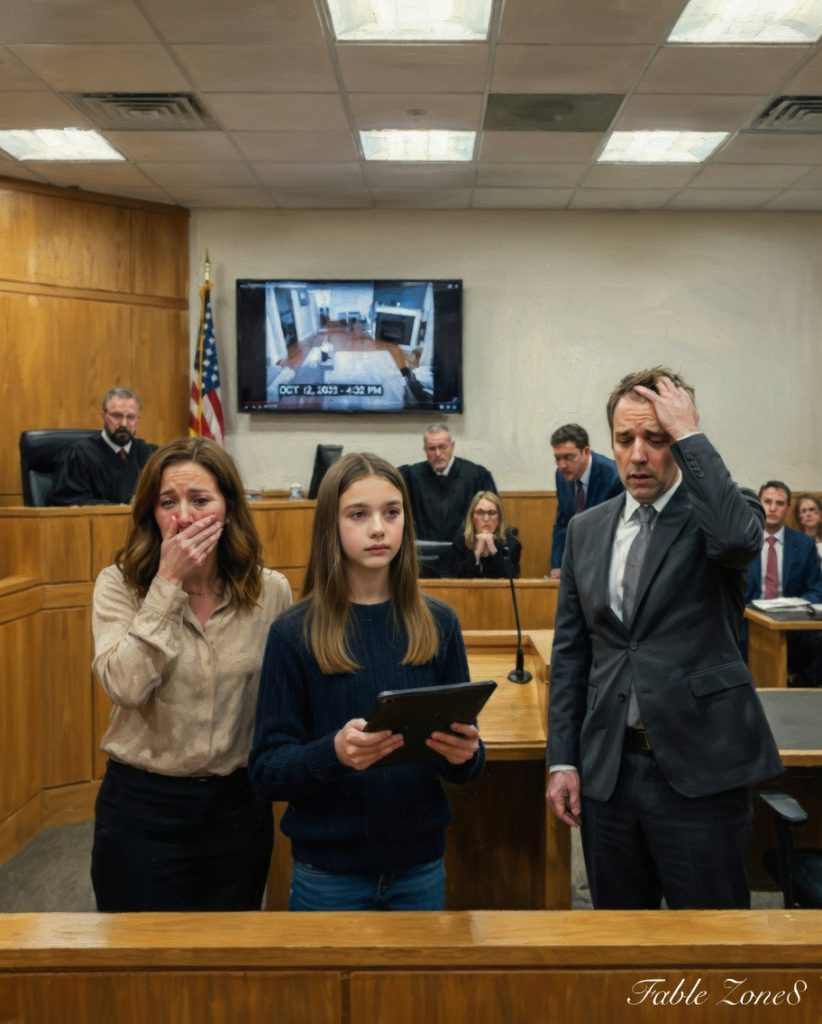
Harper sat beside me during the hearing, her small frame still, her hands folded tightly in her lap. Her feet didn’t quite touch the floor, and she kept her gaze fixed downward, as if avoiding the weight of the room. I remember noticing how quiet she was, even for her. When the judge asked if there was anything further to add before the session ended, I shook my head, already bracing myself for what felt inevitable—the slow, procedural unraveling of my role in her life. And then, unexpectedly, Harper stood up. The sound of her chair scraping lightly against the floor echoed more loudly than it should have. “Your Honor,” she said, her voice soft but steady, “can I show you something?” The room fell into a silence so complete it felt suspended in time. The judge leaned forward slightly, his expression careful, assessing. He asked if she felt comfortable speaking, if she felt safe. She nodded, though her hands trembled faintly at her sides. My first instinct was to protect her—to stop her from carrying whatever weight she was about to reveal. But something in her posture held me still. She reached into her jacket pocket and pulled out a small tablet, its edges worn, the screen marked with fingerprints. She held it carefully, almost protectively, as if it contained something fragile. “It’s a video,” she said. “I recorded it so I wouldn’t forget.” Her words landed softly, but the meaning behind them carried a weight that no one in the room could ignore.
The bailiff connected the device to the courtroom screen, and as the video began to play, I felt a wave of unease I couldn’t fully explain. The timestamp glowed in the corner: 2:03 a.m. The setting was unmistakable—our kitchen. Our home. But what followed felt like stepping into a moment I hadn’t witnessed but somehow recognized. Caleb’s voice filled the room, stripped of the calm composure he had presented in court. It was sharp, impatient, carrying an intensity that felt different when heard through speakers in a silent room. He was speaking to Harper. His words came quickly, edged with frustration, telling her to stop crying, telling her she was causing stress, warning her not to tell me. Harper’s voice followed—small, trembling, asking for me in a way that made my chest tighten. Then there was a sudden, sharp sound—something breaking—and the room reacted almost instinctively, flinching at the abruptness of it. I felt detached, as if watching from a distance, unable to fully process what I was seeing. I hadn’t known this moment existed, but I recognized the tone. It was familiar in a way that made everything inside me shift. When the video ended, the silence that followed felt heavier than any words that could have filled it. The judge’s expression had changed, the neutrality replaced by something more human, more concerned. He asked Harper why she had recorded it. She hesitated for only a second before answering. “I thought if I forgot, maybe it wouldn’t be real,” she said quietly. “But I couldn’t forget.”
That single moment altered everything. The carefully constructed narrative that had framed Caleb as steady and dependable began to fracture—not through argument, but through undeniable evidence. The hearing ended without a final decision that day, but the direction had changed. In the weeks that followed, the court ordered further evaluations, professional assessments, and supervised visitation. The language used in the proceedings shifted noticeably. Where once there had been confidence, there was now caution. Where there had been certainty, there was concern. I was granted primary custody, not framed as a victory, but as a necessary step to ensure Harper’s safety and well-being. Walking out of the courthouse that day, Harper held my hand tightly, her grip firm in a way that felt different from before. There was a release in her posture, a subtle easing of tension that had been there for longer than I had realized. She looked up at me and apologized, her voice barely audible, for not telling me sooner. I knelt down in front of her, meeting her eyes, and told her something I needed her to believe—that she had done exactly what she needed to do to protect herself. That fear doesn’t erase courage. That silence isn’t the same as weakness. She told me she had been scared. I told her I knew. And for the first time in a long while, I felt a sense of certainty I hadn’t been able to hold onto before—that she was safe.
Life after that moment didn’t suddenly become easy. Healing rarely unfolds in a straight line. There were therapy sessions, difficult conversations, and quiet moments where questions surfaced—questions about what I hadn’t seen, what I could have done differently. But over time, I began to understand that self-blame doesn’t create safety. Awareness does. Listening does. Harper began to change in ways that felt like a return to herself. She slept through the night again. She laughed more freely, her voice lighter, less guarded. She stopped flinching at raised voices, even when they came from a television show. I watched her reclaim parts of herself that had gone quiet, pieces of childhood that had been overshadowed by something she never should have had to navigate. And in that process, I changed too. I learned to trust my instincts, even when they couldn’t be easily explained. I stopped minimizing my experiences to fit narratives that made others more comfortable. I began to understand that safety isn’t defined by appearances or carefully presented arguments. It is built through presence, honesty, and the willingness to believe what isn’t always easy to hear. That day in the courtroom did more than influence a legal outcome. It reshaped my understanding of strength. Sometimes, strength isn’t loud or forceful. Sometimes, it looks like a child finding her voice in a room full of adults. And sometimes, when that voice is finally heard, it changes everything.