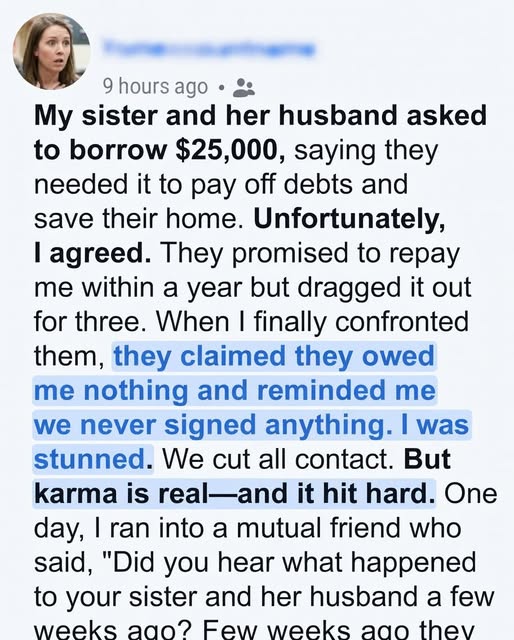
I remember the exact moment everything shifted, though at the time it didn’t feel like a breaking point—just another difficult conversation layered into an already stressful week. My sister called late that night, her voice trembling in a way I had never heard before. There was urgency, fear, and something else beneath it—something that made me instinctively set aside any doubt. She told me they were drowning. Bills had piled up, the mortgage was at risk, and everything they had built together felt like it was collapsing around them. I didn’t ask questions. I didn’t request proof or pause to weigh the risks. That’s not what family does, I told myself. Family shows up. Family helps without hesitation. So I did. I transferred $25,000—every cent I had spent years saving through long hours, missed opportunities, and quiet sacrifices. At the time, it didn’t feel like loss. It felt like purpose. Like I was stepping in when it mattered most. In the weeks that followed, they were grateful. There were emotional messages, promises to repay me, reassurances that they would never forget what I had done. I believed them—not because of what they said, but because of who they were to me. Or at least, who I thought they were. But gratitude, I would later learn, can be temporary when it is built on convenience. Time passed. Months turned into a year, then another, and then another. Each time I gently asked about repayment, there was always a reason. Something unexpected had come up. Timing wasn’t right. They needed just a little more time. I convinced myself patience was the right choice. That loyalty required endurance. Until the day I stopped asking softly and started asking clearly—and everything I believed began to unravel.
When I finally confronted them directly, I expected discomfort, maybe even defensiveness—but not indifference. Not denial. Not the kind of calm that feels rehearsed. My sister looked at me with an expression I couldn’t recognize, as though we were discussing something trivial instead of something that had defined years of my life. “We don’t owe you anything,” she said. At first, I laughed—not because it was funny, but because it didn’t make sense. It couldn’t be real. But then her husband stepped in, reinforcing the statement with cold precision. There had been no contract, no written agreement, no legal proof that the money was anything other than a gift. A gift. The word echoed in my mind, distorting every memory I had trusted. I tried to remind them of the conversations, the promises, the countless assurances that repayment was coming. But it was as if those moments had been erased—or rewritten to fit a version of reality that absolved them of responsibility. In that moment, I realized something devastating: I wasn’t just losing money. I was losing the version of them I had believed in. The people standing in front of me felt like strangers wearing familiar faces. I left without shouting, without creating a scene. There were no final words, no dramatic ending. Just silence. The kind that settles slowly but permanently, reshaping everything it touches.
Life didn’t stop after that. It rarely does, even when it feels like it should. I had to rebuild—not just financially, but emotionally. The money was a loss, yes, but it was the betrayal that lingered. Nights became filled with replayed conversations, moments I analyzed over and over, searching for signs I had missed. I worked harder, saved again, slowly reconstructing the stability I had once given away so freely. But something had changed in me. Trust no longer came easily. Generosity became something I measured, something I questioned. Friends told me to let it go, to accept that some people reveal their true nature when it benefits them most. And over time, I tried. I stopped checking in on their lives, stopped asking mutual friends for updates, stopped holding onto the quiet hope that one day they might acknowledge what they had done. The anger softened—not into forgiveness, but into distance. A quiet acceptance that this was how the story would end. They would continue on, untouched by consequences, and I would carry the lesson forward. It felt incomplete, but also final. Until, unexpectedly, it wasn’t.
I ran into a mutual friend one afternoon, the kind of chance encounter that usually ends with polite conversation and nothing more. But something in her tone made me pause. “Have you heard about your sister?” she asked, lowering her voice as if the words carried weight. My chest tightened instantly. I hadn’t thought about them in a while—not actively—but the mention of them brought everything rushing back. I shook my head, unsure if I wanted to hear the answer. She hesitated, then continued. “Everything fell apart for them.” What followed didn’t feel like gossip. It felt like the unfolding of something inevitable. A business venture they had invested in had collapsed—completely. Not just a financial setback, but a full unraveling. Legal trouble, unpaid debts, frozen accounts. The kind of situation that doesn’t just disrupt a life, but dismantles it entirely. They had tried to recover, tried to borrow money again, tried to rebuild—but this time, no one stepped in. Their reputation had quietly followed them. Stories had spread—not loudly, not publicly, but enough. Enough for people to hesitate. Enough for doors to close. And suddenly, they found themselves in the same position they had once described to me—desperate, uncertain, searching for help that no one was willing to give.
The part that stayed with me most came next. They had started reaching out—to friends, distant relatives, even people they hadn’t spoken to in years. And eventually, they reached out to me. I hadn’t seen the message right away. It had been buried beneath notifications I hadn’t bothered to check. When I finally opened it, my hands were steady, but something deeper stirred beneath the surface. The message was long. Detailed. Filled with explanations, apologies, and a tone I recognized instantly—desperation. They admitted everything they had once denied. The money. The promises. The way they had dismissed me when it mattered most. They said they were sorry—not casually, not defensively, but in a way that felt heavy. Real, perhaps, but also late. And then they asked for help again. Not the same amount, but enough to matter. Enough to reopen something I had spent years closing. I read it more than once, not because I needed clarity, but because I wanted to be sure of what I felt. And what I felt wasn’t anger. It wasn’t even sadness. It was clarity. A quiet, steady understanding of where I stood—and where I no longer needed to go.
I didn’t respond right away. I gave myself time, not because I was unsure, but because I wanted my response to come from a place of intention, not emotion. When I finally replied, it was simple. I acknowledged their message. I accepted their apology—not as a restoration of what was lost, but as an acknowledgment of truth. And then I reminded them of something they had once told me. That nothing had been signed. That nothing was owed. That responsibility only exists where it is formally defined. “You taught me something important,” I wrote. “And I’ve learned it well.” I wished them well—not out of obligation, but because I genuinely did. Then I ended the message. No anger. No accusations. No reopening of old wounds. Just a boundary—clear, firm, and finally understood. In the weeks that followed, I heard pieces of what happened next. They struggled. There was no sudden resolution, no unexpected rescue. Life, it seemed, was asking something of them they had once refused to give—accountability. And as for me, something shifted in a way I hadn’t anticipated. The weight I had carried for so long began to lift. Not because they suffered, but because the story had found its balance. I didn’t get my money back. I didn’t get the relationship back. But I gained something else—something quieter, but far more valuable. Closure. And in the end, that was worth more than anything they could have ever repaid.