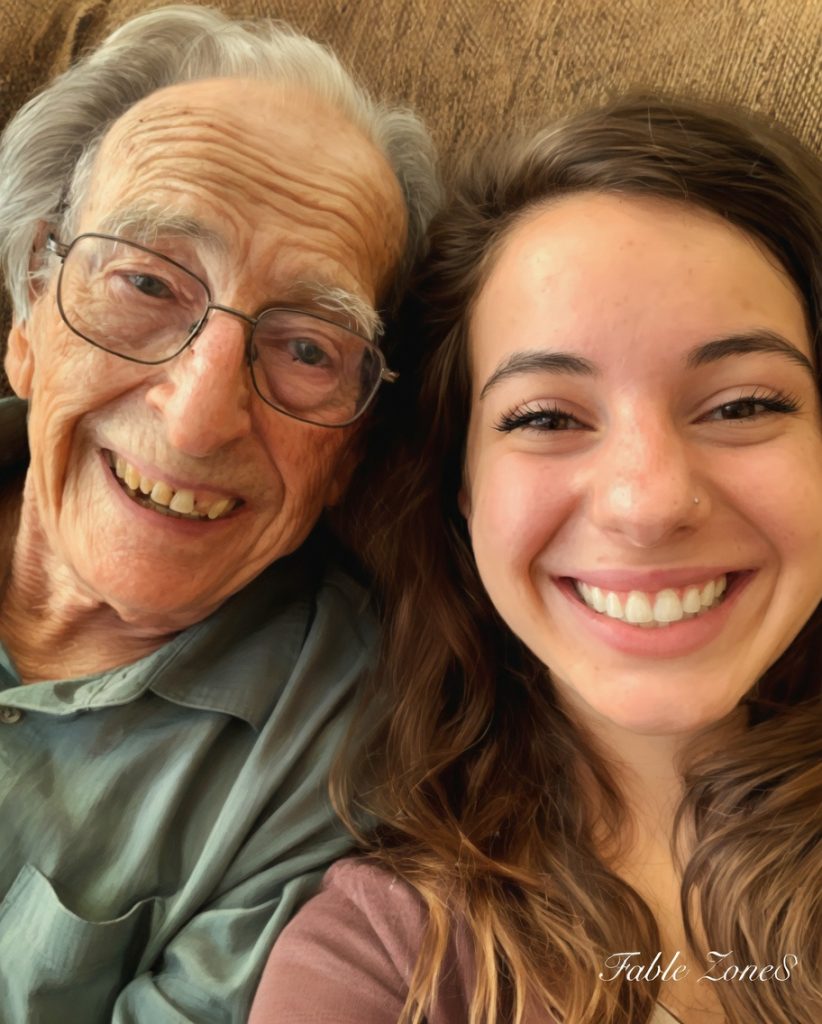
The voice on the phone wasn’t loud, and it wasn’t aggressive, but something about it made my entire body tense. It carried a kind of calm that didn’t comfort—it unsettled. I remember gripping my phone so tightly that my fingers began to ache, my pulse quickening as though my body had already sensed what my mind refused to accept. “Your grandfather wasn’t who you think he was,” the voice said, measured and deliberate. “We need to talk.” For a moment, I almost ended the call. It felt wrong to even listen, like I was betraying him somehow. He had only been gone for two weeks. Two weeks since I stood by his grave, unable to fully grasp how the world could continue without him in it. But grief doesn’t quiet curiosity—it sharpens it. “Who is this?” I asked, my voice barely steady. The question was ignored. Instead, I was given an address and a time, as if my choice had already been made for me. “If you want the truth, you’ll come,” the voice added before the line went dead. I sat there long after the call ended, staring at my reflection in the blank screen, feeling as though something invisible had shifted beneath my feet. My life had already been broken once when I lost my parents. Then again when I lost him. And somehow, I knew—without understanding why—that it was about to change all over again.
For two days, I refused to go. I told myself it was a scam, or someone trying to take advantage of my grief. But the words wouldn’t leave me alone. They lingered, echoing in quiet moments, slipping into my thoughts when I least expected them. “He wasn’t who you think he was.” It didn’t make sense. My grandfather had been everything to me—steady, dependable, selfless. He raised me when no one else could. He became my entire world when mine had fallen apart. What could I possibly not know about him? But once the thought took root, it began to grow. I started noticing things I had never questioned before. The way he avoided talking about his past, always brushing it off with a joke or a vague answer. The old desk in his room, the one with the locked drawer he never let me touch. The absence of extended family—no visits, no stories, no connections beyond the two of us. At the time, it had all felt normal. Now, it felt deliberate. By the third day, the silence in the house was suffocating. Every room held memories—his laughter, his footsteps, the way he used to call out to me from the kitchen. I couldn’t sit there anymore, trapped between grief and questions. So I went. The address led me to a quiet office building on the edge of town, the kind of place you wouldn’t notice unless you were looking for it. My heart pounded as I stepped inside, unsure of what I would find. A woman looked up from behind a desk, her expression calm but knowing. “You came,” she said softly. And in that moment, I understood—this wasn’t random. This was something he had set in motion.
She introduced herself as a lawyer. Not just any lawyer—his lawyer. The words didn’t make sense at first. My grandfather had never mentioned anything about legal matters, never hinted at a life that required such things. She gestured for me to sit, and after a brief silence that felt heavier than words, she slid a folder across the desk. My name was printed on it in clean, formal type. “Your grandfather asked me to contact you after his passing,” she explained. “But not immediately. He wanted you to have time.” That sounded like him—always thinking ahead, always protecting me, even in ways I didn’t understand. My hands trembled as I opened the folder, expecting paperwork I wouldn’t comprehend. Instead, I found a photograph. It was him—but not the version I knew. He looked younger, sharper, standing confidently in front of a large house I had never seen before. His posture was different. His expression was different. Everything about him seemed… unfamiliar. “What is this?” I asked, my voice barely above a whisper. The lawyer hesitated before answering. “Your grandfather wasn’t poor,” she said. I let out a short, disbelieving laugh. “That’s not possible,” I replied. “We struggled. We barely made ends meet.” She held my gaze, unwavering. “I know that’s what it looked like,” she said gently. “But it wasn’t the truth. He was wealthy. Very wealthy.” The room seemed to tilt, reality shifting in a way that made it hard to stay grounded. “No,” I said, shaking my head. “That doesn’t make sense.” But even as I said it, something inside me began to unravel.
The truth came slowly, piece by piece, like a story I wasn’t ready to hear but couldn’t stop listening to. Years before my parents died, my grandfather had built a successful business—one that brought him more than financial security. But success, as I would come to understand, often comes with complications. There had been a betrayal. Someone he trusted had turned against him, leading to a legal battle that drained more than just his resources—it took something from him emotionally, something that changed how he saw the world. In the aftermath, he made a decision that seemed impossible to reconcile with the man I knew. He walked away from that life. Not because he had to, but because he chose to. He sold off most of his assets, secured the rest in ways that kept them out of reach, and disappeared from that world entirely. When my parents died, he had the means to raise me differently—to give me comfort, stability, ease. But he didn’t. At first, the realization filled me with anger so sharp it felt like betrayal. Why would he let us struggle? Why would he say no to things we needed when he could have said yes? It felt like every memory had been built on something false. But the lawyer’s voice remained steady as she explained his reasoning. “He believed that giving you everything would take something from you,” she said. “He wanted you to grow up strong, independent, capable of standing on your own. He didn’t want money to shape who you became.” I shook my head, tears forming despite my resistance. “That wasn’t his decision to make,” I said quietly. “That was my life.” She nodded, not arguing, as if she understood that some truths don’t resolve—they simply exist.
Then she handed me a letter. My name was written on the front in his handwriting, familiar and unmistakable. Just seeing it made my chest tighten. I wasn’t ready to read it, but I knew I had to. My fingers trembled as I unfolded the paper, the faint scent of ink and age bringing a sudden rush of memories. “Kiddo,” it began. That single word broke through every wall I had tried to build. He wrote about everything—the choices he made, the life he left behind, the reasons he never told me. He admitted he knew I had been frustrated at times, that he had seen the disappointment in my eyes when he said no. And it had hurt him deeply. But he also wrote about his belief in me—his certainty that I was capable of more than an easy life would have allowed. He didn’t want me to depend on something that could disappear. He wanted me to know, without doubt, that I could survive anything. “I didn’t lie to hurt you,” he wrote. “I did it to protect the person I knew you could become.” By the time I reached the end, my vision was blurred with tears. The final line stayed with me longer than anything else: “Everything I have is yours now. But who you are—that’s something no one can take away.” I sat there, holding that letter, feeling as though I was seeing him for the first time—and losing him all over again.
The lawyer explained the rest—accounts, properties, investments. Numbers that felt unreal, detached from the life I had lived. It was enough to change everything, to rewrite my future in ways I had never imagined. But none of it felt as important as the letter in my hands. All I could think about was him—the quiet strength he carried, the sacrifices he made without ever asking for recognition. I thought about every moment I had misunderstood, every time I had wished for more without realizing how much I already had. Slowly, the anger I had felt began to soften. It didn’t disappear completely—some part of me still struggled with the choice he had made—but it changed. It became something more complex, more human. Understanding doesn’t erase pain, but it reshapes it. When I left the office, the world looked exactly the same, but I didn’t. I was carrying something new—two versions of him, existing side by side. The man I had known, and the man I was only just beginning to understand. And somehow, both were real. Both were him.
That evening, I sat in his old chair, the one that creaked in the same familiar way every time I leaned back. The house felt quieter than ever, but also fuller—like it was holding pieces of him I hadn’t noticed before. For the first time since he passed, I didn’t feel completely lost. I felt hurt, confused, even conflicted—but not lost. Because now I understood something I hadn’t before. Every struggle, every limitation, every “no” I had once resented—it had all been intentional. Not because he didn’t love me enough to give me more, but because he loved me enough to give me less. And maybe that’s the hardest kind of love to accept—the kind that doesn’t feel like love at the time. I don’t know what I’ll do with the life he left me. Maybe I’ll use it to build something meaningful, something that reflects both who he was and who he believed I could be. But I do know this: I am not defined by what he left behind. I am defined by what he gave me when I didn’t even realize I was receiving it. Strength. Perspective. Resilience. And a love so quiet, so deliberate, that it took losing him to fully understand it.