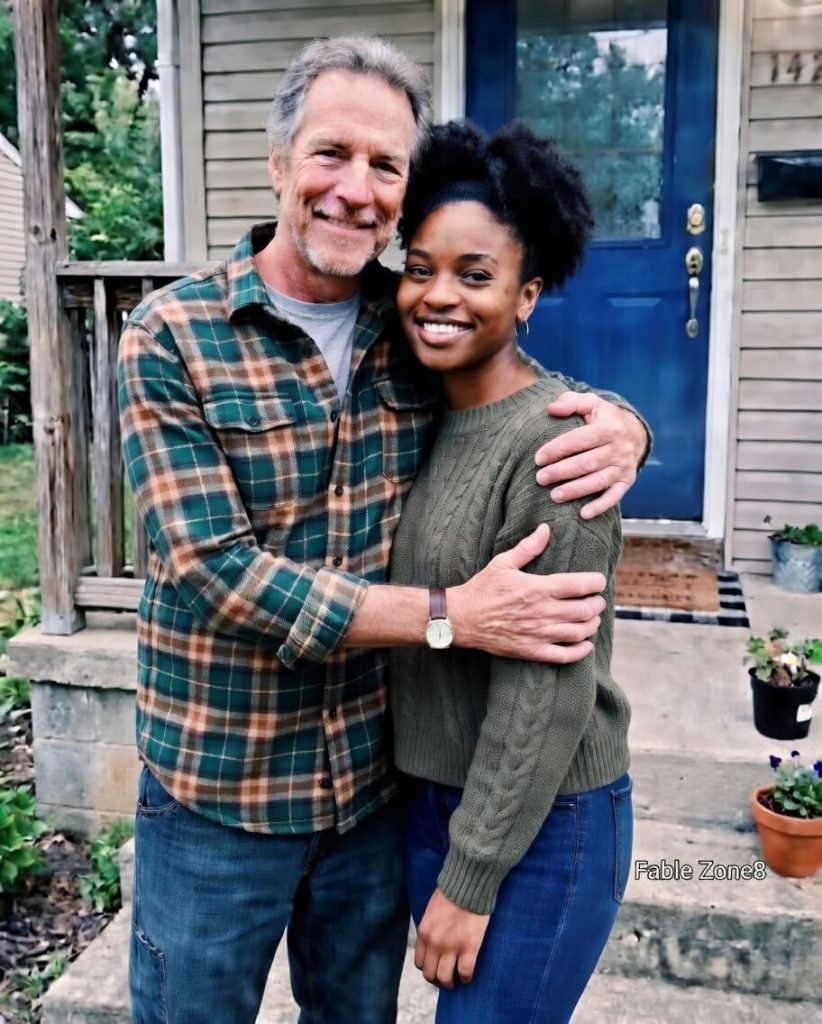
I bought my daughter a house because I wanted to give her something permanent—something steady in a world that hadn’t always been kind or predictable for her. It wasn’t just about bricks and walls. It was about security, about knowing she would always have a place where she belonged. The house itself was beautiful in a quiet, comforting way. Nestled on a peaceful street lined with tall trees that turned brilliant shades of red and gold each autumn, it felt like the kind of place where life could slow down just enough to be enjoyed. Inside, sunlight poured through wide windows into a spacious living room, while the kitchen offered a warm, welcoming atmosphere with polished countertops and soft lighting. The backyard was calm and private, a perfect spot for quiet mornings or reflective evenings. But what stood out most was the bold blue front door—bright, inviting, and full of personality, just like her. The day we first stood on that porch together, taking a photo to mark the moment, I felt something deeper than pride. At twenty-four, she had worked hard, built a career, and grown into someone strong and independent. And I had been there through every step of that journey. Helping her secure this home felt like completing a promise I had made long ago—to always be there, no matter what.
The housewarming party was meant to celebrate her new beginning. She had invited friends from work, old classmates, neighbors, and family members who had supported her along the way. I arrived early, eager to help, moving around the house arranging food, filling coolers with ice, and making sure everything was just right. The atmosphere was warm and lively as guests began to arrive, filling the space with laughter and conversation. Soft music played in the background, blending with the gentle scent of candles she had carefully placed around the room. It was everything a father could hope for—a moment of joy, of seeing your child step confidently into her own life. But that feeling shifted in an instant. I had just come in from the garage carrying a heavy bag of ice when it slipped from my hands and burst open across the kitchen floor. Ice scattered everywhere, but I barely noticed. My attention had been pulled elsewhere—to the man standing in the living room. Tall, composed, and completely at ease, he was talking and laughing with my family as if he had always belonged there. My chest tightened as I recognized him immediately. It was Jacob—her biological father. The man who had not been part of her life, now standing in the home I had just given her, surrounded by the life we had built together.
When she brought him over to introduce us, I felt a storm of emotions I couldn’t fully name. She looked at me carefully, as if searching for reassurance, while he extended his hand with confidence and an easy smile. “It’s really good to meet you,” he said, his tone friendly, almost casual. “We share a pretty amazing daughter.” I shook his hand, managing a polite response, but inside I felt something shift. Memories came rushing back—years of raising her alone after her mother left, the nights spent comforting her when she didn’t understand why things had changed, the quiet promises I made to never leave her, to always stay. I remembered school mornings, scraped knees, late-night homework sessions, and the countless sacrifices that had shaped our lives. Those weren’t grand gestures. They were small, consistent acts of love repeated over years. And now, suddenly, I was standing face-to-face with someone who shared her biology but none of those moments. As the evening went on, I watched him move easily through the crowd, making conversation, earning smiles, fitting in. And for the first time in a long time, I felt something I hadn’t expected—fear. Not loud or overwhelming, but quiet and persistent. The fear that somehow, despite everything, biology might matter more than presence.
I stepped away for a moment, retreating to the kitchen under the pretense of cleaning up the spilled ice. My cousin tried to lighten the mood, but I could barely respond. I kept replaying everything in my head, wondering if I had somehow missed something, if there was a part of her story I didn’t fully understand. But every time I looked up, I caught her glancing at me—quick, reassuring looks that carried something deeper than words. She hadn’t changed. She was still the same little girl who used to hold my hand tightly when crossing the street, the same teenager who trusted me with her fears and dreams, the same young woman who had leaned on me through life’s challenges. Those years couldn’t just disappear. They meant something. They had to. And yet, standing there in that moment, it was hard to ignore the uncertainty creeping in. The room was full of noise and laughter, but inside me, everything felt quiet and heavy.
Then, just as the evening reached its peak, she gently tapped her glass and called for everyone’s attention. Conversations faded, and all eyes turned toward her. She stood there, confident and calm, holding her glass with a small, thoughtful smile. “I’m so grateful to be here tonight with my father,” she began. For a brief second, the room seemed to shift. Jacob straightened slightly, his expression brightening. But she didn’t pause. She looked directly at me, her eyes steady and full of emotion. “And when I say my father,” she continued, “I don’t mean the one who shares my DNA. I mean the one who chose me every single day. The one who stayed. The one who showed me what love really looks like.” The room fell completely silent. Every word landed with weight and clarity. She spoke about the years we had shared, about the moments that had defined her life—not the big milestones, but the everyday acts of care and commitment. She talked about the sacrifices I had made, the support I had given her without question, and the way I had built a sense of home for her long before this house ever existed. By the time she raised her glass and said, “To Bruce—the only dad I have ever needed,” there wasn’t a dry eye in the room. Applause filled the space, but all I could feel was the overwhelming emotion rising in my chest. In that moment, every doubt disappeared. Every fear dissolved. She had made her choice—not quietly, not privately, but openly, with pride and certainty.
Later, after the guests had left and the house had grown quiet again, we stepped outside onto the porch. The night air was cool, carrying a sense of calm after the emotional intensity of the evening. She leaned against me the same way she had earlier that day, resting her head on my shoulder. “You’ve always been my dad,” she said softly. “Nothing will ever change that.” I didn’t need to say much in return. Some things don’t require words. Standing there beside her, I realized something that felt both simple and profound. Being a father isn’t about biology. It’s about presence. It’s about showing up, again and again, even when it’s hard. It’s about building trust over time, creating a bond that can’t be shaken by circumstances or history. The house I had bought her was important, yes—but it wasn’t the most meaningful thing I had given her. The real gift had been years of consistency, of love that didn’t depend on conditions. And as we stood there together, I understood that no one could take that away. Not the past. Not biology. Not anything. Because in the end, family isn’t just something you’re born into—it’s something you build, one day at a time.