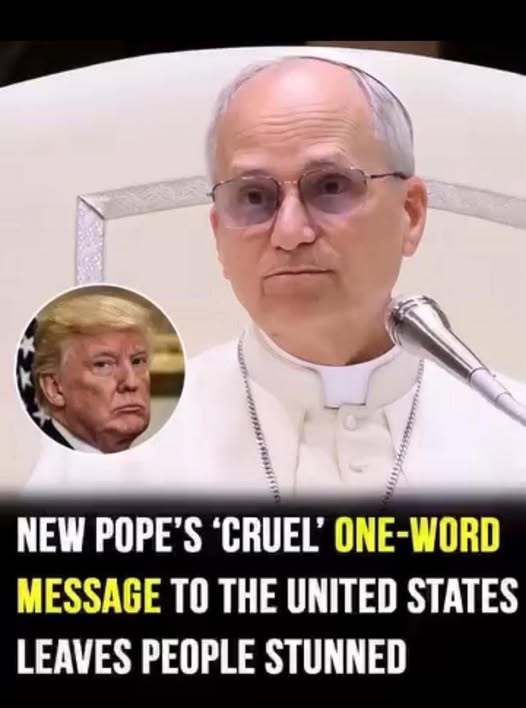
In an era dominated by constant commentary, instant reactions, and meticulously crafted political messaging, it was a moment of unexpected restraint that captured global attention. Just days after the beginning of his papacy, Pope Leo XIV was asked a seemingly straightforward question during a press conference: did he have a message for the United States? The room grew briefly quiet as he paused, smiled gently, and replied with a single word—“Many”—before offering a familiar blessing. The exchange lasted only seconds, yet it resonated far beyond the walls of the conference room. In a world conditioned to expect lengthy explanations, definitive stances, and quotable soundbites, the simplicity of the response felt almost disarming. Rather than providing clarity in the conventional sense, the Pope offered openness. Instead of defining meaning, he created space for it. That deliberate choice immediately set the moment apart, demonstrating how silence, brevity, and intention can communicate as powerfully as elaborate rhetoric.
As video of the exchange spread rapidly across social media platforms and news outlets, it became clear that the power of the moment lay not in what was said, but in what was left unsaid. Comment sections filled with interpretations ranging from humorous to deeply philosophical. Some viewers perceived the response as a subtle acknowledgment of the many challenges facing American society, while others viewed it as a gesture of humility, an admission that no single statement could adequately address such a complex nation. The word “many” functioned almost like a blank canvas, inviting projection, debate, and reflection. In a digital culture often marked by polarization and certainty, the Pope’s refusal to narrow the meaning struck many as refreshing. Rather than forcing audiences into agreement or disagreement, he allowed them to sit with ambiguity. This open-endedness did not weaken the message; it amplified it, transforming a brief exchange into a global conversation about leadership, communication, and the value of thoughtful restraint.
For many observers, the moment felt deeply aligned with Pope Leo XIV’s broader approach to public life. Born in Chicago and shaped by both American cultural influences and decades of global engagement, he embodies a dual perspective that bridges national identity and universal responsibility. Throughout his early statements and actions, he has emphasized dialogue over division, compassion over condemnation, and responsibility shared across borders. His communication style tends to favor calm presence rather than assertive proclamation, and the one-word response reflected that philosophy. It suggested a leader comfortable with complexity, unafraid of nuance, and unwilling to oversimplify issues that demand careful thought. The pause before his answer, the gentle smile, and the absence of elaboration all conveyed confidence without dominance. In that sense, the message extended beyond words. It demonstrated how leadership can be expressed through tone, timing, and intentional silence as much as through speech itself.
The response also underscored the difficulty of addressing a nation as vast and diverse as the United States. Any attempt to summarize the country’s realities in a single message risks flattening its contradictions, struggles, and aspirations. By choosing the word “many,” Pope Leo XIV appeared to acknowledge that complexity openly. The United States contains multitudes—diverse cultures, beliefs, histories, and challenges that cannot be captured by a single narrative. His answer respected that diversity rather than attempting to define it. In doing so, he avoided prescribing solutions or judgments, instead offering recognition. The word became an implicit invitation for individuals to reflect on their own roles, responsibilities, and values within a broader social fabric. Rather than speaking over people, the Pope seemed to speak alongside them, allowing meaning to emerge through personal interpretation.
The significance of the moment was heightened by the media environment in which it occurred. In a digital age characterized by speed, saturation, and relentless analysis, public figures are often pressured to respond instantly and decisively. Every phrase is dissected, every pause scrutinized. Against that backdrop, Pope Leo XIV’s measured response stood out as an act of quiet resistance to the demand for constant explanation. It demonstrated that influence does not always come from volume or frequency, but from intentionality. By offering a moment of calm amid informational noise, the Pope reminded audiences that communication can slow rather than accelerate discourse. His answer encouraged reflection rather than reaction, a rare outcome in online spaces designed for immediacy. The widespread attention the clip received illustrated a paradox of modern media: sometimes the simplest messages resonate most precisely because they resist oversaturation.
Ultimately, the brief exchange became more than a viral moment; it evolved into a symbol of how communication functions in a globalized, digitally connected world. Pope Leo XIV’s single word did not provide direction, policy, or instruction, yet it sparked discussion across cultures and borders. It revealed how meaning can be generated collectively, shaped by the perspectives and experiences of those who receive it. In an age where clarity is often equated with control, the Pope’s response suggested an alternative model of leadership—one rooted in trust, humility, and openness. His “many” served as a reminder that not all wisdom arrives fully formed, and not all guidance must be explicit. Sometimes, the most enduring messages are those that leave room for thought, reflection, and shared responsibility. In that quiet space between words, meaning continues to grow.