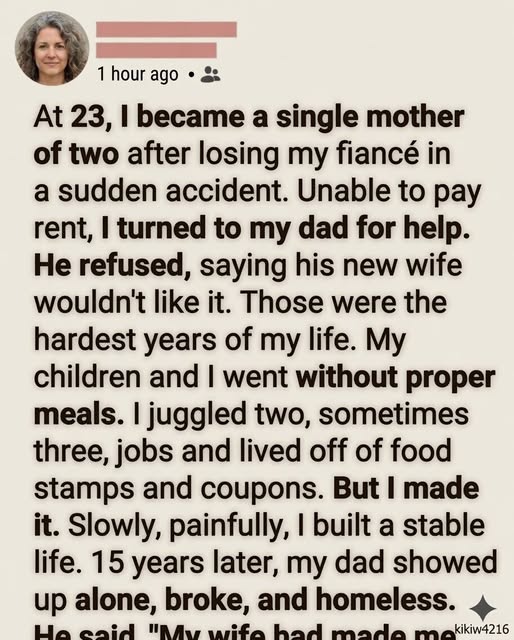
At twenty-three years old, my life split cleanly into two halves: before and after the moment everything fell apart. Before, there was love, stability, and the comforting illusion that the future was something I could plan. After, there was grief, fear, and a relentless fight to survive for the sake of my two small children. When my fiancé died suddenly in a car accident, the foundation of our young family disappeared overnight. There was no time to process the loss in a gentle or gradual way. Reality came crashing in immediately—medical bills, rent, food, childcare—each demand urgent and unforgiving.
In those early days, grief didn’t feel like sadness. It felt like pressure—tight, suffocating, constant. I didn’t have the luxury of falling apart completely because two toddlers depended on me for everything. They didn’t understand death; they only understood hunger, fear, and the sudden absence of their father. I became everything at once: mother, provider, protector, and emotional anchor, even when I felt like I was drowning.
Desperation led me to make one of the hardest decisions of my life: asking my father for help. I had always believed that no matter what happened, he would be there when it truly mattered. Standing at his door with tears in my eyes and my children holding onto me, I asked for something temporary—help with rent, maybe groceries, just enough to get through the worst of it. I didn’t expect miracles. I just expected compassion.
Instead, I was met with hesitation, then distance, and finally a refusal that cut deeper than I thought possible. He explained that his new wife wouldn’t approve, that helping me might create tension in his household, that he had to think about his “new life.” I remember the exact moment I realized he had already chosen it over us. There was no argument, no raised voices—just a quiet, devastating finality.
Walking away from his house that day felt heavier than any grief I had experienced so far. It wasn’t just the loss of support; it was the loss of a belief I had carried my entire life—that family would show up when everything else failed. That belief shattered, and in its place came something harder and colder: the understanding that I was on my own.
The years that followed were defined by survival. There is no softer way to describe it. I worked constantly—days as a cashier, evenings cleaning offices, nights waitressing. Sleep became a luxury I rarely experienced. I learned how to stretch every dollar, how to turn the cheapest ingredients into meals that could last days, how to navigate assistance programs and community resources just to keep us afloat.
There were nights when I would sit at the kitchen table long after my children had fallen asleep, staring at unpaid bills and wondering how I would make it through the next week. The fear of failure was constant, a quiet voice reminding me that one wrong step could leave us with nothing. But alongside that fear was something stronger: determination. I refused to let my children feel the full weight of our struggles. I wanted them to feel safe, even when I didn’t.
Slowly, almost imperceptibly, things began to change. I gained experience at work, moved into slightly better positions, saved small amounts of money whenever possible. It wasn’t a dramatic transformation—it was a gradual climb, one step at a time. Years passed, and the chaos of survival began to settle into something more stable. We moved into a modest but safe home. My children grew older, stronger, more aware of the world around them.
They understood, in ways most children don’t, what it meant to work hard for everything. They saw my exhaustion, my sacrifices, my refusal to give up. And in response, they developed a resilience of their own. They became kind, grounded, and deeply appreciative of even the smallest comforts.
By the time fifteen years had passed, our lives were no longer defined by struggle. We weren’t wealthy, but we were stable. We had built something real out of nothing, and that in itself felt like a quiet victory.
Then, one ordinary evening, everything changed again.
There was a knock at the door—unexpected, almost hesitant. When I opened it, I found my father standing there. For a moment, I didn’t recognize him. The man in front of me looked smaller, older, diminished in a way that went beyond physical appearance. His clothes were worn, his posture uncertain, his eyes carrying a kind of exhaustion I had only seen in mirrors during my hardest years.
He held a suitcase in one hand, as if it contained everything he had left.
“My wife left me,” he said simply.
Those words hung in the air, heavy with meaning. In that moment, time seemed to fold in on itself. I was no longer just the woman standing in my doorway—I was also the young mother he had turned away, the daughter who had walked away from him with nothing but heartbreak and responsibility.
A storm of emotions rose up inside me—anger, hurt, disbelief, and something else I wasn’t prepared for: compassion.
I thought about turning him away. The thought came quickly, almost instinctively. Part of me wanted him to feel what I had felt—to understand the weight of being abandoned when you needed help the most. It would have been easy, in a way. Just a few words, and I could have closed the door, just as he once had.
But I didn’t.
Instead, I stepped aside and let him in.
The first few weeks were tense, filled with a careful politeness that masked deeper emotions. My children, now teenagers, watched him with suspicion. They knew the story. They knew what he had done—or rather, what he had failed to do. Their questions came quickly and directly.
“Why is he here?” my daughter asked one night.
“Why are you helping him?” my son added.
I didn’t have a simple answer. The truth was complicated. I was still angry. I was still hurt. But I also knew that turning him away would not heal anything. It would only continue a cycle of pain that had already taken too much from all of us.
Over time, my father began to share what had happened in the years since we last saw each other. His second marriage, which had seemed so important at the time, had slowly unraveled. Control, isolation, and financial dependence had eroded his independence. When his wife eventually left, she took everything with her—leaving him with nothing but regret and a suitcase.
Listening to him, I began to see him differently. Not just as the man who had failed me, but as someone who had made choices he didn’t fully understand at the time—and paid for them in ways he never expected.
That didn’t erase the past. It didn’t undo the years of struggle. But it added something new to the equation: perspective.
As the months passed, our household began to change. My father made an effort to contribute in small ways—fixing things around the house, helping with chores, cooking meals. He approached everything with a quiet humility, as if he understood that he was being given something he didn’t necessarily deserve.
My children, slowly and cautiously, began to soften. They asked him questions, listened to his stories, and allowed him to become part of their lives in small, measured ways. It wasn’t forgiveness—not yet—but it was a beginning.
For me, the process was more complicated. Forgiveness is often described as a single moment, a decision you make once and move on from. In reality, it is a series of choices, made over and over again, especially when old wounds resurface.
There were conversations—difficult, painful conversations—where I told him exactly how his absence had affected us. I spoke about the nights I went to bed hungry so my children could eat, about the fear, the exhaustion, the loneliness. He listened without interrupting, without defending himself, and when I finished, he apologized in a way that felt genuine.
Those moments didn’t erase the past, but they helped me release the hold it had on me.
Eventually, we reached a new understanding. It wasn’t the relationship we once had, and it wasn’t the one we might have had if things had been different. It was something else—something built on honesty, accountability, and a shared willingness to move forward.
Today, my father lives in a small apartment nearby. He works part-time, manages his own expenses, and continues to rebuild his life step by step. Our relationship is steady, if not perfect. My children have developed their own connections with him, shaped by both the past and the present.
Looking back, I realize that life has a way of bringing us full circle—not to punish us, but to test us. To ask us who we are when we are given the same choice that once hurt us.
When my father turned me away, I learned how to survive. When he came back, I learned something even harder: how to forgive without forgetting, how to show compassion without denying my own pain, and how to break a cycle that could have easily continued.
In the end, helping him was not about him at all. It was about the kind of person I wanted to be. And in choosing compassion over resentment, I didn’t just change his life—I freed myself from the weight of the past.
That is the true meaning of full circle.