The dinner started like any other carefully staged attempt to make a good impression—except my entire future somehow felt like it was sitting on my shoulders between the folds of a black dress I had overthought for three days straight.
Every mirror check, every adjustment of my hair, every deep breath in the car ride there had been a negotiation between confidence and fear. Eleven months of dating had led to this moment, and somehow I felt like I was being evaluated for a role I didn’t know the script to.
My boyfriend, Alex, seemed unusually calm.
That should have been my first clue.
His parents were already seated when we arrived at the restaurant. Elegant, composed, observant. The kind of people who didn’t just look at you—they assessed you.
His mother smiled first, warm and welcoming. His father stood to shake my hand, firm grip, steady gaze, the kind of man who didn’t need to speak loudly to be heard.
I smiled politely, sat down carefully, and told myself to breathe.
The wine arrived. The conversation began. It was smooth at first—safe topics, easy laughter, the kind of social dance designed to hide how much everyone is actually analyzing everyone else.
I almost started to relax.
That was my second mistake.
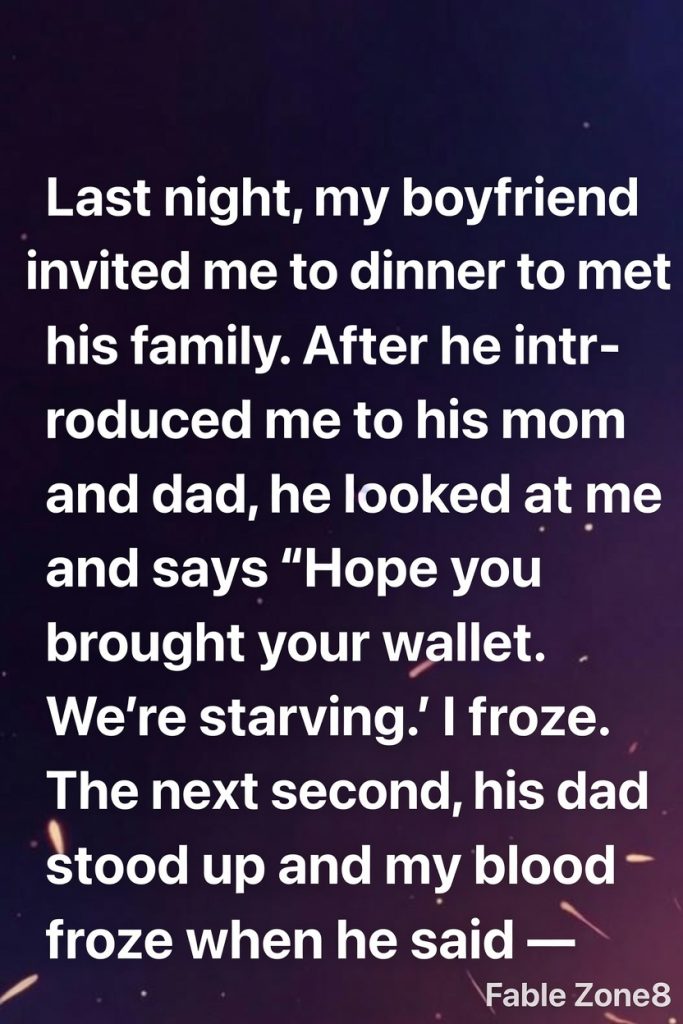
Halfway through dinner, Alex leaned back in his chair with that familiar expression I had come to recognize over months of dating—the one that meant he was about to say something he thought was funny but might not land the way he intended.
He turned to me casually.
“Hope you brought your wallet. We’re starving.”
It was meant as a joke.
At least, I think it was.
But my body didn’t register humor. It registered danger.
A flush of panic ran through me so fast I almost laughed too loudly just to cover it. My brain immediately began calculating worst-case scenarios—was this some strange family tradition? A test? A hidden expectation I had somehow missed?
I glanced at his mother.
She was smiling faintly, but not reacting.
His father, however, was watching me closely.
Too closely.
And then the atmosphere shifted.
His father pushed his chair back.
The sound scraped across the polished floor like a warning.
He stood.
And everything in me tightened.
Because whatever came next didn’t feel like small talk anymore.
“Before we continue,” he said calmly, “there’s something we should tell you.”
Alex’s face changed instantly.
So did his mother’s.
And suddenly I realized something unsettling:
This wasn’t spontaneous.
This had been planned.
My mind raced through possibilities. Bad ones. Dramatic ones. Life-altering ones. My appetite disappeared completely.
The father continued.
And what he said next didn’t just surprise me.
It rewrote the entire meaning of the evening.
He explained that their family wasn’t just successful in the traditional sense.
They had built something quieter.
A private foundation.
A long-running initiative that supported emerging artists and designers who showed potential but lacked opportunity. Not publicly advertised. Not widely known. Carefully selective.
And then came the part that made everything blur.
They had been watching my work.
For months.
Not casually.
Seriously.
Alex’s “wallet joke,” as it turned out, wasn’t cruelty or testing. It was panic disguised as humor. He was terrified I would feel overwhelmed if the truth came out too fast—that I would think I was being “bought” or manipulated into staying.
So he tried to break tension the only way he knew how.
Bad joke.
Wrong timing.
But not malicious.
The father’s voice stayed steady as he finished speaking.
“If you choose to accept it,” he said, “we want to fund your work. Fully. Studio access, mentorship, financial support. A long-term program designed to help you build a sustainable career.”
He paused.
Then added, “We believe in your talent.”
And just like that, the air in my lungs finally returned.
It took me a moment to process that the same dinner that had started with humiliation—imagined or otherwise—had turned into an introduction to an opportunity I had only ever dreamed about in passing thoughts I didn’t let myself believe too deeply.
But emotional whiplash doesn’t disappear instantly.
It lingers.
And I was still stuck between relief and disbelief.
Alex reached under the table and took my hand.
His grip was tight.
“I messed that up,” he whispered. “I’m sorry.”
And for the first time, I understood the full shape of what had just happened:
Not a trap.
Not manipulation.
But fear—fear of rejection, fear of pressure, fear of not saying things in the right order.
The rest of dinner unfolded differently.
Not awkwardly.
Not perfectly.
But honestly.
The conversation shifted from tension to storytelling. From uncertainty to explanation.
His mother talked about how the foundation began after years of watching talented people struggle without support. His father spoke about how wealth meant nothing if it wasn’t used to build something meaningful. Alex admitted he had been rehearsing that moment for weeks and still got it wrong.
And I… slowly began to breathe again.
But even as laughter returned to the table, something inside me stayed alert.
Because opportunity, no matter how generous, always comes with questions.
Why me?
Why now?
What does this change?
And more importantly—what do they expect in return?
After dessert, the conversation deepened.
Not into business.
Into values.
They didn’t ask what I would produce.
They asked how I worked.
What inspired me.
What scared me.
What I needed to create without burning out.
It was the first time I had been asked those questions without feeling judged for the answers.
By the time we left the restaurant, the city had softened into night.
Alex walked beside me quietly, as if waiting for me to decide what the evening had meant.
My mind was still catching up.
But one thing was clear:
Nothing about my life would feel the same after this.
In the car, I finally spoke.
“I thought I was being tested,” I admitted.
Alex exhaled sharply. “I know. That’s on me.”
Silence followed.
Not uncomfortable.
Just full.
At my apartment door, the night should have ended simply.
Goodnight.
See you tomorrow.
Instead, it turned into something more fragile.
A conversation about trust.
About timing.
About fear dressed as humor.
And about how easily meaning can get lost when people are afraid to be direct.
When I finally went inside, I didn’t sleep right away.
I replayed everything.
The joke.
The chair sliding back.
The offer.
The silence between words.
And I realized something uncomfortable:
The most frightening part of the evening hadn’t been the opportunity.
It had been my assumption that I wasn’t allowed to trust it.
Over the next few days, the reality of the offer settled in.
Meetings were scheduled.
Plans were outlined.
Nothing was rushed.
Nothing was forced.
And slowly, suspicion gave way to understanding.
The foundation wasn’t trying to own me.
It was trying to invest in me.
But more importantly, Alex wasn’t trying to trap me.
He was trying—and failing—to protect me from feeling overwhelmed.
Still, growth rarely arrives without tension.
I had to confront my own hesitation.
My own disbelief that something like this could be real without hidden cost.
And that process took longer than the dinner itself.
What changed me most wasn’t the money or the mentorship.
It was the realization that I had walked into that restaurant expecting evaluation, judgment, and performance—and instead found curiosity, patience, and belief.
Months later, I began working under the program.
My art improved not just technically, but emotionally.
I stopped creating for approval and started creating with intention.
The support didn’t define me.
It amplified what was already there.
Alex and I stayed together, but something shifted between us.
Not distance.
Depth.
We learned how to communicate better.
How to slow down assumptions before they turned into fear.
How to turn awkward jokes into honest conversations instead of hidden warnings.
And his parents?
They stopped feeling like examiners.
They became collaborators in my growth.
Not because I owed them anything.
But because they genuinely cared about what I was building.
Looking back, the “wallet joke” dinner no longer feels like a trap or a test.
It feels like a misunderstanding wrapped around an unexpected gift.
A moment where fear almost disguised opportunity as danger.
And maybe that’s the real lesson:
Sometimes life doesn’t introduce its best moments gently.
Sometimes it starts with confusion.
With awkward humor.
With standing chairs and unexpected silence.
And only later does it reveal what it actually was all along—
A beginning you didn’t recognize at first.
But one you’re grateful you didn’t walk away from.