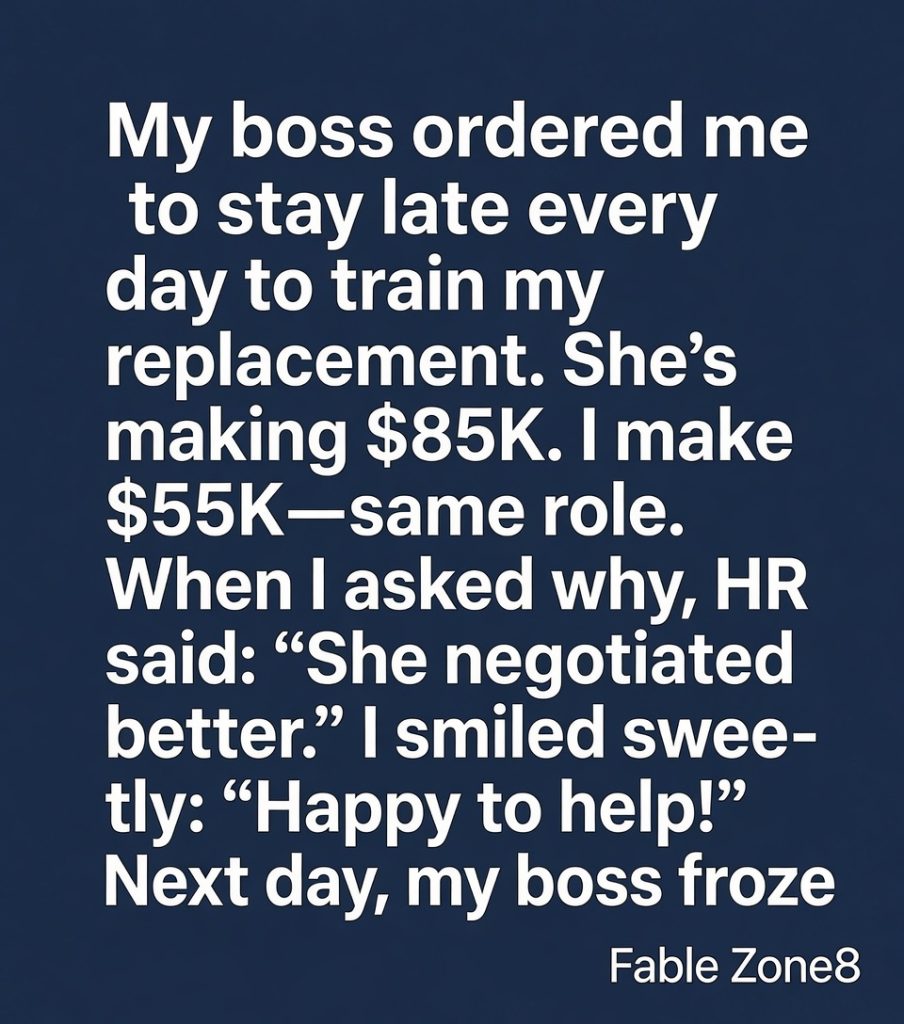
It began on a dull Tuesday afternoon, the kind where the office lights seemed harsher than usual and every email felt heavier than it should. I was called into my boss’s office without warning. That alone wasn’t unusual, but something in her tone hinted that this conversation would not be like the others.
She gestured for me to sit, her expression carefully neutral, the kind managers practice when delivering news they know won’t be well received. She spoke in polished phrases, layering corporate language over a decision that had already been made. The company, she explained, had decided to “move in a different direction.” A replacement had been hired for my role. I would be transitioning out in two weeks.
I listened without interrupting, my hands folded calmly in my lap, though my thoughts raced. Six years of loyalty. Six years of late nights, problem-solving, and stepping in whenever something broke. Six years distilled into a short, rehearsed explanation.
Then came the detail that shifted everything.
My replacement would be earning significantly more than I was—despite stepping into the exact same role, with the same responsibilities I had carried for years. The number echoed in my mind, sharp and impossible to ignore. I had spent years proving my value, only to discover that value had been quietly underestimated all along.
Still, I didn’t react. Not outwardly.
Instead, I nodded.
When she added that I would be expected to train my replacement—staying late if necessary, ensuring a “smooth transition”—I gave the same polite response I always had.
“Of course. I’m happy to help.”
That was the moment everything changed.
The next morning, I visited HR. I asked the question plainly: why was someone new being paid so much more for the same work I had been doing?
The answer was simple, almost dismissive.
“She negotiated better.”
That was it. No acknowledgment of experience, no recognition of loyalty. Just a statement that reframed years of effort as a failure to ask for more.
I thanked them, smiled, and left.
But internally, something had shifted.
I realized then that this situation wasn’t just about unfairness—it was about leverage. And for the first time, I began to see exactly where mine lay.
Training began that week.
Each evening, after most of the office had emptied, I sat with my replacement and walked her through the systems, processes, and responsibilities that defined the role. On the surface, I was thorough, patient, and supportive. I answered every question, demonstrated every task, and ensured she felt confident.
But behind that calm exterior, I was paying attention in a way I never had before.
I began documenting everything.
Not just the obvious procedures, but the unwritten rules—the shortcuts, the workarounds, the small but critical details that kept everything running smoothly. I wrote down the nuances that no official guide had ever captured.
At the same time, I started keeping records of conversations. Not out of spite, but out of awareness. I noted instructions, expectations, and the exact language used when discussing my role and its transition.
It wasn’t about revenge.
It was about clarity.
As the days passed, something unexpected happened. My replacement began to ask questions—not just about the work, but about the company.
She was curious, observant. She noticed things.
When I mentioned my salary in passing, her reaction was immediate. She hadn’t realized the gap. She hadn’t known the context behind her offer.
Our conversations shifted. They became more honest, more reflective.
I didn’t try to influence her opinion. I simply shared my experience—the late nights, the denied raises, the quiet expectation to go above and beyond without recognition.
The facts spoke for themselves.
Meanwhile, I started preparing for my next step.
I updated my resume, highlighting not just my responsibilities but the impact I had made. I reached out to contacts, explored opportunities, and began interviewing.
For the first time in years, I approached my career with intention rather than routine.
And slowly, options began to appear.
By the final week, the training was complete.
My replacement could handle the role. She understood the systems, the clients, the expectations. On paper, the transition had been successful.
But there was something the company had overlooked.
They had assumed that knowledge transfer was just about information.
They hadn’t accounted for context, for experience, for the subtle judgment developed over years of navigating complex situations.
Those things couldn’t be handed over in a few sessions.
On my last day, I arrived early.
Instead of logging into my usual tasks, I printed a letter I had prepared in advance. It was concise, professional, and direct. I outlined my resignation, effective immediately, and cited the reasons clearly: pay disparity, lack of recognition, and the conditions surrounding the transition.
I placed it on my boss’s desk.
Then I sat down and waited.
When she arrived and read the letter, her reaction was immediate. The composure she usually maintained slipped, replaced by something closer to shock.
She hadn’t expected this.
The conversation that followed was tense but controlled. She asked questions, tried to reframe the situation, even suggested adjustments—raises, incentives, reconsiderations.
But it was too late.
The decision had already been made.
What followed wasn’t dramatic in the way stories often portray. There were no raised voices, no confrontations.
Instead, there was a quiet shift.
Meetings were called. Questions were asked. Policies were reviewed.
The situation I had accepted so calmly suddenly required explanation.
And in that moment, the imbalance that had gone unnoticed for so long became impossible to ignore.
I left that day with a sense of closure.
Not because everything had been resolved, but because I had taken control of my own outcome.
A short time later, I started a new role.
The difference was immediate. My experience was valued, my contributions recognized, and my compensation reflected the work I was doing.
More importantly, I carried with me a new understanding.
Looking back, the most important lesson wasn’t about negotiation, though that mattered.
It was about awareness.
For years, I had assumed that hard work alone would be enough. That consistency and dedication would naturally lead to growth.
But the reality was more complex.
Value isn’t just demonstrated—it has to be acknowledged, communicated, and, when necessary, defended.
The experience also changed how I approached others in the workplace.
I became more transparent, more willing to discuss expectations and compensation openly. I encouraged colleagues to ask questions, to understand their worth, and to advocate for themselves.
Because silence, I realized, often benefits the system—not the individual.
As time passed, I heard updates from my former workplace.
Changes had been made. Policies adjusted. Conversations that once happened behind closed doors were becoming more visible.
I didn’t take credit for that.
But I understood that sometimes, a single decision can create a ripple effect.
In the end, what stayed with me wasn’t the frustration or the disappointment.
It was the realization that even in situations where you feel powerless, you often have more influence than you think.
Not through confrontation, but through strategy.
Not through anger, but through clarity.
That quiet “happy to help” had never been about compliance.
It had been about time.
Time to observe. Time to prepare. Time to choose a different path.
And when the moment came, it wasn’t loud or dramatic.
It was simple.
I stood up, walked away, and never looked back.