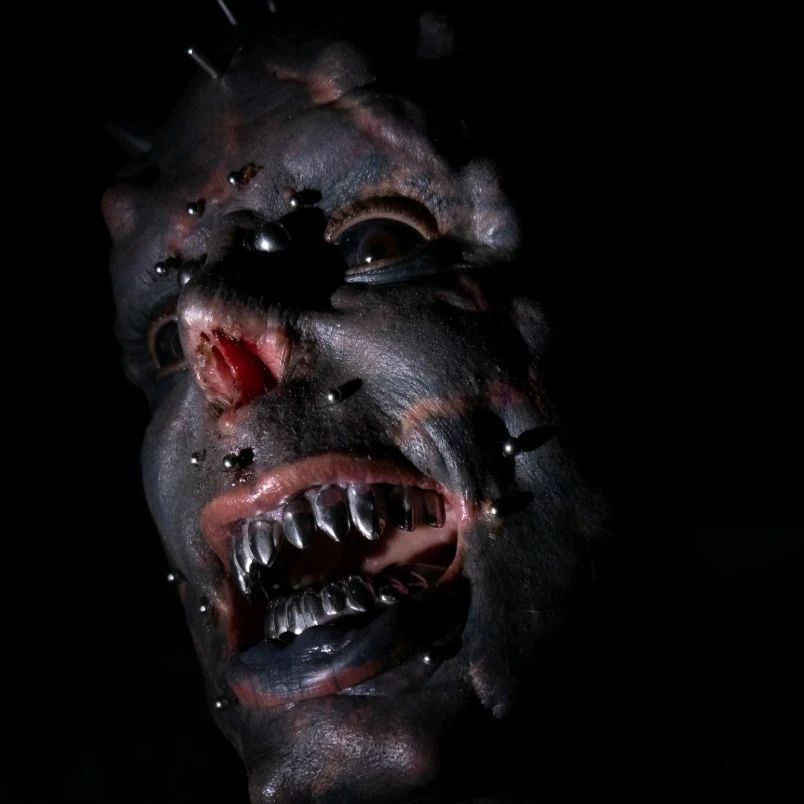
In an era where self-expression is increasingly celebrated yet often confined within socially acceptable boundaries, the story of Diabão Praddo stands as one of the most extreme and thought-provoking examples of personal transformation in modern history. Born Michel Praddo in 1975 in Santos, São Paulo, Brazil, he has spent more than two decades reshaping his body into a form that defies conventional definitions of identity, beauty, and even humanity itself. Today, known legally as Diabão Faro do Prado and widely recognized as the “Human Satan,” he has become both a global fascination and a lightning rod for controversy.
His journey did not begin with a desire to shock the world. Like many in the tattoo industry, Praddo’s early years were rooted in artistic exploration. As a professional tattoo artist, he developed a deep appreciation for body art as a medium of storytelling and personal identity. What started as traditional tattoo work gradually evolved into something far more ambitious. Over time, he began covering his own body in black ink, creating a uniform canvas that would later serve as the foundation for more radical modifications.
This transition from artist to living artwork was neither sudden nor impulsive. It unfolded slowly, shaped by personal struggles and an intense desire for reinvention. Praddo has openly discussed his difficult past, including periods of homelessness and battles with drug addiction. For him, transformation was not merely aesthetic—it was symbolic. Each modification represented a step away from his former life and toward a new identity entirely under his control.
As the years passed, his modifications grew increasingly extreme. His body is now more than 80 percent covered in black tattoos, a striking visual statement that alone sets him apart. But it is the surgical alterations that have drawn the most attention. He has undergone procedures to implant silicone horns beneath his scalp, creating rows of protrusions that resemble a demonic crown. These implants have earned him recognition for having one of the highest numbers of horn implants in the world.
In addition to the horns, Praddo has removed both of his external ears, dramatically altering the silhouette of his head. His nose has been surgically reshaped, and the whites of his eyes have been tattooed black—a procedure known for its significant risks, including potential vision loss. His tongue has been split into a fork, and the corners of his mouth have been extended to create a permanent, exaggerated grin. His teeth have been modified with metallic implants, giving them a sharp, fang-like appearance.
Perhaps one of the most controversial steps in his transformation occurred in 2025, when he chose to amputate specific fingers on both hands to create what he describes as claw-like appendages. This procedure, which he documented extensively on social media, sparked intense debate across the internet. While some viewed it as the ultimate expression of bodily autonomy, others saw it as a disturbing act of self-harm.
Despite the physical pain and medical risks associated with these procedures, Praddo has consistently maintained that each decision is deliberate and meaningful. He describes his body as a living sculpture, constantly evolving to reflect his inner vision. For him, pain is not the point—it is simply a byproduct of transformation. The end result, he insists, is worth every sacrifice.
Central to this journey is his relationship with his wife, Carol Praddo, known as “Mulher Demônia” or “Demon Woman.” Like her husband, Carol has undergone extensive body modifications, including tattoos, implants, and other procedures that align with their shared aesthetic. Together, they present a unified image that challenges traditional notions of beauty and partnership. Their relationship appears to be built on mutual understanding and support, particularly during the most physically demanding stages of their transformations.
The couple lives in Praia Grande, Brazil, where they maintain a relatively private life despite their global notoriety. They support themselves through social media, merchandise, and appearances, leveraging their unique identities to build a sustainable lifestyle. Their online presence offers glimpses into their daily routines, humanizing them beyond the shock value of their appearances.
Yet, their lifestyle is not without consequences. Public reactions to Praddo’s transformation have been deeply polarized. Supporters view him as a pioneer of radical self-expression, someone who embodies the principle of complete bodily autonomy. They argue that in a world where people routinely alter their appearances through cosmetic procedures, tattoos, and fashion, his choices are simply an extension of that same desire for individuality.
Critics, however, see his modifications as extreme and potentially harmful. Medical professionals have raised concerns about the long-term health implications of such procedures, particularly those performed outside traditional medical frameworks. Questions about mental health are frequently raised, with some suggesting that such drastic changes may be linked to conditions like body dysmorphia.
Praddo rejects these interpretations. In interviews, he has emphasized that he does not see himself as mentally ill or unstable. On the contrary, he describes his transformation as a source of clarity and empowerment. For him, becoming “Diabão” was not about escaping reality but about embracing his true self—no matter how unconventional that self might appear to others.
This tension between self-expression and societal norms lies at the heart of the broader conversation surrounding his story. Where does personal freedom end, and where does societal responsibility begin? Should individuals be allowed to modify their bodies in any way they choose, regardless of the risks? Or is there a point at which intervention becomes necessary?
These questions do not have easy answers, and Praddo’s case only complicates them further. On one hand, his transformation can be seen as a powerful assertion of autonomy. In a world that often pressures individuals to conform, he has chosen a path that is entirely his own. On the other hand, the extremity of his modifications challenges our understanding of what it means to care for one’s body.
Culturally, his story carries additional weight. Brazil, with its strong religious traditions and deeply ingrained social norms, provides a complex backdrop for his transformation. The demonic imagery he embraces stands in stark contrast to the country’s predominantly Catholic heritage, adding another layer of controversy to his public persona.
Despite this, or perhaps because of it, Praddo has become a global phenomenon. His social media posts regularly attract millions of views, drawing attention from audiences around the world. Media outlets have covered his story extensively, further amplifying his reach and influence. He has become, in many ways, a symbol—one that people project their own beliefs and fears onto.
For some, he represents the ultimate freedom to define oneself without limitation. For others, he serves as a cautionary tale about the dangers of pushing boundaries too far. And for many, he is simply a source of fascination, a living example of how far the human body can be transformed.
What makes his story particularly compelling is its ongoing nature. At 50 years old, Praddo shows no signs of stopping. He continues to explore new possibilities for modification, hinting at future procedures that could push the limits even further. Each new step adds to a narrative that is already unlike anything else in contemporary culture.
In reflecting on his journey, it is important to move beyond simple judgments. Whether one views his choices as admirable or troubling, they undeniably force us to confront deeper questions about identity, freedom, and the human experience. Why do we feel the need to change our bodies? What drives us to seek transformation? And how do we define the boundaries of self-expression?
Praddo’s story does not provide clear answers, but it does offer a unique perspective. It challenges us to reconsider our assumptions and to recognize the diversity of human experiences. In doing so, it expands the conversation around what it means to be an individual in a rapidly changing world.
Ultimately, the legacy of Diabão Praddo may not be defined solely by his appearance, but by the dialogue he inspires. Love him or criticize him, it is impossible to ignore the impact of his choices. Through pain, determination, and unwavering commitment to his vision, he has created something that transcends traditional categories—a living work of art that continues to provoke, inspire, and unsettle in equal measure.
As society continues to evolve, stories like his will remain at the forefront of debates about autonomy and identity. They remind us that the human desire for self-expression is both powerful and complex, capable of producing outcomes that challenge our understanding of what is possible. In that sense, Diabão Praddo is more than just an individual—he is a reflection of the endless ways in which people seek to define themselves in a world that is constantly changing.