Few figures from the golden age of modern Hollywood embody longevity, adaptability, and quiet resilience quite like Dyan Cannon. Rising to prominence in the late 1960s and flourishing throughout the 1970s, she carved out a career defined not only by talent but by an unmistakable presence that blended charisma, intelligence, and emotional depth. In an industry that has historically celebrated youth while sidelining aging women, her enduring visibility tells a far more complex and meaningful story—one about identity, reinvention, and the courage to exist authentically beyond the confines of public expectation.
When Cannon first emerged on the Hollywood scene, she quickly distinguished herself in a landscape crowded with rising stars. Her performances carried a rare balance: she could embody humor without triviality and vulnerability without weakness. This duality made her compelling to audiences and filmmakers alike. During a period marked by social transformation—when conversations around gender roles, independence, and personal freedom were beginning to reshape cultural narratives—she came to represent a new kind of femininity. It was neither confined to traditional expectations nor entirely detached from them, but rather something fluid, evolving, and real.
Her work during the 1970s showcased a range that resisted easy categorization. She moved between romantic comedies, dramas, and character-driven stories with an ease that reflected both instinct and discipline. Recognition followed, including critical acclaim and industry accolades, yet what truly set her apart was not any single performance but the consistency of her craft. She built her reputation over time, role by role, proving that staying power in Hollywood often depends less on momentary brilliance and more on sustained authenticity.
At the same time, her life beyond the screen drew intense public interest, particularly her relationship with Cary Grant. Their marriage became one of Hollywood’s most talked-about unions, blending glamour with intrigue. From the outside, it appeared to be a fairy tale—two charismatic figures united at the height of their fame. But as Cannon later revealed, the reality was far more complicated. She spoke candidly about the emotional challenges within the relationship, offering insight into how it shaped her sense of self.
This openness marked a turning point in how she was perceived. No longer just a star projected onto the screen, she became a voice—someone willing to share experiences that resonated with a broader audience. In discussing the complexities of her marriage and eventual divorce, she illuminated themes of identity, independence, and emotional resilience. These were not abstract ideas but lived realities, and her willingness to articulate them added depth to her public persona.
The end of her marriage to Grant was not simply a personal milestone; it was a moment of transformation. It required her to redefine herself outside of a highly visible partnership, to reclaim her narrative in an industry that often defines women by their relationships. In doing so, she demonstrated a quiet strength that would become a defining characteristic of her later life.
Motherhood also played a significant role in shaping her journey. It provided a grounding force amid the volatility of fame, offering a sense of purpose that existed independently of public validation. Balancing career and personal life is never simple, particularly under the scrutiny of Hollywood, yet Cannon navigated this terrain with a determination that reflected her broader approach to life: steady, intentional, and deeply personal.
As the decades passed, the landscape of the entertainment industry shifted dramatically. New faces emerged, trends evolved, and the relentless pace of change often left little room for those unwilling or unable to adapt. For many actresses of her generation, opportunities diminished with age, reinforcing the notion that relevance was tied to youth. Cannon, however, resisted this narrative—not through confrontation, but through persistence.
She continued to explore creative avenues, appearing in projects that allowed her to express different facets of her talent. While she may not have maintained the same level of mainstream visibility as in her earlier years, she never fully disappeared. Instead, she occupied a space that was less about constant exposure and more about selective presence. This approach, though subtle, carried its own form of defiance. It suggested that stepping back did not equate to fading away, and that relevance could be defined on one’s own terms.
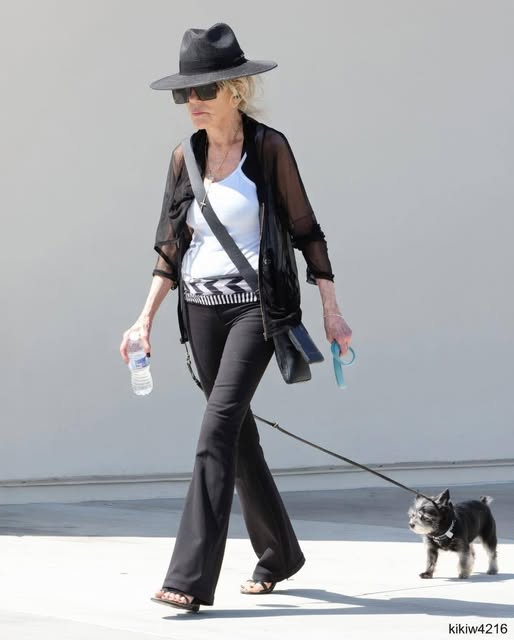
In recent years, public attention returned in unexpected ways. A simple moment—a walk with her dogs—became a focal point for widespread discussion after photographs circulated online. The images showed her as she is now, unfiltered and unstyled, moving through the world without the performative gloss that once defined her public appearances. The reactions were revealing.
Some observers responded with admiration, seeing in her a reflection of grace and authenticity. Others reacted with discomfort, highlighting the persistent unease society feels toward visible aging, particularly among women who were once celebrated for their beauty. The contrast between these responses underscored a broader cultural tension: the desire to celebrate longevity versus the reluctance to accept its physical realities.
This moment, though seemingly trivial, became symbolic. It exposed the ways in which public figures are often denied the simple right to age naturally. For someone like Cannon, whose image was once carefully curated by an industry built on illusion, stepping outside that framework was both an act of liberation and a challenge to entrenched norms.
Aging, in her story, is not framed as decline but as evolution. It is a process that brings clarity, perspective, and, perhaps most importantly, freedom. Freed from the pressures of maintaining a particular image or meeting external expectations, she has embraced a more authentic way of being. This authenticity is not about rejecting the past but integrating it—acknowledging the different phases of her life as parts of a larger, cohesive whole.
Her reflections in later years carry a sense of calm that contrasts sharply with the intensity of her earlier experiences. There is a noticeable shift from external validation to internal understanding, from performance to presence. She speaks not as someone seeking approval but as someone who has already found a measure of peace. This shift is subtle yet profound, offering a perspective that resonates far beyond the context of celebrity.
In a culture still grappling with its relationship to aging, her example holds particular significance. The entertainment industry, despite some progress, continues to struggle with representation, often privileging youth while marginalizing older voices. Cannon’s continued visibility challenges this imbalance, reminding audiences that stories do not lose value with time—they gain depth.
Her journey also invites a broader reflection on identity. Who are we when the roles we once played no longer define us? How do we navigate the transition from one phase of life to another without losing our sense of self? These questions are universal, yet they take on added complexity in the context of public life, where identity is often shaped by perception as much as reality.
Cannon’s answer, it seems, lies in embracing change without surrendering authenticity. She has allowed herself to evolve, to adapt, and to redefine what it means to be present in the world. This willingness to change, coupled with a commitment to remaining true to herself, forms the core of her enduring relevance.
There is also an element of quiet rebellion in her story. Not the kind that seeks attention or provokes controversy, but one that operates through consistency and integrity. By simply continuing to exist on her own terms—by refusing to disappear or conform—she challenges a system that often expects women to do exactly that.
This rebellion is perhaps most evident in the way she navigates visibility. She does not chase it, yet she does not avoid it either. Instead, she engages with it selectively, choosing when and how to step into the public eye. This approach reflects a broader philosophy: that visibility should be a choice, not an obligation.
In many ways, her life can be seen as a series of reinventions. Each phase—rising star, public figure, partner, mother, seasoned actress—represents a different aspect of her identity. Rather than being confined by any one of these roles, she has moved between them, allowing each to inform but not define her. This fluidity is what gives her story its enduring relevance.
As society continues to evolve, the conversations surrounding aging, identity, and representation are likely to become more nuanced. Figures like Cannon play an important role in this process, not by offering definitive answers but by embodying alternative possibilities. Her life suggests that aging need not be something to fear or hide, but something to engage with openly and honestly.
Ultimately, the legacy of Dyan Cannon extends beyond her filmography. It resides in the example she sets—in the way she has navigated the complexities of fame, the challenges of personal transformation, and the realities of time. Her story is not one of perfection but of persistence, not of unchanging identity but of continuous growth.
In a world that often equates visibility with value and youth with relevance, she offers a different perspective. She reminds us that true presence is not about maintaining an image but about inhabiting one’s life fully, at every stage. And in doing so, she transforms what might otherwise be seen as an ending into something far more meaningful: an ongoing journey defined by grace, resilience, and an unwavering commitment to authenticity.