Travel carries with it an unspoken contract of trust. When people leave their homes and step into unfamiliar spaces, they do so believing that the environment they have paid for will provide safety, privacy, and a temporary sense of belonging. Over time, especially for frequent travelers, this trust becomes almost automatic. Online booking platforms streamline decisions, offering glossy photos, verified badges, and long lists of positive reviews that quietly reassure guests that someone else has already done the vetting. Familiarity breeds confidence, and confidence reduces caution. Yet modern travel exists within a digital ecosystem shaped by surveillance technology, data collection, and systems that prioritize convenience over scrutiny. What once felt like a simple exchange between host and guest has evolved into a layered transaction mediated by algorithms and appearances. This story is not driven by paranoia or an urge to sensationalize, but by the realization that trust can be carefully constructed, convincingly marketed, and deeply misleading. When that realization arrives, it reshapes how one understands safety, privacy, and the cost of assuming that comfort equals protection.
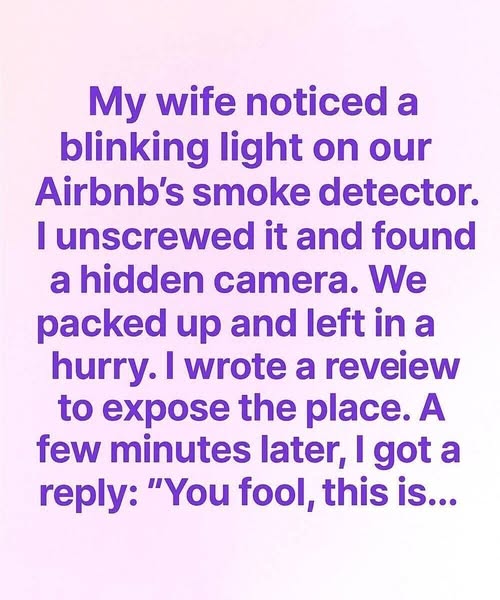
The moment that shattered our assumptions did not arrive with alarms or confrontation. It emerged quietly, disguised as something mundane. After hours on the road, we arrived at a vacation rental that matched its online listing perfectly. The space was clean, inviting, and thoughtfully decorated, giving no reason for suspicion. Fatigue and relief dulled our instincts, and we settled in without question. It was only later, when the house had grown quiet, that my wife noticed a faint blinking light embedded in a smoke detector. At first, it seemed insignificant, easy to rationalize as a technical feature or faulty wiring. But discomfort has a way of persisting when logic tries to dismiss it. A closer inspection revealed a hidden lens concealed behind plastic meant to symbolize safety rather than observation. In that instant, the room transformed. What had felt warm and welcoming became intrusive. Every surface felt suspect, every shadow heavier. We did not debate or deliberate. We packed our belongings quickly, guided by instinct rather than reason, because once privacy is compromised, hesitation feels dangerous. Leaving was not dramatic; it was urgent, necessary, and sobering.
Driving away offered temporary relief, but it was incomplete. The adrenaline lingered, mixing with anger and disbelief. We stopped at a brightly lit diner, hoping familiarity would ground us, and there I posted a detailed warning online, partly to protect others and partly to regain a sense of agency. I expected denial, silence, or a delayed response. Instead, the host replied almost immediately. The tone was not apologetic or confused, but sharp, dismissive, and unsettling. Rather than addressing the concern directly, the message hinted at unnamed others who would be “looking for it,” a phrase that carried an implied threat rather than reassurance. That response shifted the experience from violation to fear. It suggested awareness, confidence, and a lack of concern about accountability. The question was no longer just why a camera existed, but who was behind it and what they believed they could get away with. The hostility of the reply stripped away any lingering doubt that the situation might be a misunderstanding. It felt deliberate, calculated, and deeply disturbing.
As we revisited the photos we had taken inside the rental, searching for clarity or confirmation, the unease deepened. A faint reflection in one image, barely noticeable at first glance, hinted at another device positioned elsewhere in the room. That detail changed everything. One hidden camera could be dismissed as an anomaly or misguided security measure, but multiple points of observation suggested planning and intent. The space no longer felt accidental; it felt curated. The realization that surveillance could be embedded so seamlessly into an ordinary environment was sobering. Digital trust had replaced direct accountability, and the systems designed to protect users had instead created cover for exploitation. Reviews, verification symbols, and professional photography had built a convincing narrative of safety, but narratives can be engineered. Once that understanding takes hold, it becomes impossible to ignore how easily manipulation can blend into normalcy, especially when convenience encourages complacency.
Distance eventually brought some calm, but peace remained elusive. We drove for hours, choosing anonymity over comfort, stopping only when exhaustion made it unavoidable. Even then, rest came in fragments. The idea that we might have been recorded lingered, raising questions without clear answers. Actions that might once have seemed excessive, such as disconnecting devices, documenting evidence, and filing reports, now felt necessary. Yet alongside those efforts was a nagging uncertainty about accountability. Would authorities take this seriously? Would the platform act decisively? Technology evolves faster than regulation, and responsibility often dissolves into gray areas where platforms, hosts, and law enforcement defer to one another. That ambiguity is exhausting, leaving victims not only violated but burdened with proving that their fear is justified. The emotional toll of that uncertainty can be as heavy as the initial discovery, reinforcing how vulnerable travelers can feel once trust collapses.
With time and reflection, the broader lesson became clear. Travel safety in the modern world is no longer defined solely by locks, lighting, or location. It now includes an awareness of how digital tools can be misused and how easily privacy can be compromised without visible force. Familiarity with platforms can breed false confidence, especially among travelers who rely on established routines and reputations. Awareness does not require fear, but it does demand attentiveness and the willingness to question what seems ordinary. Simple habits, such as checking devices, trusting intuition, and leaving when something feels wrong, are acts of self-protection rather than overreaction. Most importantly, safety cannot be fully outsourced to platforms or promises. It begins with personal vigilance and the courage to disrupt comfort when instincts signal danger. In a world where trust can be simulated with convincing ease, protecting oneself means learning to look beyond appearances and listening carefully when something feels wrong, even if nothing looks out of place.