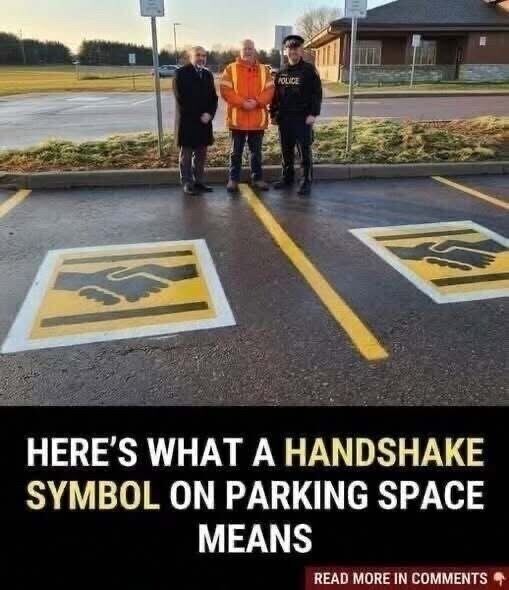
In today’s increasingly digital world, the way people buy and sell everyday items has changed dramatically. Online marketplaces have made it easier than ever to connect with strangers, negotiate deals, and arrange exchanges within minutes. Yet, while the convenience is undeniable, the moment when two people meet in person to complete a transaction remains one of the most uncertain and potentially risky parts of the process. It is precisely within this gap—between digital agreement and physical exchange—that a simple but effective idea has begun to gain traction. Painted onto parking spaces in select locations, a modest handshake symbol is quietly redefining how people approach these meetings. At first glance, it may seem insignificant, just another marking on the pavement. But behind it lies a carefully considered response to modern concerns about safety, trust, and accountability in a world where interactions often begin online but must eventually move offline.
The concept is both practical and intuitive. These handshake-marked spaces serve as designated safe exchange zones, typically located in highly visible, well-lit areas, often near police stations or public buildings. One well-known example can be found in the Canadian town of Pembroke, where such spaces were introduced outside a local law enforcement facility to encourage safer in-person transactions. The idea is simple: instead of meeting a stranger in a secluded area or inviting them to a private residence, individuals can choose a neutral location specifically designed to reduce risk. The presence of cameras, lighting, and nearby authorities creates an environment where both parties feel more secure. While officers are not directly involved in the exchange, their proximity alone acts as a deterrent to potential misconduct. This subtle shift in location can significantly alter the dynamics of a meeting, replacing uncertainty with a greater sense of confidence.
The rise of peer-to-peer marketplaces has brought undeniable benefits, but it has also introduced new vulnerabilities. Stories of scams, theft, and unsafe encounters have become increasingly common, reminding users that convenience can come at a cost if precautions are not taken. The handshake symbol represents a proactive solution to these challenges. Rather than waiting for incidents to occur and responding after the fact, communities are beginning to design environments that prevent problems before they arise. These safe exchange zones embody that philosophy. They are not complex systems or high-tech innovations; instead, they rely on visibility, accessibility, and a shared understanding of purpose. By simply providing a better option, they encourage safer behavior without requiring enforcement or intervention.
What makes these spaces particularly impactful is not just their physical setup, but the psychological influence they exert. When two strangers agree to meet in a designated safe zone, there is an unspoken agreement about how the interaction should unfold. The setting itself communicates expectations—honesty, transparency, and respect. This subtle social cue can shape behavior in meaningful ways. People are less likely to act dishonestly or aggressively when they know they are in a public, recognized space where accountability feels immediate. In this sense, the zones function as more than just locations; they become part of a broader social framework that promotes trust. The handshake symbol reinforces this message, drawing on a universally understood gesture of agreement and cooperation to signal that the space is intended for safe and straightforward exchanges.
Beyond safety, these zones also contribute to a smoother and more efficient transaction process. One of the challenges of arranging in-person meetings is deciding where to meet—a decision that often involves negotiation, compromise, and sometimes discomfort. By establishing clearly marked, widely recognized locations, communities eliminate much of that uncertainty. Buyers and sellers can default to a known, trusted spot, simplifying communication and reducing hesitation. This clarity benefits both parties, allowing them to focus on the transaction itself rather than the logistics surrounding it. Over time, as more people become familiar with these spaces, they may become the standard choice for meetups, further normalizing safe practices within online commerce.
The adaptability of the concept is another reason for its growing popularity. While it may have originated in specific towns or regions, the idea can be easily replicated in a variety of settings. Shopping centers, municipal parking lots, university campuses, and even large residential complexes can implement similar zones with minimal effort. All that is required is a clearly marked space, good lighting, and a commitment to maintaining visibility. This simplicity ensures that the initiative remains accessible to communities of all sizes and resources. It also allows the concept to evolve alongside changing patterns of commerce, ensuring that it remains relevant as new platforms and technologies emerge.
As digital platforms continue to shape how people interact, there is also potential for deeper integration between online tools and these physical spaces. Marketplace apps could incorporate features that suggest nearby safe exchange zones when users arrange meetups. Navigation systems could highlight these locations, and users could receive reminders encouraging them to choose safer options. By linking digital convenience with real-world safety infrastructure, the entire process of buying and selling could become more seamless and secure. This kind of integration represents the next step in aligning online behavior with offline realities, ensuring that safety is considered at every stage of the transaction.
Despite their simplicity, handshake-marked parking spaces carry a deeper cultural significance. They reflect a shift in how society approaches safety—not as an afterthought, but as an integral part of everyday activities. They demonstrate that meaningful change does not always require complex solutions; sometimes, it can begin with something as straightforward as a painted symbol and a shared understanding. In a fast-paced, technology-driven world, these spaces offer a grounded reminder that human interactions still benefit from thoughtful design and intentional choices. They show that as the ways we connect continue to evolve, so too can the ways we protect and support one another.
Ultimately, the impact of these safe exchange zones lies in their ability to influence behavior in subtle yet powerful ways. They encourage people to pause, consider their surroundings, and make decisions that prioritize their well-being. They foster a sense of trust not only between individuals, but within communities as a whole. And perhaps most importantly, they illustrate how small, practical ideas can address complex challenges. The handshake symbol may be simple, but its message is clear: safety matters, trust can be built, and even in a digital age, the spaces where we meet still shape the experiences we share.