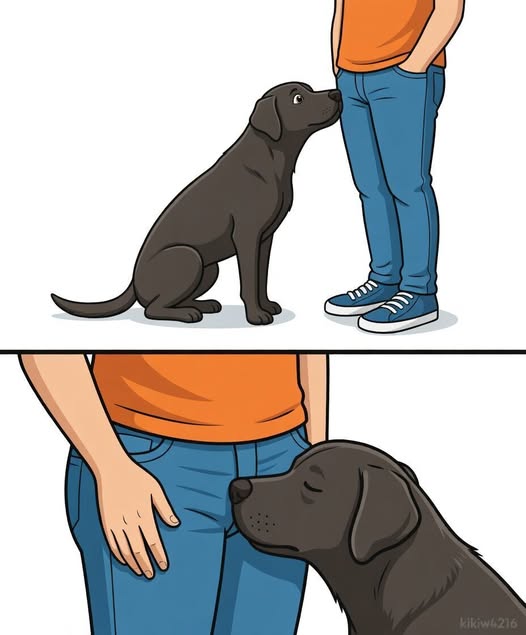
Dogs have fascinated humans for thousands of years with their loyalty, intelligence, and emotional sensitivity. Yet one canine behavior continues to confuse and embarrass people around the world: the tendency of dogs to sniff human private areas. While humans often react awkwardly, laugh nervously, or try to pull away, dogs see the situation very differently. To them, sniffing is not rude, invasive, or inappropriate. It is simply one of the most natural ways to gather information.
What appears embarrassing in human society is actually a remarkable example of biology in action. Dogs possess one of the most sophisticated scent-detection systems in the animal kingdom. Their noses are capable of identifying emotional changes, health conditions, hormonal fluctuations, and personal identity with a level of precision that scientists still struggle to fully understand.
The next time a dog suddenly becomes interested in sniffing your groin area, remember this: the animal is not trying to offend you. It is reading a complex chemical story your body is constantly telling.
The Incredible Power of a Dog’s Nose
Humans experience the world primarily through vision. Dogs experience it through smell.
A person walking into a room may notice colors, shapes, lighting, and facial expressions first. A dog, however, instantly notices scent trails, emotional cues, hormonal changes, and chemical signatures floating invisibly through the air.
The average human nose contains roughly five to six million olfactory receptors. Dogs possess anywhere from one hundred million to more than three hundred million depending on the breed. Bloodhounds, German Shepherds, Beagles, and Labrador Retrievers are especially famous for their advanced scent capabilities.
But the number of receptors alone does not explain the full picture. Dogs also dedicate a far larger portion of their brains to analyzing smells. In proportion to body size, the scent-processing area of a dog’s brain is dramatically more developed than that of humans.
This means dogs do not merely “smell better.” They experience scent in layers.
While humans might smell a meal cooking and identify it simply as pasta or soup, a dog can distinguish the individual ingredients, the person who prepared it, how recently it was made, and even subtle changes caused by heat and moisture.
Their noses are so sensitive that trained dogs can detect tiny traces of substances buried underground, hidden underwater, or trapped beneath rubble after disasters.
Scientists have repeatedly confirmed that dogs can detect diseases such as cancer, diabetes, Parkinson’s disease, infections, and even impending seizures by smelling subtle changes in human body chemistry.
So when a dog sniffs a person’s body, especially areas rich in scent glands, it is gathering enormous amounts of information.
Why Dogs Focus on the Groin Area
Humans have sweat glands throughout the body, but not all sweat glands are the same.
The body contains two primary types: eccrine glands and apocrine glands.
Eccrine glands are found almost everywhere and help regulate temperature by producing watery sweat. Apocrine glands, however, are concentrated in places like the armpits and groin. These glands release thicker secretions filled with proteins, hormones, and chemical compounds.
When bacteria on the skin break down these secretions, they create unique body odors.
To humans, these smells may seem unpleasant or barely noticeable. To dogs, they are incredibly informative.
The groin area acts almost like a chemical identification badge. Because it contains a high concentration of apocrine glands, it produces stronger scent signals than many other parts of the body.
When a dog sniffs there, it may learn:
- Your sex
- Your age range
- Your emotional condition
- Hormonal changes
- Reproductive status
- General health
- Familiarity or unfamiliarity
- Recent physical activity
- Dietary changes
- Medication use
Dogs are not interested in human modesty or social boundaries. They are simply using the most effective source of biological information available.
Understanding Pheromones and Chemical Communication
One major reason dogs behave this way involves pheromones.
Pheromones are chemical signals released by living organisms that influence the behavior or physiology of others. Many animals rely heavily on pheromones to communicate social information.
Dogs possess a specialized structure called the vomeronasal organ, also known as Jacobson’s organ. Located between the roof of the mouth and nasal cavity, this organ is specifically designed to detect pheromones.
Unlike ordinary smells, pheromones communicate biological and emotional information.
In the animal world, pheromones can indicate:
- Mating readiness
- Fear
- Aggression
- Stress
- Territory boundaries
- Maternal bonding
- Social hierarchy
Humans also release pheromones and hormone-related compounds, even though we rely more on language and facial expressions than scent communication.
Dogs still recognize these chemical signals immediately.
This is why dogs may behave differently around pregnant women, anxious individuals, sick people, or someone experiencing hormonal changes.
To the dog, the body is constantly broadcasting information.
Dogs Can Smell Emotions
One of the most fascinating discoveries in canine science is that dogs can detect emotional changes through scent.
When humans feel stressed, frightened, excited, or anxious, the body releases hormones such as cortisol and adrenaline. These chemicals alter body odor in subtle ways.
Humans usually cannot notice these scent changes, but dogs can.
Research has shown that dogs often react differently to sweat samples taken from fearful people compared to relaxed individuals.
This explains why dogs sometimes seem to “know” when their owners are upset before a single word is spoken.
A dog may approach more gently, stay close, become protective, or display signs of concern.
In many ways, dogs read emotional chemistry more honestly than human facial expressions because scent cannot easily lie.
If you are nervous, your dog probably already knows.
Why Certain People Get More Attention
Some individuals notice that dogs become especially interested in them.
There are several scientific reasons for this.
Hormonal Changes
Women experiencing menstruation, pregnancy, ovulation, or postpartum recovery produce noticeable hormonal changes that affect body chemistry.
Dogs can detect these shifts almost instantly.
Pregnant women frequently report that dogs become more affectionate, protective, or curious around them.
Illness or Medical Conditions
Changes caused by infection, inflammation, blood sugar fluctuations, or disease can alter scent patterns.
Dogs sometimes focus intensely on areas affected by illness because the body emits unusual chemical compounds during disease processes.
New Products or Scents
A new perfume, soap, detergent, lotion, or deodorant may temporarily alter someone’s scent profile.
Dogs often investigate unfamiliar odors to update their understanding of a person.
Stress and Anxiety
People under emotional stress release different chemical signals through sweat.
Dogs may react by sniffing more frequently, acting protective, or appearing unusually attentive.
Recent Exercise
Physical activity increases sweat production and changes body chemistry, making scents stronger and more noticeable.
Dogs Greet Each Other the Same Way
To truly understand this behavior, it helps to look at how dogs interact with one another.
Dogs commonly greet nose-to-rear.
While humans shake hands or make eye contact, dogs exchange scent information.
The anal glands of dogs release pheromones that communicate:
- Identity
- Sex
- Mood
- Health
- Social status
- Reproductive condition
This greeting ritual may seem strange to humans, but in canine society it is perfectly normal and highly efficient.
When dogs greet humans by sniffing the groin area, they are simply adapting the same instinctive behavior.
They do not understand that humans consider those areas private.
From the dog’s perspective, it is the fastest way to gather information and establish familiarity.
The Medical Importance of Canine Scent Detection
Scientists have become increasingly interested in dogs because of their astonishing ability to detect disease.
Studies around the world have shown that dogs can identify:
- Lung cancer
- Breast cancer
- Prostate cancer
- Ovarian cancer
- Skin cancer
- Diabetes-related blood sugar changes
- Epileptic seizures
- Bacterial infections
- COVID-19
- Parkinson’s disease
In some experiments, trained dogs achieved impressive accuracy rates when identifying disease samples.
Researchers believe dogs detect volatile organic compounds produced by illness-related changes in metabolism.
This means that when dogs show unusual interest in certain body areas, they may sometimes notice changes humans cannot perceive.
Of course, dogs sniffing someone does not automatically mean illness is present. Most of the time it is simply curiosity and information gathering.
Still, the scientific evidence highlights how extraordinary canine noses truly are.
Why Dogs Sometimes Seem Obsessed With Certain Smells
Dogs do not view scents emotionally the way humans do.
Humans often divide smells into categories like pleasant, disgusting, clean, or embarrassing.
Dogs focus more on intensity, novelty, and informational value.
Strong scents are exciting because they provide more data.
This explains why dogs may enjoy sniffing:
- Dirty laundry
- Shoes
- Sweat
- Gym clothes
- Used socks
- Bedding
- Human skin
To humans, these smells may seem unpleasant. To dogs, they are rich sources of social and biological information.
The stronger the scent, the more interesting the investigation.
How to Respond Without Encouraging the Behavior
Although the behavior is natural, many people understandably prefer dogs not sniff guests or strangers this way.
The good news is that dogs can learn polite greeting behavior through calm training.
Stay Calm
Sudden yelling or pushing can confuse or excite the dog.
Dogs respond best to calm, consistent guidance.
Redirect Attention
Offer your hand for the dog to sniff instead.
You can also redirect attention using a toy, treat, or command.
Teach Commands
Commands such as “sit,” “leave it,” or “off” can help establish greeting boundaries.
Reward calm behavior immediately.
Use Positive Reinforcement
Dogs learn best through rewards, praise, and repetition.
Punishment often creates anxiety rather than understanding.
Socialize Early
Puppies exposed to respectful greeting training early in life adapt more easily to human social expectations.
Why Punishment Is Usually the Wrong Approach
Many people mistakenly believe the behavior reflects dominance, disrespect, or bad training.
In reality, it is deeply instinctive.
Punishing a dog harshly for sniffing may create fear or confusion because the dog does not understand why normal investigative behavior suddenly caused anger.
Instead of punishment, experts recommend gentle interruption and redirection.
Dogs can absolutely learn manners, but the learning process should respect their natural instincts rather than shame them.
The Science of Human-Dog Bonding
Dogs evolved alongside humans for thousands of years.
During domestication, dogs became highly attuned to human emotions, routines, and behaviors.
Research shows dogs can:
- Recognize human facial expressions
- Interpret tone of voice
- Respond to pointing gestures
- Detect emotional states
- Synchronize emotionally with owners
Scent plays a major role in this connection.
A dog’s ability to identify its owner’s smell provides comfort and security.
Some dogs even sleep beside clothing items carrying their owner’s scent when separated.
This demonstrates how deeply smell influences canine attachment.
Pregnancy and Dogs
One especially interesting area involves dogs and pregnancy.
Many pregnant women report that dogs become clingier, calmer, or unusually protective.
Scientists believe dogs detect hormonal and metabolic changes associated with pregnancy.
These changes affect pheromones, sweat composition, and overall body chemistry.
Some dogs begin reacting before the woman herself knows she is pregnant.
While dogs cannot medically confirm pregnancy, their sensitivity to scent changes is remarkable.
Dogs and Anxiety Detection
Dogs also excel at detecting emotional distress.
People experiencing panic attacks, severe stress, or trauma may unknowingly release stronger chemical stress signals.
Certain service dogs are trained specifically to respond to these changes.
Psychiatric service dogs can interrupt panic attacks, provide grounding behaviors, and alert handlers before emotional episodes escalate.
Again, this incredible skill begins with scent detection.
Cultural Reactions Versus Canine Reality
Humans interpret the world through social etiquette.
Dogs interpret the world through instinct and sensory information.
This difference explains why humans often feel embarrassed while dogs remain completely unconcerned.
A dog does not attach shame to body odors.
It simply detects information.
Recognizing this difference can help owners react more patiently and compassionately.
Common Myths About Dogs Sniffing People
Myth: Dogs that sniff private areas are poorly trained.
Reality: The behavior is instinctive and biologically normal.
Myth: Only male dogs do it.
Reality: Both male and female dogs may sniff people this way.
Myth: The behavior means dominance.
Reality: Sniffing is information gathering, not social domination.
Myth: Dogs are behaving sexually.
Reality: Dogs are responding to scent cues, not human-style attraction.
Myth: Yelling stops the problem permanently.
Reality: Harsh reactions may create anxiety without addressing the instinct.
Why Dogs Depend on Smell More Than Sight
Dogs evolved as scent-driven hunters and social animals.
Their survival depended on identifying food, danger, territory, family members, and prey through smell.
Even today, smell remains their dominant sense.
While humans remember visual details, dogs often remember scent signatures.
A dog may forget a person’s appearance after years apart but instantly recognize their scent.
This extraordinary memory system helps explain why smell-based greetings matter so much to them.
Giving Dogs Healthy Outlets for Their Senses
Dogs need opportunities to use their noses.
Mental stimulation through scent activities can improve behavior and reduce anxiety.
Healthy scent-based enrichment includes:
- Scent games
- Snuffle mats
- Tracking exercises
- Puzzle toys
- Long walks with sniffing opportunities
- Hide-and-seek treats
Allowing dogs to explore scent safely and appropriately satisfies their natural instincts.
The Emotional Intelligence of Dogs
Beyond smell alone, dogs demonstrate astonishing emotional awareness.
Studies suggest dogs can distinguish between happy and angry voices, recognize emotional expressions, and respond empathetically to human crying.
Combined with their scent-detection abilities, this makes dogs uniquely connected to humans.
Many owners describe feeling understood by their dogs in ways difficult to explain.
Science increasingly supports the idea that dogs truly are exceptional emotional companions.
What This Behavior Reveals About Dogs
When a dog sniffs a person’s private area, the behavior may feel awkward, but it reflects several extraordinary truths about canine biology:
- Dogs process the world primarily through smell.
- Their noses detect information humans cannot perceive.
- Pheromones and hormones shape social communication.
- Dogs instinctively gather information through scent.
- Emotional and physical states alter body chemistry.
- Canine curiosity is rooted in survival and bonding.
Rather than seeing the behavior as rude, understanding the science behind it reveals just how advanced dogs truly are.
Building Better Understanding Between Humans and Dogs
Much frustration between humans and dogs comes from misunderstanding.
Humans expect dogs to naturally understand social customs, but dogs operate according to instincts shaped over thousands of years.
The more owners understand canine behavior, the easier it becomes to guide dogs patiently and effectively.
Knowledge transforms annoyance into empathy.
Recognizing why dogs sniff helps people respond calmly instead of react emotionally.
Final Thoughts
A dog sniffing your private area may feel uncomfortable, but to the dog it is simply an efficient way to gather information.
Your body carries chemical signals that reveal mood, health, identity, hormones, and emotional state. Dogs possess extraordinary biological tools capable of detecting these signals with incredible precision.
What humans experience as embarrassment, dogs experience as communication.
Their noses are not merely sensitive; they are astonishing scientific instruments refined through evolution.
The same abilities that help dogs detect diseases, locate missing people, and respond to emotional distress are also responsible for those occasionally awkward greeting moments.
Understanding this behavior helps strengthen the bond between humans and dogs. Instead of viewing the action as inappropriate or disobedient, it can be recognized as part of the incredible sensory world dogs inhabit every day.
The next time a curious dog leans in for an awkward sniff, remember that you are not just a person to that animal. You are a living collection of chemical stories, emotions, memories, and biological signals.
And through the extraordinary power of scent, your dog is simply trying to understand you better.