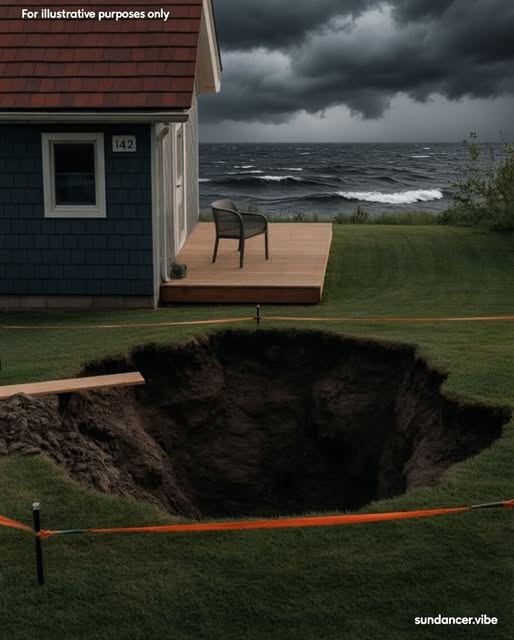
The day everything broke apart began like any other Saturday—quiet, ordinary, almost insultingly normal.
Adam kissed me goodbye in our kitchen while the kids argued over cereal and the coffee machine hissed like it always did. He adjusted his tie, checked his phone twice, and told me he had a three-day work trip in Portland.
I remember nodding without thinking. We had done this routine a hundred times. He traveled. I held things together. That was our rhythm.
“Don’t forget Sam’s soccer pickup,” I reminded him automatically.
“I won’t,” he said, smiling.
And just like that, he walked out.
I watched his car disappear down the street and thought nothing of it.
Not yet.
By noon the next day, I would be standing in a backyard staring into a freshly dug grave.
But at that moment, life was still innocent enough to believe in.
Saturday should have been simple. The kids were restless, bouncing off walls like they had electricity running through their bones. The house felt too small for their energy.
“Let’s go to the lake house,” I decided finally.
The idea sparked instant excitement. Within twenty minutes we were packed, snacks shoved into bags, towels thrown into the back seat, and the dog barking like he understood the concept of vacation.
The lake house belonged to Adam’s family. It was old, slightly crooked, and always smelled faintly of cedar and dust. But it was ours. Our escape. Our peace.
Or so I believed.
The drive felt peaceful. Sunlight filtered through the trees as we left the city behind. I even remember thinking how lucky we were—how life, despite its chaos, still gave us pockets of calm.
That illusion lasted until we turned into the gravel driveway.
That’s when everything stopped.
Adam’s car was parked outside the house.
My stomach tightened instantly.
“That’s Daddy’s car,” Kelly said from the back seat.
“No,” I said too quickly. “That can’t be.”
He was supposed to be in another state.
I told the kids to stay in the car. My voice sounded strange even to me—too sharp, too controlled. They obeyed without argument.
Then I walked.
Each step toward the house felt heavier than the last. The door was slightly open.
Adam never left doors open.
Never.
“Adam?” I called out.
No answer.
Inside, everything looked almost normal. Too normal. His glasses sat on the counter. A coffee mug was half full. His jacket hung on the chair like he had simply stepped outside for a moment.
But something was wrong.
The air felt wrong.
Then I saw it through the kitchen window.
The backyard.
The ground was torn open like the earth itself had been wounded. A massive hole yawned behind the herb garden, fresh soil piled around it like a warning.
My breath stopped.
And then I heard it.
Metal scraping dirt.
Someone was digging.
I ran.
“Adam!”
The scraping stopped.
A second later, his head appeared over the edge of the pit.
He looked nothing like the man who kissed me that morning.
Dirt smeared his face. His hands shook. His expression was panic and something deeper—something broken.
“Mia—don’t come closer.”
I froze. “What are you doing?”
“Please just trust me.”
Trust.
That word felt absurd.
“You told me you were in Portland.”
“I know.”
“What is that?” I pointed at the hole.
His silence told me everything before I even saw it.
I stepped forward anyway.
And looked down.
The world tilted violently.
Bones.
Human bones.
Half-buried, tangled in old fabric, yellowed by time. A skull angled upward as if still watching.
I screamed before I could stop myself.
“What did you do?”
“I didn’t kill anyone!” Adam shouted instantly.
“Then whose grave is this?”
His face crumbled.
“My great-grandfather.”
The words made no sense at first.
Then slowly, painfully, they began to.
We sat beside the hole as the wind moved through the trees. The lake shimmered in the distance, indifferent to everything happening on land.
Adam’s voice shook as he explained.
His father, recently placed in assisted care, had begun slipping between memories. In one of his clearer moments, he insisted something had been buried here long before the house was built.
Not just something.
Someone.
A man named Samuel.
A story buried in fragments.
A forbidden relationship.
A town that chose shame over truth.
Samuel, he said, had loved a woman who belonged to someone powerful. When the affair became known, the town turned on him. Jobs disappeared. Friends vanished. His name became poison.
And when he died, the church refused him burial.
So his wife did the only thing she could.
She buried him here.
On family land.
Hidden.
Protected.
Forgotten.
Or so they thought.
Adam pulled out a folded letter from his pocket, shaking as he handed it to me.
It was old. Fragile.
The handwriting was elegant, emotional.
Let them deny him rest in their cemetery. I will give him rest where the lake still remembers his name.
My throat tightened.
“You dug him up because you believed your father?” I whispered.
“I had to know if it was real.”
“And now?”
He looked into the grave.
“It’s real.”
That night we called the authorities.
The lake house became a crime scene by sunrise. Yellow tape, uniforms, cameras. Our children were confused and frightened. I had no answers that made sense.
Because nothing made sense anymore.
Then a historian arrived.
She knew the name immediately.
Samuel wasn’t just a rumor.
He was documented.
Destroyed.
Erased.
She showed us newspapers—old, yellowed, cruel. They called him immoral. Dangerous. A disgrace.
But beneath the headlines was something else.
Whispers of corruption in the town’s elite.
Financial manipulation.
Land fraud during the Depression.
Samuel hadn’t just loved the wrong person.
He had discovered the wrong truth.
And that truth had cost him everything.
Including his life.
Inside the attic of the lake house, we found the journal.
That was when everything expanded.
Page after page revealed what Samuel had uncovered—illegal land seizures, forged signatures, families displaced without justice. A system built on quiet corruption.
He had documented it all.
Names.
Dates.
Evidence.
And then he disappeared from public record entirely.
Erased not by time.
But by design.
Adam stared at the pages like they burned.
“If this is real…” he whispered.
“It is,” I said.
Because I could feel it.
Truth has weight.
And this was heavy enough to collapse history.
Then the threats began.
A quiet car outside the house.
Phone calls with no voice.
Footprints in the yard at night.
Someone else knew.
Or remembered.
Or feared.
Adam wanted to stop.
But I couldn’t.
Not anymore.
Because Samuel deserved more than silence.
And so did every family hurt by what had been buried with him.
We went public.
And the town cracked open.
Stories surfaced. Families came forward. Old wounds reopened like they had been waiting decades for air.
And suddenly Samuel was no longer just bones in a yard.
He was a man.
A story.
A warning.
A truth too long denied.
The reburial happened weeks later.
The cemetery was full.
Not of mourning strangers—but of descendants, historians, and people carrying inherited silence.
Adam stood beside me as the casket was lowered.
And for the first time since it began, I felt something other than fear.
I felt clarity.
Some secrets rot when buried too long.
Others grow roots.
Samuel had both.
Later that night, we sat by the lake again.
The same place where everything had begun.
The same water that had watched a man die and a truth survive.
Adam held my hand tightly.
“I never meant to bring this into our lives,” he said.
“I know.”
“But I’m glad we didn’t leave him there.”
I looked at the water.
Neither was I.
Because somehow, beneath all the fear and chaos and broken certainty, something else had grown.
Understanding.
Not everything buried is meant to stay buried.
And not every grave contains only death.
Some contain stories waiting for someone brave enough to listen.
And sometimes, the past doesn’t return to destroy you.
It returns to ask you to finally tell the truth.
That night, I realized something I didn’t expect.
Our lives hadn’t been broken by what we found.
They had been expanded by it.
Because love—real love—is not afraid of truth.
Even when it rises from the ground covered in dirt and bones and a hundred years of silence.