Most people don’t think twice about it.
You’re lying in bed, wrapped in blankets, half drifting off—and then it happens. One foot slowly slips out from under the covers and rests into the cooler air of the room. You don’t plan it. You don’t consciously decide it. It just… happens.
For years, this was dismissed as a quirky sleeping habit. Something random. Something meaningless.
But sleep researchers are now suggesting something far more interesting: this small, unconscious action may actually be part of a built-in biological system designed to help the body fall asleep faster and stay asleep longer.
And in a world where millions struggle with poor sleep, insomnia, overheating at night, and restless tossing and turning, this tiny habit might be doing more than anyone realized.
It might be helping you sleep better than you think.
The body’s hidden nighttime mission: cooling down
To understand why one exposed foot matters, you have to understand what your body is doing every night before you fall asleep.
Sleep is not just “switching off.” It’s an active biological process. One of the most important steps is temperature regulation.
As bedtime approaches, your body begins to lower its core temperature. This drop is not accidental—it is essential. It signals to your brain that it’s time to shift into sleep mode.
At the same time, your brain releases melatonin, the hormone that helps regulate sleep cycles. Your blood vessels begin to change as well, especially in your hands and feet, which become key tools for releasing heat.
This cooling process is one of the strongest biological signals for sleep.
If your body cannot cool down properly, sleep becomes harder to initiate and maintain.
That’s where the “one foot out” behavior becomes surprisingly important.
Why your feet are actually sleep tools
Your feet are not just passive body parts under a blanket. They are highly specialized heat-release zones.
They contain unique blood vessel structures that allow your body to dump heat quickly into the environment. When blood flows through your feet, warmth escapes efficiently through the skin.
When you slip one foot out from under a blanket, you are essentially creating a thermal escape valve.
Warm blood flows into the foot, heat is released into the cooler air, and your core temperature gently drops.
And that drop is exactly what your brain is waiting for.
Sleep scientists often refer to this as the body entering its “thermal downshift phase.” Without it, falling asleep becomes more difficult and fragmented.
With it, the transition into sleep is smoother and faster.
The science behind sleep temperature regulation
Researchers measure something called the distal-to-proximal temperature gradient.
It sounds complex, but the idea is simple:
- “Proximal” = core body temperature (chest, torso)
- “Distal” = extremities (hands, feet)
When your hands and feet are warmer relative to your core, you fall asleep faster.
Why? Because warm extremities mean your body is successfully pushing heat outward.
A higher gradient = better sleep onset.
A lower gradient = more difficulty falling asleep.
This is why warm baths before bed can help some people sleep better. It sounds counterintuitive, but warming the skin encourages heat to release afterward.
And it also explains why one foot outside the blanket works so well—it accelerates heat loss naturally without waking you up.
Why the brain loves a cooler body
Your brain is extremely sensitive to temperature changes.
Even small drops in core temperature signal safety and rest. They tell your nervous system that it is no longer in “active mode.”
When your body is too warm, the brain stays slightly alert. That is a leftover survival mechanism from human evolution, when overheating could signal environmental stress.
Cooler temperatures tell the brain:
“You are safe. You can sleep now.”
That is why sleep quality often improves in cooler environments and why overheating at night leads to tossing, turning, and fragmented sleep cycles.
Why so many people instinctively do it
What’s fascinating is that most people don’t consciously decide to stick a foot out of the blanket.
It happens automatically.
That suggests something important: it may be a built-in regulatory behavior.
Your body constantly monitors temperature while you sleep. If it detects overheating, it adjusts—sometimes by shifting position, sometimes by loosening blankets, and sometimes by exposing a foot or hand.
This is your nervous system trying to correct imbalance without waking you up fully.
It is sleep intelligence in action.
The modern sleep problem: we are too warm
One of the biggest challenges in modern sleep is overheating.
Unlike our ancestors, who slept in naturally cooling environments, modern bedrooms often trap heat:
- Thick duvets
- Insulated homes
- Heated rooms in winter
- Memory foam mattresses that retain heat
- Limited airflow
The result is a sleeping environment that is often too warm for optimal rest.
So the body improvises.
One foot comes out.
A hand slips free.
A shoulder escapes the blanket.
These are all tiny cooling strategies.
How overheating disrupts deep sleep
When the body fails to regulate temperature properly during the night, sleep becomes lighter and more fragmented.
You may not remember waking up, but your brain does.
These micro-awakenings interrupt deep sleep cycles, preventing full recovery.
Over time, this leads to:
- Morning fatigue
- Brain fog
- Irritability
- Reduced focus
- Poor emotional regulation
Even if you sleep 7–8 hours, poor temperature regulation can make that sleep less restorative.
Why one foot out works better than you think
It may seem trivial, but exposing a single foot can have a disproportionate effect because:
- It provides a direct heat-release point
- It does not disrupt full-body warmth
- It avoids waking you fully like removing a blanket would
- It allows continuous micro-adjustment during sleep
In other words, it’s the perfect low-effort cooling system.
But it doesn’t work for everyone
Sleep scientists also emphasize that this isn’t universal.
Some people—especially those with poor circulation or conditions affecting blood flow—may actually need more warmth at night.
Cold feet can sometimes delay sleep instead of improving it.
In those cases, warming the feet before bed can trigger the opposite effect: better circulation, followed by natural cooling once sleep begins.
This is why sleep advice is never one-size-fits-all.
The emotional side of sleep comfort
Sleep is not just biological—it’s emotional.
For many people, blankets represent safety, comfort, and security. Removing part of that coverage can feel uncomfortable or even unsettling.
That emotional layer is just as important as temperature regulation.
The best sleep environment is one where the body feels both safe and physically balanced.
The bigger picture: sleep as a temperature dance
Sleep is not passive.
It is a constant negotiation between warmth and cooling, between alertness and relaxation, between environmental conditions and internal biology.
Your body is constantly adjusting:
- Releasing heat through skin
- Changing blood flow
- Modifying breathing patterns
- Lowering heart rate
- Entering deeper sleep cycles
And sometimes, all it needs is a small adjustment—like letting a foot breathe.
What this means for your sleep
If you often find yourself sticking a foot out of the blanket at night, you are not doing something random or meaningless.
You are likely responding to your body’s natural cooling system.
And that system is trying to help you sleep better.
Simple changes can support it:
- Slightly cooler room temperatures
- Breathable bedding materials
- Lighter blankets
- Improved airflow
But even without changes, your body will often find its own solution.
The quiet intelligence of the sleeping body
The most fascinating part of all this is not the science itself—it’s the realization that your body already knows what it needs.
Even while you are unconscious, it is working constantly to regulate temperature, protect sleep cycles, and guide you toward rest.
That small movement—a foot slipping out from under the blanket—is not random at all.
It is your biology speaking in the quietest way possible.
And sometimes, the path to better sleep isn’t found in expensive solutions or complicated routines.
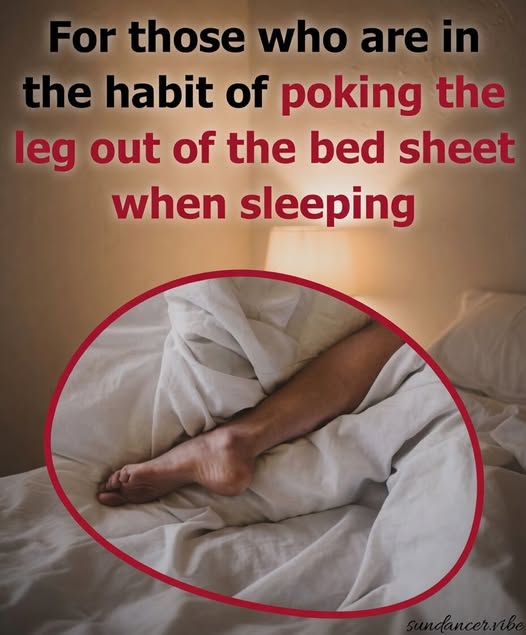
Sometimes, it starts with something as simple as letting one foot breathe.
