The moment my boss said it, I felt something shift inside me.
Not anger—not yet. Something quieter. Something colder.
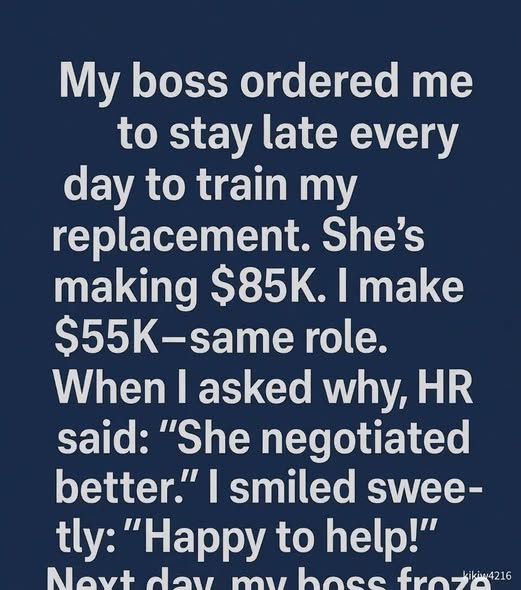
“We’ve hired someone to take over your role,” she said, folding her hands neatly on the desk like this was just another routine update. “Her name is Sarah. You’ll be training her over the next two weeks.”
I nodded slowly.
“And she’ll be starting at eighty-five thousand.”
That number landed harder than everything else.
I had been making fifty-five.
Same job. Same workload. Same responsibility. For six years.
I didn’t react the way she expected. No shock, no protest. Just a small, polite smile.
“Of course,” I said. “Happy to help.”
That was the moment she relaxed.
And the moment I started paying attention differently.
That night, I didn’t vent.
I didn’t call a friend or spiral into frustration.
I sat quietly at my kitchen table and thought.
About every late night. Every time I stayed back to fix something no one else understood. Every weekend email I answered because “it would only take a minute.” Every performance review where I was told I was “invaluable”—but somehow never valuable enough for a raise.
The next morning, I went to HR.
Not because I expected fairness.
But because I wanted confirmation.
“She negotiated better,” the HR rep said, adjusting his glasses like he’d delivered that explanation a hundred times before.
That was it.
Years of loyalty reduced to a single sentence.
I smiled again.
“Got it,” I said.
And I meant it.
Because now I understood the rules.
Training started that same week.
Sarah was smart. Capable. Eager.
And completely unaware of what she had stepped into.
I didn’t resent her. Not really. She had done exactly what the system rewarded—she asked for more, and they gave it to her.
But the system itself?
That was something else.
We spent long hours together in the conference room, going through processes, systems, workflows. I showed her everything—how to manage accounts, how to handle client escalations, how to fix issues that technically weren’t part of the job but always became part of mine.
But while I trained her, I was also observing.
Documenting.
Not just tasks—but patterns.
Who made decisions. Who avoided responsibility. Where things broke down. What knowledge existed only in my head.
And most importantly—what would happen if that knowledge disappeared.
By the third day, Sarah asked the question.
“Can I ask you something?” she said carefully.
“Sure.”
“How long have you been here?”
“Six years.”
She hesitated.
“And… have you always been in this role?”
“Yes.”
She looked at me, then back at her notes.
“I didn’t realize,” she said slowly.
I smiled.
“Most people don’t.”
That’s when I told her—calmly, factually—what I was making.
She blinked.
“That’s… not right.”
“No,” I said. “It isn’t.”
I didn’t say it with bitterness.
Just truth.
That night, I started preparing.
Not emotionally.
Strategically.
I updated my resume. Documented every responsibility I had taken on beyond my job description. Reached out to contacts I hadn’t spoken to in years.
And quietly, I started recording things.
Conversations. Instructions. Policies explained in ways that contradicted themselves.
Not to cause chaos.
But to protect myself.
Training continued.
And I did my job well.
Better than well.
Because I wasn’t just teaching Sarah how to succeed—I was showing the company exactly how much I had been carrying.
Every workaround I had created. Every gap I had filled. Every invisible responsibility that had somehow become “just part of the role.”
I handed it all over.
But I also made something clear—without ever saying it directly.
None of this had been accidental.
It had been built.
By me.
At the end of the second week, I finalized everything.
A new job offer had already come through.
Ninety thousand.
Remote.
Clear expectations. Transparent pay structure.
It didn’t feel like luck.
It felt like correction.
The next morning, I arrived early.
Like always.
I placed my resignation letter on my boss’s desk.
Simple. Direct. Immediate.
No two weeks.
No transition period.
Next to it, I left a folder.
Documentation. Notes. A record of everything I had done—and everything that had been overlooked.
Then I sat at my desk.
And waited.
She walked in at exactly nine.
Coffee in hand. Same routine.
Until she saw the envelope.
I watched from across the office as her expression changed.
Confusion.
Then realization.
Then something else.
She picked up the letter. Read it once. Then again.
And froze.
Completely.
The confidence she carried so easily just days before—gone.
She looked up at me.
“What is this?” she asked.
“My resignation,” I said calmly.
“You can’t just—leave,” she said. “You’re in the middle of training—”
“I finished it,” I replied.
Silence.
Then urgency.
“We can fix this,” she said quickly. “We can adjust your salary. Match her offer. Even go higher.”
It came so fast.
Like the number had always been available.
Just not for me.
I shook my head.
“It’s not about the number anymore.”
And that was true.
Because it never really had been.
The meeting that followed was tense.
HR was called in. Then leadership.
Questions were asked. Explanations attempted.
But something had already shifted.
Because now they weren’t talking to someone trying to stay.
They were talking to someone who had already left.
Emotionally. Mentally.
All that was left was the paperwork.
Sarah stood quietly in the background.
Afterward, she approached me.
“I didn’t know,” she said.
“I know,” I replied.
She hesitated.
“I’m not sure I want to stay here anymore.”
I nodded.
“That’s something you’ll have to decide for yourself.”
By the end of the day, they offered me a retention package.
Back pay. Immediate raise. Adjusted title.
Everything I had been asking for—without ever quite asking.
I declined.
Because once you see how easily things could have been different, it’s hard to accept them being “fixed” only when you’re leaving.
I packed my things slowly.
Same desk. Same box I had used years ago when I first arrived, hopeful and ready to prove myself.
As I walked out, no one stopped me.
Not really.
Because what could they say?
That I should stay?
After everything?
The new job felt different from day one.
Not perfect.
But fair.
And that made all the difference.
Weeks later, I heard updates.
Policy changes.
Salary reviews.
Internal discussions about “retention” and “equity.”
Not because they suddenly became better.
But because losing someone had cost them something.
And companies only learn when something costs them.
Looking back, I don’t think of it as revenge.
I think of it as alignment.
I stopped trying to prove my value to people who had already decided what it was worth.
And instead, I moved to a place where it didn’t need to be questioned.
The most powerful moment wasn’t her frozen expression.
It wasn’t the offer.
It wasn’t even the exit.
It was the moment I said “happy to help”—and actually meant something completely different.
Because sometimes, the strongest move isn’t resistance.
It’s understanding the system well enough to step out of it on your own terms.
Quietly.
Completely.
And without looking back.