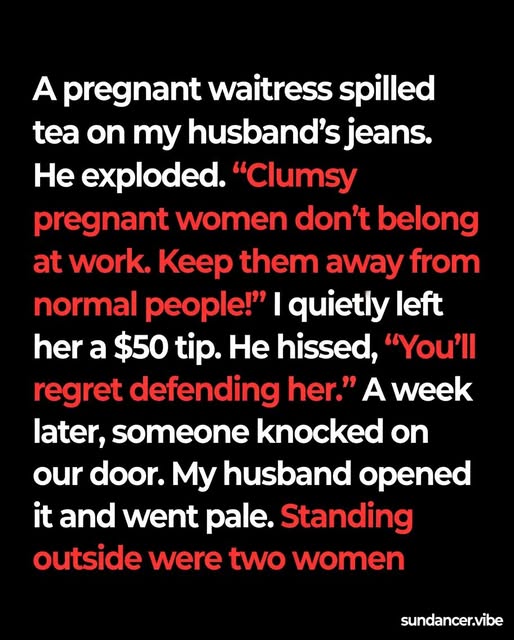
The restaurant had been chosen carefully.
Not too formal, not too casual—just the kind of place where you could sit across from someone you loved and pretend, for a couple of hours, that life wasn’t as heavy as it often felt. Soft lighting, low music, the steady rhythm of conversations blending into the background. It was meant to be a reset, a pause between busy days.
My husband arrived tense.
I noticed it immediately—the stiffness in his shoulders, the way he exhaled sharply before even sitting down. Work had been difficult lately, or at least that’s what he said. I had learned not to press too much at the beginning of an evening. Give it time, let things settle—that was the pattern we had fallen into over the years.
So I smiled, kept things light, asked simple questions.
He answered, but briefly.
When the waitress came to take our order, I noticed her before he did.
She moved carefully, one hand resting instinctively against her stomach. She was pregnant—visibly so—but still working, still moving from table to table with quiet determination. Her smile was polite, but there was fatigue behind it, the kind you can’t fully hide.
She took our order, thanked us, and left.
Nothing unusual.
Until she came back.
It happened so quickly it barely registered at first. As she placed the teacup down, her grip faltered just slightly. A small amount of tea spilled forward, splashing onto my husband’s jeans.
Not much.
Not enough to matter.
But enough to change everything.
“I’m so sorry,” she said immediately, her voice tight with panic as she reached for napkins.
She didn’t even have time to finish the sentence.
My husband pushed his chair back abruptly, the harsh scrape cutting through the calm atmosphere of the restaurant.
“Clumsy pregnant women don’t belong at work,” he snapped.
The words didn’t just land—they echoed.
“Keep them away from normal people.”
The room shifted.
Conversations paused. Eyes turned. The quiet warmth of the evening collapsed into something sharp and uncomfortable.
The waitress froze.
Her hands trembled as she tried to clean the spill, her gaze fixed downward, as if making herself smaller could somehow undo what had just happened.
And I sat there, stunned.
Not because of the spill.
Because of him.
There are moments when someone reveals a side of themselves so clearly that you can’t look away from it afterward. This was one of those moments.
I reached into my purse without thinking, pulled out some cash, and placed it gently on the table near her.
“It’s okay,” I said softly.
She nodded, but her eyes were distant now.
Something had already broken.
My husband leaned toward me, his voice low, controlled—but edged with something darker.
“You’ll regret defending her.”
I didn’t respond.
What could I say in that moment that would matter more than what had already been said?
We left shortly after.
The drive home was silent—not peaceful silence, but the kind filled with unspoken tension. I stared out the window, replaying the scene again and again, trying to reconcile the man I knew with the one I had just seen.
He acted like nothing had happened.
That was the part that unsettled me the most.
For him, it was over.
For me, it had just begun.
In the days that followed, life continued as usual on the surface. Work, errands, conversations that didn’t touch anything real. But underneath, something had shifted.
I kept thinking about her.
About the way her hands shook. About the effort it must have taken to keep working after that moment. About the fact that she didn’t argue, didn’t defend herself—just absorbed it.
And I kept thinking about him.
About how quickly anger had replaced empathy. About how easily he had reduced someone to a problem instead of seeing them as a person.
A week passed.
Then came the knock.
It was late afternoon when it happened. The kind of quiet hour where nothing unexpected usually occurs. My husband went to answer the door, casual, unbothered.
Until he opened it.
I watched his posture change instantly—his body stiffening, his expression draining of color.
I stood up slowly and moved closer.
Two women stood outside.
One of them was the waitress.
But she wasn’t the same as before.
She stood straighter now, her expression calm, composed. There was still softness in her face, but also something new—certainty.
Beside her stood another woman, older, dressed neatly, holding a folder.
She didn’t need to raise her voice to command attention.
“I’m the owner of the restaurant,” she said calmly. “And her mother.”
The air shifted again—but this time, inside our home.
She explained everything clearly.
The incident hadn’t stayed in that room. Other diners had seen it. Someone had recorded it. The video had been shared—first among a few people, then more widely.
What had seemed like a moment had become a reflection.
Not just of behavior, but of character.
“We’re not here to create a scene,” she continued. “We’re here because actions have consequences—and sometimes those consequences need to be faced directly.”
My husband tried to respond.
But the confidence he usually carried wasn’t there.
He minimized it at first—called it stress, a misunderstanding, something taken out of context.
But the presence of evidence—and the quiet strength of the two women standing there—left little room for that argument to hold.
Then the waitress spoke.
Her voice was steady.
“You probably forgot about that night,” she said. “I didn’t.”
There was no anger in her tone.
Just truth.
“I went home and cried. Not because of the tea. Because of what you said. Because in that moment, I felt like I didn’t deserve to be there. Like I was a problem just for existing.”
Silence filled the space between us.
Not empty silence.
Heavy silence.
“My mom taught me to work hard,” she continued. “Even when it’s difficult. Especially when it’s difficult. But that night made me question whether trying was enough.”
That was the moment something shifted.
Not dramatically.
Not instantly.
But noticeably.
My husband stopped interrupting.
Stopped explaining.
Stopped defending.
And started listening.
When he spoke again, it was different.
Slower.
Less certain.
“I’m sorry,” he said.
Not rushed. Not dismissive.
Just… said.
Whether it was enough, I didn’t know.
Maybe it wasn’t.
Maybe apologies don’t erase moments like that.
But it was the first time he had acknowledged what he had done without trying to reshape it.
After they left, the house felt unfamiliar.
The same walls, the same furniture—but something had changed.
We sat in silence for a long time.
Not the tense silence from before.
A different kind.
Reflective.
Unavoidable.
“I didn’t think it mattered that much,” he said finally.
“That’s the problem,” I replied.
Because it did matter.
Not just to her.
To me.
To how I saw him.
To what kind of person he chose to be when something small went wrong.
In the days that followed, there was no immediate transformation.
People don’t change overnight.
But there was awareness.
And sometimes, that’s where change begins.
He spoke more carefully.
Paused more often.
Listened differently.
Not perfectly.
But differently.
As for me, I couldn’t unsee what I had seen that night.
But I also couldn’t ignore what I had seen at the door.
Because character isn’t just revealed in moments of failure.
It’s revealed in what comes after.
Whether someone denies it.
Or faces it.
That unexpected visit didn’t just bring consequences.
It brought clarity.
And sometimes, clarity is the most uncomfortable—and most necessary—truth of all.